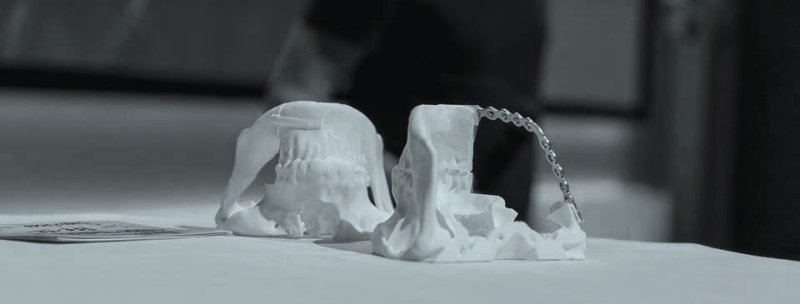
Custom 3D printed bone implants could revolutionize reconstructive surgery

lsint stmzxpauxdhkjafa
Credit: Particle3D

Become partially android for a couple of years while your body heals itself.

It may sound far-fetched, but for patients needing reconstructive surgery, this could soon be the pitch from Danish startupย Particle3D. The company is pioneering a novel method for 3D printing lightweight,ย customized bone implantsย that fuse with your skeleton before slowly disappearing.

The technology carriesย a lowerย risk of infection andย theย implantsย areย tailored to your bodyย (andย the methodย could soon be heading to space with astronauts!).

Traditional implants generally consist of non-degradable materials such as polymer or titanium. Particle3D uses a โ€œbio-inkโ€ made from tricalcium phosphate (TCP) powder particles and fatty acids. TCP beenย used in reconstructive surgery for decades,ย but is normally manually sculpted by surgeons from solid blocks into the desired implant shape. This approach can limit the potential positive effects of TCP, for example, when it comesย to stimulating natural bone growth.

โ€ฆ

3D printing TCP enables the company to create more porous implants. The porous structures allow the implants to function as scaffolds for blood vessels and natural bone to grow, and the implants degrade over time as they are supplanted by natural bone.


Read the original post

{{ reviewsTotal }}{{ options.labels.singularReviewCountLabel }}
{{ reviewsTotal }}{{ options.labels.pluralReviewCountLabel }}
{{ options.labels.newReviewButton }}
{{ userData.canReview.message }}

Related Articles

Infographic: Global regulatory and health research agencies on whether glyphosate causes cancer

Infographic: Global regulatory and health research agencies on whether glyphosate causes cancer

Does glyphosateโ€”the world's most heavily-used herbicideโ€”pose serious harm to humans? Is it carcinogenic? Those issues are of both legal and ...

Most Popular

Screenshot 2026-05-26 at 10.15
Viewpoint: Double standardโ€”Why does the wellness industry get a free pass while Big Healthcare is treated as morally suspect?
ChatGPT-Image-Jun-4-2026-11_49_36-AM-2
โ€˜You donโ€™t understand Tolkienโ€™: Skeptic Pope trolls tech giants about the exaggerated, risk-less benefits of AI
ChatGPT-Image-Jun-4-2026-01_27_58-PM
Viewpointโ€”N.A.D.+: Why Gwenyth Paltrowโ€™s heralded anti-aging supplement doesnโ€™t work
Screenshot-2026-06-03-at-1.24.46-PM
Challenging anti-GMO disinformation: Why genetically-tweaked crops offer bushels of benefits
Screenshot 2025-07-30 at 10.48
Can gene editing eliminate Down syndrome? Scientists have done it in lab-grown cells
Screenshot-2026-06-04-at-12.05.08-PM
Cases of brain inflammation surge as U.S. measles pandemic approaches 2000
downsyndrome_compilation_MID_1
CRISPR breakthrough that can remove the chromosome responsible for Down syndrome raises ethical questions
ChatGPT-Image-Mar-10-2026-01_39_01-PM
Viewpointโ€”โ€œMiracle moleculeโ€ debunked: Why acemannan supplements donโ€™t work
tick-DNA
GLP podcast: Spread meat allergy with gene-edited ticks? Bioethicists pose vile โ€˜thought experimentโ€™
ChatGPT Image May 26, 2026, 08_42_17 AM (1)
Viewpoint: Greenpeace and poison: How environmental advocacy groups rely on compliant (and often ignorant) journalists to spread disinformation and spark litigation
ChatGPT-Image-May-26-2026-07_51_21-AM-2
Viewpoint: There are more than 1,000 chemicals in a cup of coffeeโ€”including many substances that can cause cancer. Why isnโ€™t it banned?

Sorry. No data so far.

glp menu logo outlined

Get news on human & agricultural genetics and biotechnology delivered to your inbox.