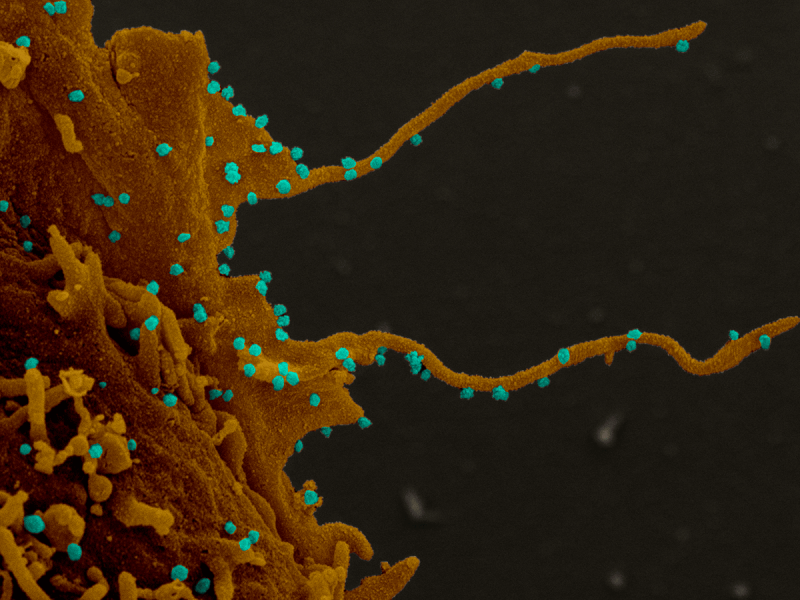
‘Zombie cells’ infected with coronavirus sprout ‘ghoulish’ tentacles that reach out and hijack neighbors

cells infected with sars cov
Credit: Elizabeth Fischer/NIAID/NIH

Researchers exploring the interaction between the coronavirus and its hosts have discovered that when the SARS-CoV-2 virus infects a human cell, it sets off a ghoulish transformation. Obeying instructions from the virus, the newly infected cell sprouts multi-pronged tentacles studded with viral particles.

These disfigured zombie cells appear to be using those streaming filaments, or filopodia, to reach still-healthy neighboring cells. The protuberances appear to bore into the cells’ bodies and inject their viral venom directly into those cells’ genetic command centers — thus creating another zombie.

The authors of the new study, an international team led by researchers at UC San Francisco, say the coronavirus appears to be using these newly sprouted dendrites to boost its efficiency in capturing new cells and establishing infection in its human victims.

The scientists also believe they have identified several drugs that could disrupt the viral takeover of cells and slow the process by which COVID-19 takes hold. These compounds, many of which were designed as cancer treatments, seem likely to work because they block the chemical signals that activate filopodia production in the first place.

[T]he discovery of filopodia in coronavirus-infected cells suggests that this virus has developed more than one way to wheedle its way into cells and establish itself as a force to be reckoned with.


Read the original post

{{ reviewsTotal }}{{ options.labels.singularReviewCountLabel }}
{{ reviewsTotal }}{{ options.labels.pluralReviewCountLabel }}
{{ options.labels.newReviewButton }}
{{ userData.canReview.message }}

Related Articles

Infographic: Global regulatory and health research agencies on whether glyphosate causes cancer

Infographic: Global regulatory and health research agencies on whether glyphosate causes cancer

Does glyphosate—the world's most heavily-used herbicide—pose serious harm to humans? Is it carcinogenic? Those issues are of both legal and ...

Most Popular

Screenshot-2026-04-22-at-12.21.32-PM
Viewpoint: Why the retracted Monsanto glyphosate study doesn’t change the science—the world’s most popular herbicide is safe 
Picture1
The FDA couldn’t find a vaccine safety crisis, so it buried its own research
ChatGPT-Image-May-1-2026-11_42_59-AM-2
Viewpoint: NAD is the wellness grifters latest evidence-lite longevity fad. At least the mice are impressed.
ChatGPT-Image-Apr-16-2026-02_56_53-PM
Financial incentives, over diagnosis, and weak oversight: Autism claims are driving up Medicare costs
global warming
‘Implausible’: Top climate scientists reject worst-case scenario—soaring temperatures and fast-rising sea levels
Screenshot-2026-05-21-at-12.15.17-PM
UK gene-editing milestone: Livestock barley that increases ruminant value and reduces methane emissions is first-approved CRISPR crop
Screenshot-2026-05-21-at-3.15.53-PM
Chiropractors may no longer be modern-day snake oil salesmen, but the benefits of their therapy are limited–at best
ChatGPT-Image-May-12-2026-11_27_01-AM-2
AI likely to improve health care, research shows—but not for blacks and ethnic minorities

Sorry. No data so far.

glp menu logo outlined

Get news on human & agricultural genetics and biotechnology delivered to your inbox.