‘Everything smells like a more disgusting version of Spaghetti O’s’: Recovered COVID patients report awful phantom smells

no smell wide c e ef d b d dead c
Credit: Cornelia Li/NPR

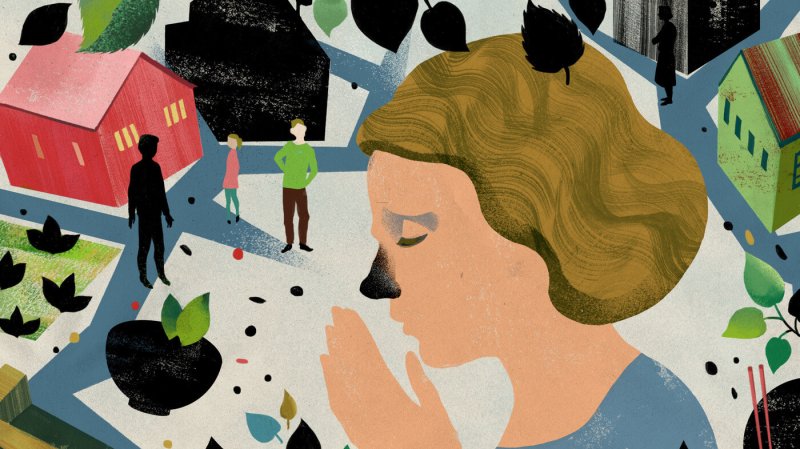
Instead of a scentless world, an increasing number of people who lost their sense of smell because of Covid-19 are complaining that things just don’t smell right.

They no longer wake up and can’t smell the coffee; because of parosmia, their coffee smells like burning rubber or sewage. Parosmia is most often an unpleasant smell, a distortion of an actual odor, making many foods smell and taste revolting. Phantosmia is more random, occurring without a scent trigger, uninvited and unwanted. Phantosmias, which can be fleeting or linger, are also usually foul smells, often cigarette smoke or burning wood—or for one poster on Reddit, “everything smells like a more disgusting version of Spaghetti O’s.”

…

The good news, says Nancy Rawson, vice president and associate director at Monell Chemical Senses Center, a non-profit interdisciplinary research institute in Philadelphia, is that cells in the olfactory epithelium can regenerate after they have been damaged. But that regeneration can take time—up to two years, or more. “If it’s affecting mature neurons, then the immature neurons need to mature fully and connect to the olfactory bulb,” she says.

Mis- and disinformation are distorting science and public policy. Subscribe to our Daily and Weekly Digests for incisive coverage of ‘disruptive’ innovations in AI, agricultural biotechnology, food, chemicals, nuclear energy, vaccines, and other disruptive innovations.

Rawson says that because the brain is receiving incomplete smell information, “when the recovery process is happening in patches, or recovery is partial in different regions, you may go through that stage of parosmia on the way to a fuller recovery.”


Read the original post

Related Articles

Infographic: Global regulatory and health research agencies on whether glyphosate causes cancer

Infographic: Global regulatory and health research agencies on whether glyphosate causes cancer

Does glyphosate—the world's most heavily-used herbicide—pose serious harm to humans? Is it carcinogenic? Those issues are of both legal and ...

Most Popular

ChatGPT-Image-Mar-10-2026-01_39_01-PM
Viewpoint—“Miracle molecule” debunked: Why acemannan supplements don’t work
Screenshot-2026-09-28-at-11.26.17-AM
Viewpoint: Wellness movement activists reposition nicotine from a killer addictive drug into a cure-all for brain ills
Screenshot-2026-10-02-at-9.11.36-AM
The genetics of personality
strand of dna genetics
No, GMO foods do not “damage genes, natural disposition and hormones, or decrease physical health and intelligence”
Radioactive-Americana-Collage-2
The kooky logic behind the raft of spurious cancer claims from Harvard’s T.H. Chan School of Public Health
Screenshot-2026-10-02-at-8.56.38-AM
Trump finalizes Medicare drug price cuts, drawing Big Pharma’s fury and a legal challenge
Screenshot-2026-10-01-at-10.52.08-AM
Non-browning CRISPR gene-edited bananas move one step closer to British markets
Screenshot-2026-10-02-at-11.12.24-AM
‘Why do we keep falling for this stuff?’ America’s love affair with snake oil salesmen and scams
Screenshot-2026-09-22-at-10.54.12-AM
‘They misunderstand science’: Research attempting to tie autism to changes in the gut microbiome comes under fire
AI-Force-Leadership-Portrait
Jay Clayton controversy: The divisive history of Trump’s newly-appointed AI czar
ChatGPT-Image-Sep-21-2026-11_21_39-AM
Viewpoint: Food cults: Online ‘nutrition communities’ can pose unique dangers
glp menu logo outlined

Get news on human & agricultural genetics and biotechnology delivered to your inbox.