Drought, cropland expansion push Great Plains toward ‘Dust Bowl 2.0,’ climate scientists say

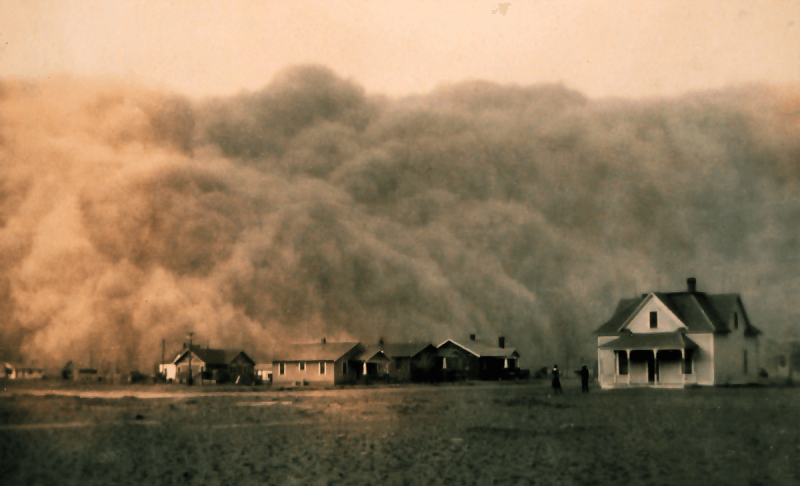
dust storm texas
Credit: NOAA George E. Marsh Album

Earlier [in October], a storm front swept across the Great Plains of the United States, plowing up a wall of dust that could be seen from space…. It was a scene straight from the Dust Bowl of the 1930s, when farmers regularly saw soil stripped from their fields and whipped up into choking blizzards of dust.

…. According to a new study, dust storms on the Great Plains have become more common and more intense in the past 20 years, because of more frequent droughts in the region and an expansion of croplands. “Our results suggest a tipping point is approaching, where the conditions of the 1930s could return,” says Gannet Haller, an atmospheric scientist at the University of Utah ….

Follow the latest news and policy debates on sustainable agriculture, biomedicine, and other ‘disruptive’ innovations. Subscribe to our newsletter.

The dust storms not only threaten to remove soil nutrients and decrease agricultural productivity, but also present a health hazard, says Andy Lambert, a co-author on the study and a meteorologist at the U.S. Naval Research Laboratory in Monterey, California. The dust contains ultrafine particles that can penetrate cells in the lungs and cause lung and heart disease.

The findings, reported on 12 October in Geophysical Research Letters, show that across large parts of the Great Plains, levels of wind-blown dust have doubled over the past 20 years. One clue that agriculture is responsible is that the dust levels tend to peak during spring and fall—planting and harvesting seasons, Hallar notes.


Read the original post

{{ reviewsTotal }}{{ options.labels.singularReviewCountLabel }}
{{ reviewsTotal }}{{ options.labels.pluralReviewCountLabel }}
{{ options.labels.newReviewButton }}
{{ userData.canReview.message }}

Related Articles

Infographic: Global regulatory and health research agencies on whether glyphosate causes cancer

Infographic: Global regulatory and health research agencies on whether glyphosate causes cancer

Does glyphosate—the world's most heavily-used herbicide—pose serious harm to humans? Is it carcinogenic? Those issues are of both legal and ...

Most Popular

wuhan institute of virology main entrance
​​COVID lab leak? Making a case that the Wuhan market origins theory is wrong
Screenshot-2026-06-17-at-9.44.03-AM
Viewpoint: Embryos are becoming the newest battleground of love, loss, and legal uncertainty
Screenshot-2026-06-16-at-10.02.22-PM
Viewpoint: ‘Industrial food’ primer—Challenging the dangerous delusions of the alternative food movement
Screenshot-2026-06-17-at-11.57.12-AM
Viewpoint: Raw milk and the myth of safety—ProPublica exposes the growing anti-homogenization movement
ChatGPT-Image-Jun-16-2026-10_01_45-AM-2
Viewpoint—Recursive self-improvement: AI leader Anthropic calls for AI slowdown
ChatGPT-Image-Jun-16-2026-10_29_11-AM
What’s behind Anthropic’s warning about the accelerating development of AI
ChatGPT-Image-Jun-9-2026-01_11_37-PM
Turmeric supplements: More risks than benefits
ChatGPT-Image-Mar-10-2026-01_39_01-PM
Viewpoint—“Miracle molecule” debunked: Why acemannan supplements don’t work
Screenshot-2026-06-18-at-11.41.51-AM
Viewpoint—Protecting baloney science: Far right senators move to protect the phony homeopathy industry
ChatGPT-Image-Jun-4-2026-03_07_27-PM
AAP v. Kennedy: While a court challenge grinds on, RFK Jr. quietly advances his anti-vaccine conspiracy agenda
newborn infant baby mother
Facts & Fallacies Podcast: The truth about vitamin K shots
ChatGPT-Image-Jun-15-2026-02_31_28-PM-2
Trump-appointed cancer panel head backed by supplement and anti-vaccine companies promotes discredited support for ivermectin as a potential cure
Screenshot-2026-06-18-at-2.52.05-PM
Activist organization accuses Trump of protecting methane-generating stripper wells to benefit billionaire and donor Jeffrey Hildebrand 
glp menu logo outlined

Get news on human & agricultural genetics and biotechnology delivered to your inbox.