The COVID vaccine race champion appears to be mRNA technology used by Pfizer and Moderna. Here’s a primer

t z rc eh giek rtrmadp health coronavirus thailand vaccine e
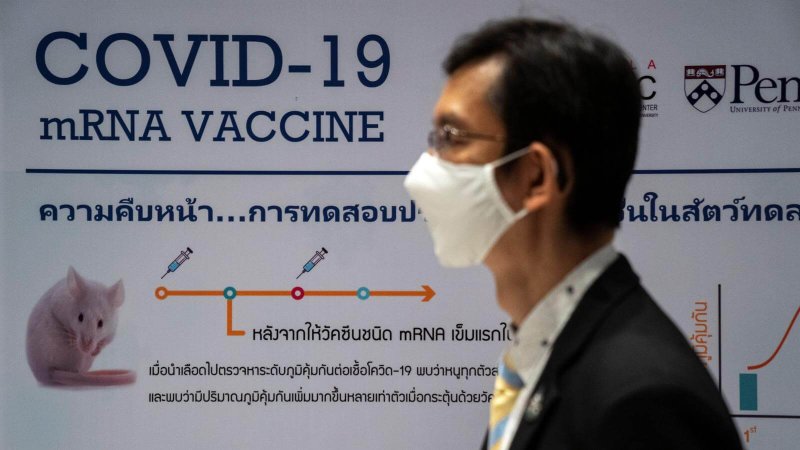
Credit: Athit Perawongmetha/Reuters

There are about a dozen experimental vaccines in late-stage clinical trials globally, but the ones being tested by Pfizer and Moderna are the only two that rely on messenger RNA.

For decades, scientists have dreamed about the seemingly endless possibilities of custom-made messenger RNA, or mRNA.

Researchers understood its role as a recipe book for the body’s trillions of cells, but their efforts to expand the menu have come in fits and starts. The concept: By making precise tweaks to synthetic mRNA and injecting people with it, any cell in the body could be transformed into an on-demand drug factory.

But turning scientific promise into medical reality has been more difficult than many assumed. Although relatively easy and quick to produce compared to traditional vaccine-making, no mRNA vaccine or drug has ever won approval.

Even now, as Moderna and Pfizer test their vaccines on roughly 74,000 volunteers in pivotal vaccine studies, many experts question whether the technology is ready for prime time.

Follow the latest news and policy debates on sustainable agriculture, biomedicine, and other ‘disruptive’ innovations. Subscribe to our newsletter.

Whether mRNA vaccines succeed or not, their path from a gleam in a scientist’s eye to the brink of government approval has been a tale of personal perseverance, eureka moments in the lab, soaring expectations — and an unprecedented flow of cash into the biotech industry.


Read the original post

{{ reviewsTotal }}{{ options.labels.singularReviewCountLabel }}
{{ reviewsTotal }}{{ options.labels.pluralReviewCountLabel }}
{{ options.labels.newReviewButton }}
{{ userData.canReview.message }}

Related Articles

Infographic: Global regulatory and health research agencies on whether glyphosate causes cancer

Infographic: Global regulatory and health research agencies on whether glyphosate causes cancer

Does glyphosate—the world's most heavily-used herbicide—pose serious harm to humans? Is it carcinogenic? Those issues are of both legal and ...

Most Popular

Screenshot-2026-04-13-at-1.39.26-PM
Viewpoint: ‘Safer for children?’ Stonyfield yogurt under fire for deceptive organic marketing
Screenshot-2026-04-22-at-10.46.29-AM
Viewpoint: How to counter science disinformation? Science journalist offers 12 practical tips
ChatGPT-Image-May-7-2026-12_16_37-PM-2
Viewpoint: Are cancer rates ‘skyrocketing’ as RFK, Jr. and MAHA claim? The evidence says mostly the opposite
Picture1-14
When superbugs threaten vulnerable children: Can AI help solve antibiotic resistance?
ChatGPT-Image-May-12-2026-08_39_41-PM
GLP podcast: Big Pharma, Big Ag, Big Food—health harming industries or life-saving innovators?
Screenshot-2026-04-23-at-11.00.36-AM
Regulators' dilemma: Thalidomide, Metformin, and the cost of getting drug approvals wrong
Picture1-1
Cooling the planet with balloons: Could a geoengineering gamble slow global warming?
png-pill-omega-Supp-fish-oil
Millions take omega-3 fish oil for brain health. New research suggests it may do the opposite.
bigstock opioids on chalkboard with rol
GLP podcast: 'Safe injection sites': enabling drug addiction or saving lives?
glp menu logo outlined

Get news on human & agricultural genetics and biotechnology delivered to your inbox.