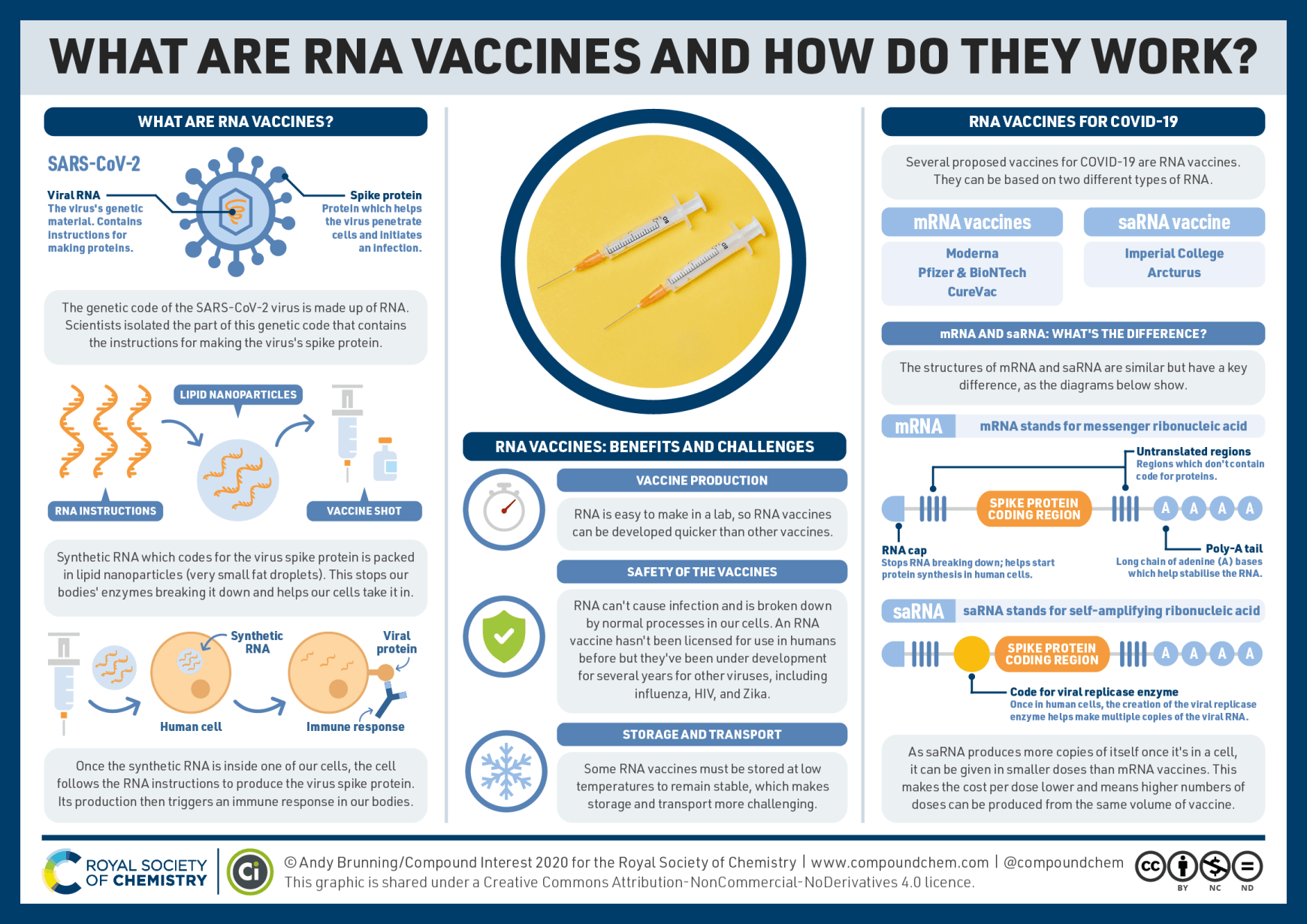
Infographic: What are mRNA COVID-19 vaccines and how do they work?

Credit: Houston Methodist

As of 1 December 2020, thirteen vaccines have reached the final stage of testing: where they are being given to thousands of people to test if they protect against the SARS-CoV-2 virus. Though the end goal is the same, these vaccines vary in the ways in which they try to trigger our immune system to recognise the virus.

Other types of vaccines often use inactive or weakened forms of a virus to trigger an immune response. But RNA vaccines use a virus’s own genetic code against it. RNA stands for ribonucleic acid; you’re probably more familiar with DNA, the molecule which makes up human genetic code. RNA makes up the virus genetic code, which contains instructions for the proteins the virus needs to make.

RNA vaccines have several benefits over other vaccine types. The most obvious is the pace at which we can make them… Synthetic RNA is straightforward to make in a lab, so it doesn’t take long to design and produce these vaccines.

Follow the latest news and policy debates on sustainable agriculture, biomedicine, and other ‘disruptive’ innovations. Subscribe to our newsletter.

RNA vaccines also have safety benefits. The synthetic RNA can’t cause illness – though it’s a blueprint for virus spike protein production in our bodies’ cells, production of this protein alone can’t trigger an infection. The RNA itself gets broken down by normal processes in our cells, so it doesn’t hang around for long anyway.

 

Read the original post

Related Articles

Infographic: Global regulatory and health research agencies on whether glyphosate causes cancer

Infographic: Global regulatory and health research agencies on whether glyphosate causes cancer

Does glyphosate—the world's most heavily-used herbicide—pose serious harm to humans? Is it carcinogenic? Those issues are of both legal and ...

Most Popular

ChatGPT-Image-Aug-4-2026-10_15_14-AM
Viewpoint—A hard look at the Fauci diaries: Do they change what we know about COVID’s origins?
ChatGPT-Image-Mar-10-2026-01_39_01-PM
Viewpoint—“Miracle molecule” debunked: Why acemannan supplements don’t work
ChatGPT-Image-Aug-4-2026-12_42_58-PM
Viewpoint: Fact-checking CNN interview with RFK, Jr. underscores the depth of his disinformation delusions
Picture1
Hiroshima at 81: America’s new nuclear bomb, a buried Iranian target, and a question no one wants to ask
ChatGPT-Image-Jul-17-2026-09_50_27-AM
Viewpoint: How disease tracking and prevention has cratered under the Kennedy-Trump administration
Screenshot-2026-07-17-at-1.34.59-PM
Poll: Vaccine hesitancy soars when patients distrust health providers and turn to social media
ChatGPT-Image-Aug-4-2026-07_52_00-PM
No liability for scientific due diligence: California Supreme Court rejects bizarre lawsuit faulting Gilead for fully evaluating HIV drug before release
png livestock cow cattle a
Consumer skepticism about gene-edited milk is neither fixed nor particularly high—and falls even more if it’s priced lower
ChatGPT-Image-Aug-4-2026-02_05_46-PM
Does Congress have the guts to successfully challenge Trump’s politicization of science funding?
ChatGPT-Image-Aug-4-2026-09_31_50-AM-2
Viewpoint: Could the U.S. become dependent on China to develop critical new genetic and drug therapies?
ChatGPT Image Jul 29, 2026, 10_17_59 AM
Viewpoint: What does it mean when critics of conventional agriculture say many fruits and vegetables are “linked” to pesticide poisoning?
ChatGPT Image Jul 29, 2026, 06_26_01 PM 2
Facts & Fallacies podcast: Organic food myths make a comeback on Instagram, with Dr. Kevin Folta
ChatGPT Image Jul 29, 2026, 09_08_15 AM 2
The retreat of environmental extremism: Why activist NGOs are losing favor
glp menu logo outlined

Get news on human & agricultural genetics and biotechnology delivered to your inbox.