Not so random after all: Human egg cells choose which sperm is the lucky winner

a image a
Credit: Visuals Unlimited
[H]ormones present at ovulation can drive a woman to choose a cocky, confident man with a slight stubble and more masculine features. Men can sniff out an ovulating woman just by smelling her T-shirt, while women appear to prefer the smell of a man with dissimilar genes, which could give her offspring a boost up the evolutionary ladder.

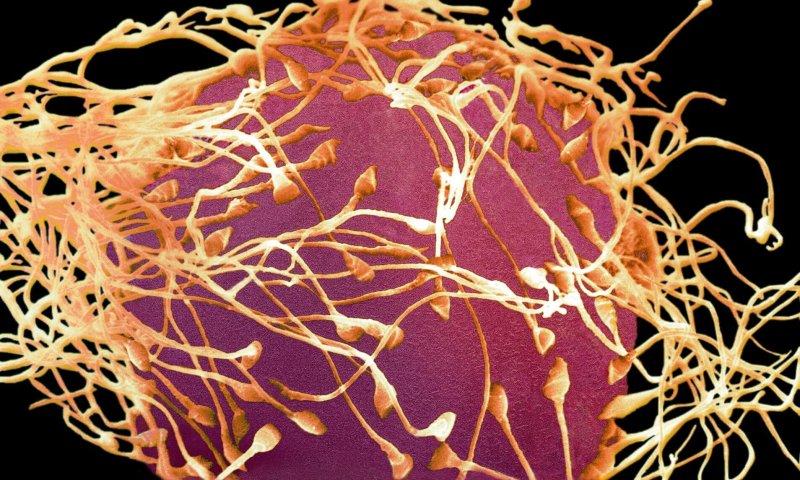
A fascinating new study finds those chemical-based preferences continue even after sex. Human eggs appear to “choose” which sperm will become the lucky winner in conceiving a baby.

“Human eggs release chemicals called chemoattractants, which leave a sort of chemical breadcrumb trail that sperm use to find unfertilized eggs,” said study author John Fitzpatrick, an assistant professor in the department of zoology at Stockholm University in Sweden.

“What we didn’t know until this study is those chemical breadcrumbs act differently on sperm from different males, in effect choosing which sperm is successful,” Fitzpatrick added.

Follow the latest news and policy debates on sustainable agriculture, biomedicine, and other ‘disruptive’ innovations. Subscribe to our newsletter.

And here’s the extraordinary finding: A woman’s egg doesn’t always agree with her choice of partner.

“We expected to see some sort of partner effect, but in half of the cases the eggs were attracting more sperm from a random male,” Fitzpatrick said. “The most likely explanation for this is that these chemical signals allow females to choose males who are more genetically compatible.”


Read the original post

{{ reviewsTotal }}{{ options.labels.singularReviewCountLabel }}
{{ reviewsTotal }}{{ options.labels.pluralReviewCountLabel }}
{{ options.labels.newReviewButton }}
{{ userData.canReview.message }}

Related Articles

Infographic: Global regulatory and health research agencies on whether glyphosate causes cancer

Infographic: Global regulatory and health research agencies on whether glyphosate causes cancer

Does glyphosate—the world's most heavily-used herbicide—pose serious harm to humans? Is it carcinogenic? Those issues are of both legal and ...

Most Popular

ChatGPT-Image-Jul-8-2026-12_32_48-PM
Viewpoint: SCOTUS strikes a blow against junk science in Bayer glyphosate case. Will it deter mass tort litigators?
ChatGPT-Image-Mar-10-2026-01_39_01-PM
Viewpoint—“Miracle molecule” debunked: Why acemannan supplements don’t work
Screenshot-2026-07-08-at-9.36.03-AM
Viewpoint: Long-contained diseases are on the rise in the U.S. Are Trump cuts to blame?
afb-a-b
As the EU loosens restrictions on agricultural gene editing, it remains years behind the rest of the world on equally-safe GMO foods
Viewpoint: Consensus as truth? How ‘misinformation police’ control policy narratives
Which among war, weather and cyber attacks is the biggest world threat? None of the above. It’s misinformation, and here’s why.
c9f0a584-46e9-4dd8-9a77-f5f5a7a51a84
Across Eastern Europe, science disinformation has spread far beyond COVID and vaccine denialism. Here’s the grim list.
Screenshot 2026-07-11 100209
Viewpoint: Supplements to clean your liver? Not a good idea.
ChatGPT-Image-Jun-25-2026-12_23_17-PM
No, Bill Gates did not secretly engineer ticks to promote veganism
ChatGPT-Image-Jul-7-2026-01_57_55-PM
Viewpoint: Europe’s rejection of air conditioning is the poster child for misunderstanding how to mitigate the impact of climate change
Gemini_Generated_Image_gabo48gabo48gabo
Viewpoint: A plastic surgeon on why banning gender-transition surgery without further research is wrong and harmful
ChatGPT-Image-Jul-1-2026-03_33_49-PM
‘Alternative’ cancer treatments that could kill you
Screenshot-2026-07-10-at-3.10.50-PM
Snake-oil cures throughout history
ChatGPT-Image-Jul-1-2026-12_37_08-PM
Viewpoint: Trump poised to politicize all U.S.-supported science research
glp menu logo outlined

Get news on human & agricultural genetics and biotechnology delivered to your inbox.