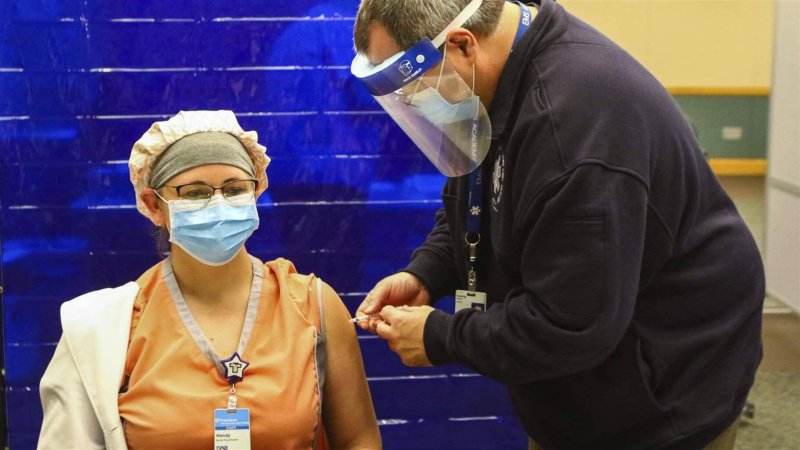
Healthcare workers are less likely to support vaccine mandates than the general public. What can — or should — be done?

Credit: Kale Wilk/Northwest Indiana Time/Associated Press

The question of whether employers should compel their workforces to be immunized against the coronavirus is rippling through the health-care industry and beyond. It is a question of uncommon intricacy, involving public health, ethics, law, labor relations and ingrained American values.

Largely hypothetical while the three coronavirus vaccines allowed in the United States were in scarce supply, the debate is building in intensity as doses become more plentiful.

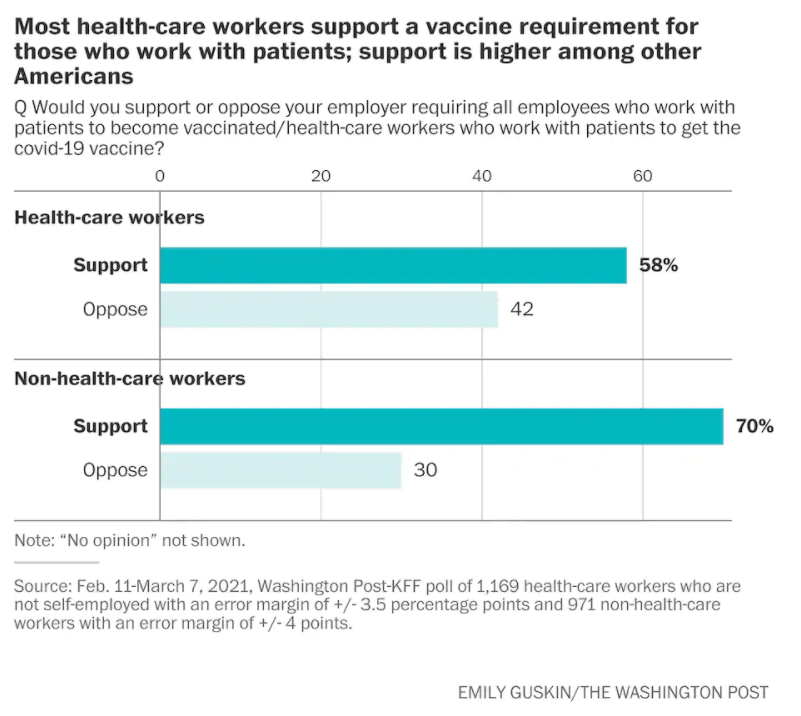
Whether bosses should be able to dictate a protective shot is a polarizing matter among front-line health-care workers, according to a recent Washington Post-Kaiser Family Foundation poll. Among health-care workers who have an employer, rather than being self-employed, nearly 6 in 10 said they would support their boss requiring vaccination for all employees who work with patients. 

[Houston Methodist] became the nation’s first to announce that vaccination would be mandatory for the 26,000 employees at its eight hospitals and many outpatient settings, starting with managers, who must get at least one shot by April 15, or risk suspension or layoff.

Follow the latest news and policy debates on sustainable agriculture, biomedicine, and other ‘disruptive’ innovations. Subscribe to our newsletter.

“Everybody is thinking about it,” said Lorraine M. Martin, president of the National Safety Council, a group of 16,000 U.S. businesses and organizations. “A lot of companies are calling each other, trading notes, trying to land in the right place.”

Read the original post

{{ reviewsTotal }}{{ options.labels.singularReviewCountLabel }}
{{ reviewsTotal }}{{ options.labels.pluralReviewCountLabel }}
{{ options.labels.newReviewButton }}
{{ userData.canReview.message }}

Related Articles

Infographic: Global regulatory and health research agencies on whether glyphosate causes cancer

Infographic: Global regulatory and health research agencies on whether glyphosate causes cancer

Does glyphosate—the world's most heavily-used herbicide—pose serious harm to humans? Is it carcinogenic? Those issues are of both legal and ...

Most Popular

d-b
Blocked arteries, kidney stones, nausea, constipation, fatigue: Long list of health problems caused by too much vitamin D 
Screenshot-PM-24
Viewpoint: The herbicide glyphosate isn’t perfect. Banning it would be far worse.
ChatGPT-Image-Apr-30-2026-12_21_05-PM-2
The tech billionaires behind the immortality movement
79d03212-2508-45d0-b427-8e9743ff6432
Viewpoint: The Casey Means hustle—Wellness woo opportunism dressed up as medical wisdom
ChatGPT-Image-Mar-27-2026-11_27_05-AM
The myths of “process”: What science says about the “dangers’ of synthetic products and ultra-processed foods

Sorry. No data so far.

glp menu logo outlined

Get news on human & agricultural genetics and biotechnology delivered to your inbox.