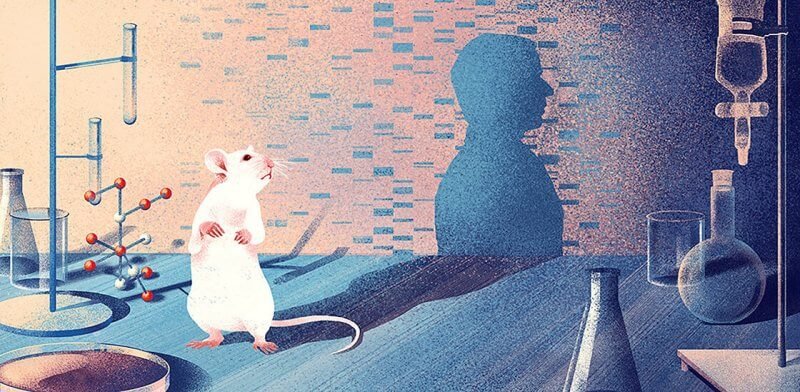
Lab-grown creations called chimeras are celebrated as science breakthroughs — but they are also a cause for concern

Credit: Cornelia Li/Spectrum

[R]esearchers from the Salk Institute for Biological Studies in La Jolla, Calif., and China’s Kunming University of Science and Technology injected human stem cells—made by reprogramming mature skin or blood cells—into 132 embryos from macaque monkeys. 

…

The new chimera experiment highlights a dilemma. When human stem cells are injected into an animal embryo at such an early stage of development, there so far is no way to control where they go or limit what type of adult cells they become.

…

In a glimpse of the potential effects, researchers at the University of Rochester in 2014 transplanted human fetal brain cells called astrocytes into young laboratory mice. They discovered that within a year the human cells had taken over the mouse brains. Moreover, standard tests for mouse memory and cognition showed that the altered mice were smarter.


In such ways, stem-cell chimeras have “the potential to radically humanize the biology of laboratory animals,” [bioethicist Dr. Insoo] Hyun says.

Mis- and disinformation are distorting science and public policy. Subscribe to our Daily and Weekly Digests for incisive coverage of ‘disruptive’ innovations in AI, agricultural biotechnology, food, chemicals, nuclear energy, vaccines, and other disruptive innovations.

[Researcher Dr. Juan Carlos] Izpisua Belmonte says he welcomes oversight. At his urging, the recent experiment was reviewed beforehand not just by institutional review boards in the U.S. and China but also by three independent bioethics experts. “Not everything that we scientists can do should be done,” he says. “Experiments like this certainly raise many concerns.”


Read the original post

Related Articles

Infographic: Global regulatory and health research agencies on whether glyphosate causes cancer

Infographic: Global regulatory and health research agencies on whether glyphosate causes cancer

Does glyphosate—the world's most heavily-used herbicide—pose serious harm to humans? Is it carcinogenic? Those issues are of both legal and ...

Most Popular

Screenshot-2026-10-01-at-10.52.08-AM
Non-browning CRISPR gene-edited bananas move one step closer to British markets
AI-Force-Leadership-Portrait
Jay Clayton controversy: The divisive history of Trump’s newly-appointed AI czar
Screenshot-2026-09-22-at-10.54.12-AM
‘They misunderstand science’: Research attempting to tie autism to changes in the gut microbiome comes under fire
ChatGPT-Image-Mar-10-2026-01_39_01-PM
Viewpoint—“Miracle molecule” debunked: Why acemannan supplements don’t work
Elderly-Speaker-at-MAHA-Institute
At anti-vaccine MAHA conference, RFK Jr. pledges to unify federal health information and combat vaccine safety ‘misinformation’
ChatGPT-Image-Sep-21-2026-11_21_39-AM
Viewpoint: Food cults: Online ‘nutrition communities’ can pose unique dangers
ChatGPT-Image-Sep-10-2026-10_36_07-AM
Viewpoint: Even lousy scientific articles can shield authors when they hype dubious health claims and products
Screenshot 2026-10-01 at 12.30
Combating ‘narrative distortion’: Will pharma companies step up to challenge health misinformation?
ChatGPT-Image-Sep-21-2026-03_15_09-PM
Viewpoint: Chipotle-inspired lesson: 10,000 sick customers suggest that processed foods can be safer than fresh ones
generated-1790707585414
Facts & Fallacies podcast: America's health care system is broken. A doctor explains how to fix it
glp menu logo outlined

Get news on human & agricultural genetics and biotechnology delivered to your inbox.