‘Understanding long COVID is like trying to nail Jell-O to a wall’: Research emerges on long-time sufferers

Credit: STAT News
Credit: STAT News

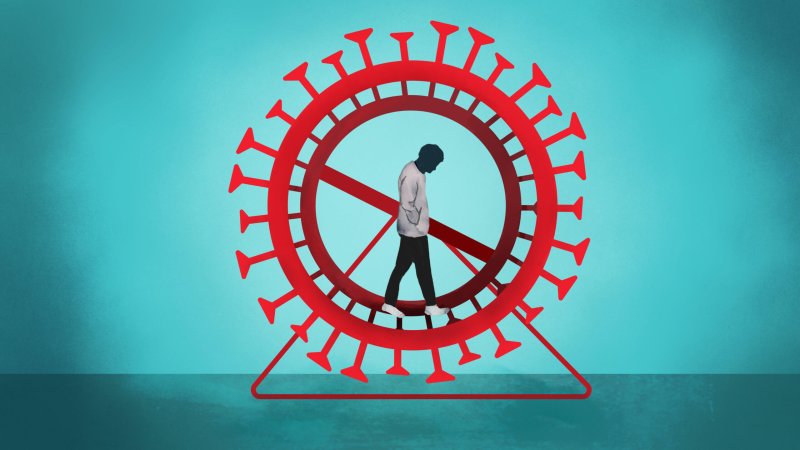
“There is currently no accepted case definition for symptoms or duration of long COVID. Consequently, it is difficult to estimate the prevalence or characteristics of this new condition,” one paper writes. It sometimes feels like trying to understand long COVID is like trying to nail Jell-O to a wall.

But there’s good news: In recent weeks, we have gotten some honest and quality research on what happens to people with long-term consequences from COVID.

Follow the latest news and policy debates on sustainable agriculture, biomedicine, and other ‘disruptive’ innovations. Subscribe to our newsletter.

The actual reason these symptoms occur is currently up for intense debate among those who study long COVID. Some think it’s due to a small amount of persistent coronavirus that still remains in long-haulers, causing immune fatigue. Others think it’s due to dysautonomia, in which the virus starts impacting the nervous system.

A [recent study] in the Journal of Clinical Immunology also found an interesting link: People who have had long COVID generally had relatively lower antibody levels than those who had COVID and recovered. That’s led some to believe that boosting immune response — by vaccination or injection of outside antibodies — might be a reasonable idea to help long COVID sufferers.


This is an excerpt. Read the original post here.

{{ reviewsTotal }}{{ options.labels.singularReviewCountLabel }}
{{ reviewsTotal }}{{ options.labels.pluralReviewCountLabel }}
{{ options.labels.newReviewButton }}
{{ userData.canReview.message }}

Related Articles

Infographic: Global regulatory and health research agencies on whether glyphosate causes cancer

Infographic: Global regulatory and health research agencies on whether glyphosate causes cancer

Does glyphosate—the world's most heavily-used herbicide—pose serious harm to humans? Is it carcinogenic? Those issues are of both legal and ...

Most Popular

ChatGPT-Image-May-7-2026-12_16_37-PM-2
Viewpoint: Are cancer rates ‘skyrocketing’ as RFK, Jr. and MAHA claim? The evidence says mostly the opposite
Screenshot-2026-04-13-at-1.39.26-PM
Viewpoint: ‘Safer for children?’ Stonyfield yogurt under fire for deceptive organic marketing
Screenshot-2026-04-22-at-10.46.29-AM
Viewpoint: How to counter science disinformation? Science journalist offers 12 practical tips
Picture1-14
When superbugs threaten vulnerable children: Can AI help solve antibiotic resistance?
Screenshot-2026-04-23-at-11.00.36-AM
Regulators' dilemma: Thalidomide, Metformin, and the cost of getting drug approvals wrong
Picture1-1
Cooling the planet with balloons: Could a geoengineering gamble slow global warming?
ChatGPT-Image-May-12-2026-08_39_41-PM
GLP podcast: Big Pharma, Big Ag, Big Food—health harming industries or life-saving innovators?
bigstock opioids on chalkboard with rol
GLP podcast: 'Safe injection sites': enabling drug addiction or saving lives?
png-pill-omega-Supp-fish-oil
Millions take omega-3 fish oil for brain health. New research suggests it may do the opposite.

Sorry. No data so far.

glp menu logo outlined

Get news on human & agricultural genetics and biotechnology delivered to your inbox.