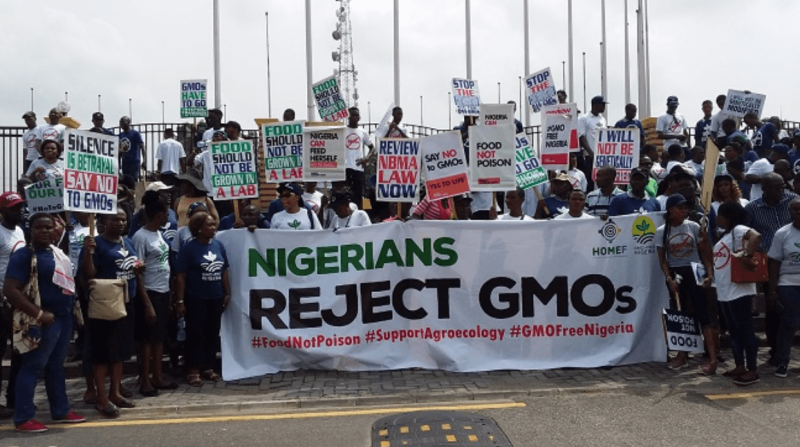
Viewpoint: ‘Endless war’ — Nigeria and other African countries challenged by conflicting claims about benefits and alleged unknowns of GMO crops

Credit: EnviroNews Nigeria

There’s been an endless war against the introduction of Genetically Modified Organisms (GMOs) in Nigerian food staples and its touted messianic roles.

While the promoters argue its introduction would increase crop yield and guarantee food availability, experts in plant and animal husbandry as well as genetic engineering, insist that consumption of GMOs is toxic to blood cells, adrenalin, spleen, causes kidney failure and damage to the liver.

[NABDA Director Abdullahi Mustapha said] the concerns raised by some of the anti-GMO groups about allergy on genetically modified foods has not been scientifically proven, saying that GMOS are not only safe for human consumption, but also for the environment. 

According to him, biotechnology provides a sure substitute to the use of large-scale insecticides, and pesticides, which have been established to have great adverse impact on the environment.

Mustapha noted that the two GM crops that have been commercialised in Nigeria, include the Bt cowpea and Bt. cotton, and that both help to cut down the total amount of insecticides used. 

Follow the latest news and policy debates on sustainable agriculture, biomedicine, and other ‘disruptive’ innovations. Subscribe to our newsletter.

More so, Country Coordinator of Open Forum on Agricultural Biotechnology (OFAB), Dr. Rose Gidado, said with the threat of climate change and its consequences of food insecurity, Nigeria cannot afford to let go of the benefits of biotechnology.


This is an excerpt. Read the original post here.

{{ reviewsTotal }}{{ options.labels.singularReviewCountLabel }}
{{ reviewsTotal }}{{ options.labels.pluralReviewCountLabel }}
{{ options.labels.newReviewButton }}
{{ userData.canReview.message }}

Related Articles

Infographic: Global regulatory and health research agencies on whether glyphosate causes cancer

Infographic: Global regulatory and health research agencies on whether glyphosate causes cancer

Does glyphosate—the world's most heavily-used herbicide—pose serious harm to humans? Is it carcinogenic? Those issues are of both legal and ...

Most Popular

ChatGPT-Image-Jun-25-2026-12_23_17-PM
No, Bill Gates did not secretly engineer ticks to promote veganism
ChatGPT-Image-Mar-10-2026-01_39_01-PM
Viewpoint—“Miracle molecule” debunked: Why acemannan supplements don’t work
Screenshot-2026-06-05-at-2.12.30-PM
Some plants can poison you. So how did humans figure out what is safe to eat?
ChatGPT-Image-Jun-23-2026-03_12_23-PM
Is cellular reprogramming junk science? Nearly 20 patients are getting eye injections in the first FDA-cleared cellular trial
ChatGPT-Image-May-18-2026-12_06_18-PM-2
Defying death: The immortality movement goes mainstream
ChatGPT-Image-Jun-17-2026-10_52_43-AM
Anguished parents, doctors in tears: Utah’s long measles outbreak takes a toll
artificial intelligence brain think illustration md
Viewpoint — Digital gods and human extinction: Will we be the first species ever to design our own descendants?

Sorry. No data so far.

glp menu logo outlined

Get news on human & agricultural genetics and biotechnology delivered to your inbox.