‘A gene called jealousy’: The growing pains of the biotechnology revolution

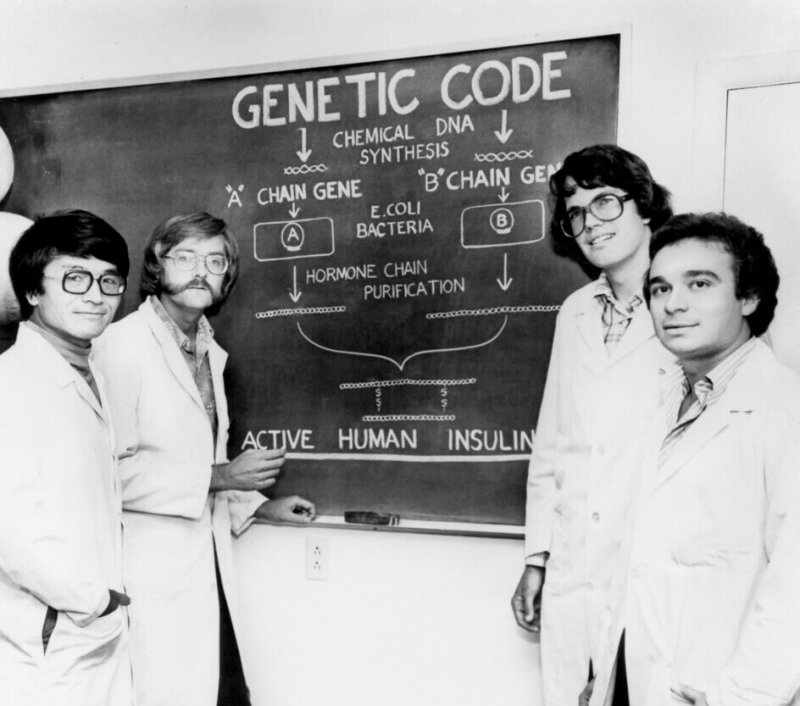
In 1978, (from left) Keiichi Itakura, Arthur Riggs, David Goeddel and Roberto Crea revolutionized diabetes treatment when, in collaboration with Genentech scientists, they used synthetic DNA chemistry and recombinant DNA technology to make a human insulin gene. Credit: Flickr

If there was one word I would use to describe the atmosphere in the early biotech days, it would be excitement. Biotech already included scientists, professors, companies, and investors. But it was a small group of people compared to today.

There was also some discomfort with the commercialization of bioresearch, especially among academics. Whenever money is involved, many people change how they view things.

That was certainly the case in academia, where more than a few looked negatively at the dollars flowing into basic science research. Here’s an example.

Follow the latest news and policy debates on sustainable agriculture, biomedicine, and other ‘disruptive’ innovations. Subscribe to our newsletter.

In 1975, the late Judah Folkman, MD, received the first large industrial grant that I believe that anybody ever obtained. It totaled $23 million, was from Monsanto, and made front-page headlines.

Around 25 years later, Folkman was a dinner speaker, and he was asked to describe the advantages and disadvantages of the grant.

Folkman, who was an extremely humble man, replied, “Let me state the disadvantages first.” He said there’s a gene that a lot of people have, including many professors, that is never expressed directly—a gene called jealousy.


This is an excerpt. Read the original post here.

{{ reviewsTotal }}{{ options.labels.singularReviewCountLabel }}
{{ reviewsTotal }}{{ options.labels.pluralReviewCountLabel }}
{{ options.labels.newReviewButton }}
{{ userData.canReview.message }}

Related Articles

Infographic: Global regulatory and health research agencies on whether glyphosate causes cancer

Infographic: Global regulatory and health research agencies on whether glyphosate causes cancer

Does glyphosate—the world's most heavily-used herbicide—pose serious harm to humans? Is it carcinogenic? Those issues are of both legal and ...

Most Popular

ChatGPT-Image-Mar-10-2026-01_39_01-PM
Viewpoint—“Miracle molecule” debunked: Why acemannan supplements don’t work
ChatGPT-Image-Jun-30-2026-01_09_47-PM
Viewpoint: As MAHA blows up over Supreme Court ruling limiting glyphosate litigation, Trump offers toothless plan to reduce pesticides in food
ChatGPT-Image-Jun-25-2026-12_23_17-PM
No, Bill Gates did not secretly engineer ticks to promote veganism
ChatGPT-Image-Jun-23-2026-12_19_35-PM
Ideological red flag: Led by anti-vax doctor, Tennessee is now the U.S. epicenter selling potent ivermectin shown worthless to prevent or treat Covid
ChatGPT-Image-Jun-25-2026-01_14_50-PM
Viewpoint: Disinformation grift: The wellness industry is a lucrative and mostly worthless marketplace of ‘balms, brews, and baloney’
Screenshot-2026-06-30-at-3.08.03-PM
From infrared sauna blankets to collagen gummies, here’s the top 10 social-media-promoted wellness shams
Screenshot-2026-06-30-at-10.43.50-AM
Viewpoint: Why are there no approved bioengineered insect-protected (Bt) apples?
ChatGPT-Image-Mar-4-2026-09_39_03-AM
Transgender female athletes and Title IX: Separating ‘policy’ from ‘legality’
photodune farming tractor s
Viewpoint: Glyphosate may be hazardous, but it is not dangerous as used by farmers. Critics of the Supreme Court’s Roundup ruling garble hazard with risk
Screenshot-2026-06-30-at-2.06.25-PM
PEW study: The sick state of American health information
Screenshot-2026-06-17-at-12.31.01-PM
Viewpoint: The dangerous influence of ‘woke’ post-modernism in science
marijuana-pot-in-hand-nveri-st-xpm-t-abq-fkifeos-s-rws-cmpx-
Facts & Fallacies podcast: Legalized weed drives drug addiction, psychosis?
ChatGPT-Image-Jun-30-2026-02_48_10-PM
Independent news review site launches free credibility and fact-vetted aggregation chatbot

Sorry. No data so far.

glp menu logo outlined

Get news on human & agricultural genetics and biotechnology delivered to your inbox.