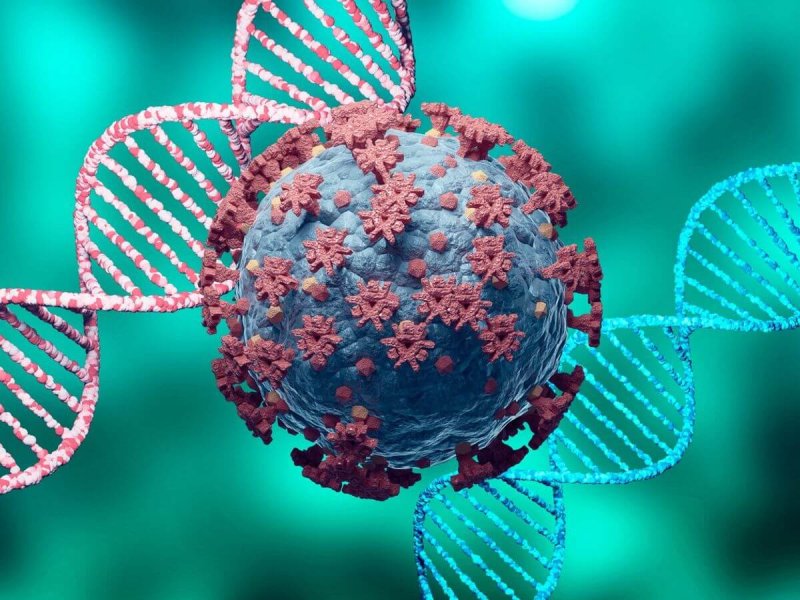
Omicron contains dozens of new mutations — but that doesn’t mean the variant is more dangerous

Credit: iStock
Credit: iStock

The Omicron variant of the coronavirus has alarmed many scientists because of the sheer number of genetic mutations it carries — about 50 in all, including at least 26 that are unique to it. But more does not necessarily mean worse: Mutations sometimes work together to make a virus more fearsome, but they may also cancel one another out.

“In principle, mutations can also work against each other,” said Jesse Bloom, an evolutionary biologist at the Fred Hutchinson Cancer Research Center in Seattle. “However, in this case evolutionary selection is more likely to lead to the spread of a new variant with favorable than unfavorable combinations of mutations.”

Still, this phenomenon, called epistasis, is why scientists are reluctant to speculate on Omicron’s attributes.

Follow the latest news and policy debates on sustainable agriculture, biomedicine, and other ‘disruptive’ innovations. Subscribe to our newsletter.

Omicron carries a mutation called N501Y, which is thought to allow the virus to bind to human cells more tightly. This mutation was also present in the Alpha variant and was linked to its contagiousness.

“Nonetheless, it ended up being Delta, which doesn’t have that particular mutation, that was more even more transmissible than Alpha,” Dr. Bloom said. “That’s because Delta had other mutations that enhance transmissibility.”


This is an excerpt. Read the original post here. 

{{ reviewsTotal }}{{ options.labels.singularReviewCountLabel }}
{{ reviewsTotal }}{{ options.labels.pluralReviewCountLabel }}
{{ options.labels.noReviewsLabel }}
{{ options.labels.newReviewButton }}
{{ userData.canReview.message }}

Related Articles

Infographic: Global regulatory and health research agencies on whether glyphosate causes cancer

Infographic: Global regulatory and health research agencies on whether glyphosate causes cancer

Does glyphosate—the world's most heavily-used herbicide—pose serious harm to humans? Is it carcinogenic? Those issues are of both legal and ...

Most Popular

ChatGPT-Image-Mar-10-2026-01_39_01-PM
Viewpoint—“Miracle molecule” debunked: Why acemannan supplements don’t work
ChatGPT-Image-Jun-25-2026-02_53_56-PM
Embryo gene editing is on the horizon, stirring mixed emotions
a-mature-farmer-working-in-the-field-at-sunrise-harvesting-crops-generated-by-ai-photo
What’s the prospect of developing gene-altered crops that are more nutritious and resist climate disruption
Screenshot-2026-07-01-at-2.49.48-PM
Dr. TikTok and male fertility: Viral claims tout GLP-1 drugs as fertility boosters. What does the science say?
ChatGPT-Image-Jul-6-2026-02_25_26-PM
40 million Americans take glucosamine. If you have memory loss, it could accelerate cognitive decline.
png-upside-food-syn-bio-cultured-meat
Regulating cultured meat around the world
Screenshot-2026-07-21-at-6.22.06-PM
The Indian physician’s one-woman battle against health disinformation on Wikipedia
YearReview Grift
Viewpoint: A practical guide to evaluating social media wellness hype
reverse-aging
Rapamycin: Here’s the skinny on the anti-aging pill that increases the lifespan—of mice by 10%
ChatGPT-Image-Jul-17-2026-12_42_10-PM
Viewpoint: RFK, Jr. is setting up a panel to compensate people who claim they were injured by a COVID vaccine–no proof needed 
ChatGPT-Image-Jun-17-2026-03_29_08-PM
Viewpoint: What’s the impact of the U.S. abandoning support for global health?
file-f-d-d-
Facts & Fallacies Podcast: Europe's AC debacle underscores fatal flaw in green activism
glp menu logo outlined

Get news on human & agricultural genetics and biotechnology delivered to your inbox.