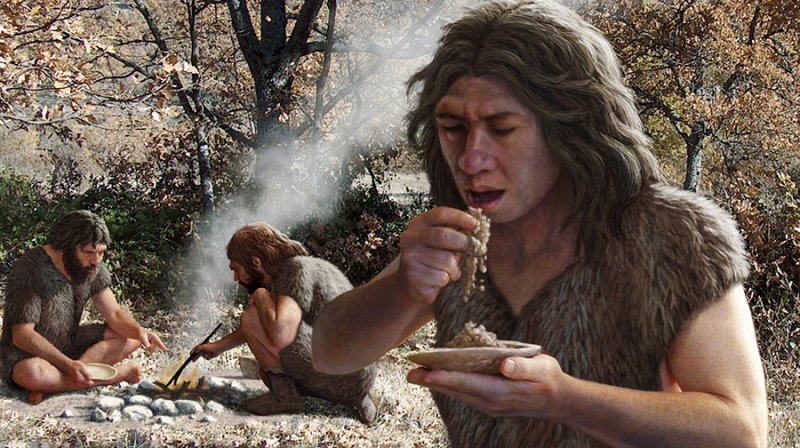
Did cannibalism play a role in the extinction of the Neanderthals?

Credit: NPR
Credit: NPR

Spanish anthropologists Jordi Augustí and Xavier Rubio-Campillo (2016) conducted a virtual experiment to study factors underlying the extinction of Neandertals.

In their experimental model, they included the location of the group with a definitive home range (where resources are collected), the size of the group, cannibalism (in order to eliminate competition and gain additional resources), and the chance that a group will fracture in two (fission).

What their computer model revealed was provocative.

From a game-theory point-of-view, cannibalism appears to be an optimal way to obtain resources. Here, it is important to distinguish between two kinds of cannibalism: endocannibalism and exocannibalism.

Endocannibalism is where a group eats its own members. This type of cannibalism can be practiced for nutritional reasons.

Follow the latest news and policy debates on sustainable agriculture, biomedicine, and other ‘disruptive’ innovations. Subscribe to our newsletter.

Exocannibalism, in contrast, involves eating members from other groups. Exocannibalism might be practiced to eliminate competition from a group’s resources (food, shelter, etc.), to frighten away other groups, and/or for symbolic or nutritional reasons.

Augustí and Rubio-Campillo found that when resources were plentiful, neither endo- nor exocannibalism would be necessary to survive. However, when resources were scarce and/or the environmental conditions were difficult (e.g., extreme cold), cannibalism may have been an optimal trait.


This is an excerpt. Read the original post here. 

{{ reviewsTotal }}{{ options.labels.singularReviewCountLabel }}
{{ reviewsTotal }}{{ options.labels.pluralReviewCountLabel }}
{{ options.labels.newReviewButton }}
{{ userData.canReview.message }}

Related Articles

Infographic: Global regulatory and health research agencies on whether glyphosate causes cancer

Infographic: Global regulatory and health research agencies on whether glyphosate causes cancer

Does glyphosate—the world's most heavily-used herbicide—pose serious harm to humans? Is it carcinogenic? Those issues are of both legal and ...

Most Popular

Screenshot-PM-24
Viewpoint: The herbicide glyphosate isn’t perfect. Banning it would be far worse.
79d03212-2508-45d0-b427-8e9743ff6432
Viewpoint: The Casey Means hustle—Wellness woo opportunism dressed up as medical wisdom
d-b
Blocked arteries, kidney stones, nausea, constipation, fatigue: Long list of health problems caused by too much vitamin D 
ChatGPT-Image-Mar-27-2026-11_27_05-AM
The myths of “process”: What science says about the “dangers’ of synthetic products and ultra-processed foods
ChatGPT-Image-Apr-30-2026-12_21_05-PM-2
The tech billionaires behind the immortality movement
ChatGPT-Image-Mar-3-2026-01_17_14-PM
MAHA wellness influencers deride proven anxiety medications, tout lifestyle fixes
ChatGPT-Image-Mar-10-2026-01_39_01-PM
Viewpoint—“Miracle molecule” debunked: Why acemannan supplements don’t work
ChatGPT-Image-Apr-30-2026-05_00_48-PM
Wellness grifter physician turned wellness influencer out as surgeon general nominee

Sorry. No data so far.

glp menu logo outlined

Get news on human & agricultural genetics and biotechnology delivered to your inbox.