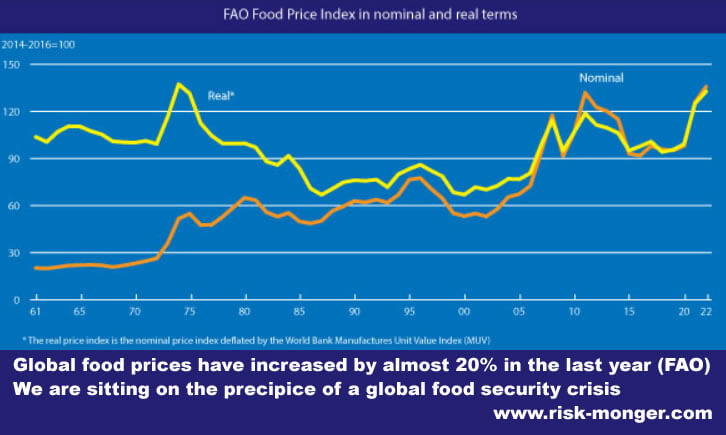
From the Book of Revelation, the four horsemen represent different elements of the apocalypse: conquest, war, death and famine. That pretty well sums up where we are today. In global food security, there is a perfect storm of increasing costs in energy and fertiliser, a radical cut in food supply from a breadbasket region, a financial market slowdown with increased commodity speculation, anti-agriculture regulatory restrictions and increased global unrest post-pandemic. This crisis is evolving without a single failed harvest or significant yield decline (although Canadian farmers have been sounding the alarm bells).
Fertiliser: Global fertiliser prices had been escalating due to rising fossil fuel and other feedstock prices. Farmers’ access to affordable, effective fertilisers have been further exacerbated by incredibly stupid regulatory restrictions imposed by EU officials who seem to know nothing about what farmers need to produce sustainable yields on limited agricultural land.
Now fertiliser imports from Russia and Belarus will be blocked (either through sanctions, blacklists or internal restrictions). Some numbers: 23% of ammonia ,14% of urea and 21% of potash production come from Russia. Belarus produces 18% of the world’s potash. Farmers are already struggling with production costs but with less fertiliser at higher prices, yields will decline and less fertile land will have to be be taken out of production.
It doesn’t take a genius to understand what that will do to global food supply and prices.
Speculators: In the first week of the Russian invasion of Ukraine, wheat futures rose 40%. It will likely double again in the next week. 25% of global wheat production comes from Russia and Ukraine with a higher proportion of exports going to developing countries. In blockading the Black Sea, one quarter of the daily loaves on tables around the world have been removed. The region also dominates on corn, sunflower, barley, soybean and OSR production.
Shortages undoubtably invite speculators, amplifying prices and access to food. A trader in a pit in the Chicago Mercantile Exchange may not be bothered by the cost of a sandwich, but he or she could tell you the price of a bushel down to the grain kernel. Commodities traders bet on future prices for staples and in times of uncertainty, often weather-related, prices go up. Affluent environmental activists pushing for more organic food claim we don’t pay the true cost of food, but these inflated prices won’t go to farmers who locked into prices last year (likely now at a loss).
That a large number of Ukrainian farmers won’t be planting or tending their fields this year should escalate futures far beyond real values and far beyond what most consumers could afford at a time when energy prices and supply chain disruptions are already wreaking havoc on global markets, inflation levels and trade.
It doesn’t take a genius to understand what that will do to global food supply and prices.
Global civil unrest, revolution and war: The last spike in food prices from 2010 led to a series of protests, revolutions and civil wars. In 2011, shortly after the Egyptian uprising, I made the following analysis:
Do a Google search of “food prices + Egypt” and you will get a wide range of articles in the months of December and January showing how prices for basic foodstuffs had almost doubled. In comfortable cities like Brussels, food accounts for around 15-20% of an average middle-class income – so most of us can handle price increases. In developing countries this budget can rise to around 80% of monthly incomes. Double the food prices and hard decisions give rise to frustration. I believe this was the spark that ignited the tinderbox of long-term youth unemployment and inept, corrupt governments. Being under-employed is a slap in the face; not being able to feed your family is a shot in the gut.
The 2010 food price spike was nothing compared to what is just starting to hit global food supplies before even a single seed fails to germinate. The 44 million Ukrainians are clearly suffering but, as a consequence of inaction, incompetence and ineptitude in Western capitals, more than 500 million in more vulnerable developing countries will soon pay with their lives and their futures.
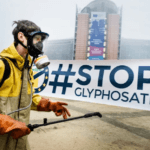
So who will be to blame for the chaos and suffering? As our leaderless Western states lack integrity and inspiration, it is safe to say they will not be accountable for their failures. They will blame Russia no doubt. The clopportunists will blame climate change (the go-to reflex for all that ails us). Lost biodiversity, water, bees, glyphosate, even capitalism – pick your poison and pass the blame. The last crisis was blamed on the speculators so that excuse probably still has legs. No one presently in power will claim accountability and admit the food/hunger-based political crises will have been caused by our lack of foresight or risk management capacity.
Taking a basic staple like bread out of the reach of large parts of the global population will have dire consequences. If not famines, then extreme poverty. If not revolutions, then mass migration waves of desperate people. If not civil wars, then social injustice. Do not tell me in two years’ time that you did not see this coming. Anyone with basic risk management skills has been raising red flags.
It doesn’t take a genius to understand what increases in global food prices and shortages will do to geopolitics.

The last horseman of the apocalypse is famine. With famines and civil unrest clearly on the horizon, the European Commission is blindly pushing forward a package of regulations under their Green Deal obsession called Farm2Fork that intends to cut fertiliser use, remove vital crop protection tools and promote a luxury organic food approach. How could this possibly be a responsible policy at such a dire moment in history?
The green death: From Farm2Famine
If Western European nations had leaders with foresight and responsibility (ie, proper risk managers) they would be doing whatever they could today to try to prevent this pending food security disaster from reaping hardship on their populations and famines and civil unrest across the developing world. Instead, myopic precautionistas in Brussels, fixated by their environmental ideology, are stubbornly sticking to their Green Deal objectives. This is the only strategy the European Commission is capable of articulating. If two years of a global pandemic could not waken Ursula and Frans from their dogmatic slumber, what difference would the invasion of a neighbouring country have on their narrow lens? Giving up Russian gas would interrupt Timmermans’ Green Energy Transition plans so any serious sanctions were never in the cards. But what about major famines?
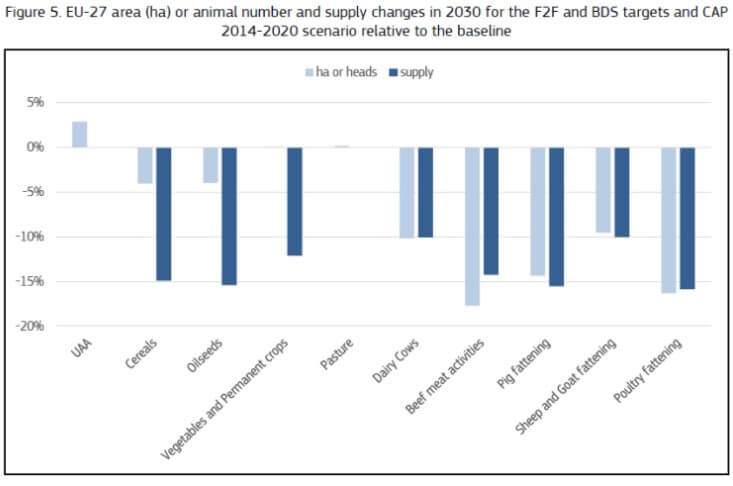
What damage will the European Commission’s Farm2Fork strategy do to the present food security vulnerabilities as this disaster is quickly develops? Gasoline … matches. Farm2Fork is the European Commission’s agricultural chapter of their Green Deal strategy to fight climate change. It intends to reduce synthetic pesticide use and livestock antibiotics by 50%, increase land for organic food production to 25% and cut fertiliser use by 20%. Most scientists, including the European Commission’s own Joint Research Centre (JRC), have warned such a policy will lead to serious agricultural yield reductions, cuts in farmers’ margins and increases in land converted to farming. See my analysis of the warnings from the scientific community over the European Commission’s Farm2Fork folly and why Frans Timmermans can’t seem to listen.
Despite the green virtue signalling, Farm2Fork will not support sustainable farming, will not cut greenhouse gas emissions and will not improve European food supply.
No farmers nor agronomists were consulted when the European Commission set their Farm2Fork targets. No farmers nor agronomists were listened to during the consultation phase (none of the original targets were amended during two years of “stakeholder engagement”). The JRC warned of at least a 20% reduction in yield and significant price increases if Farm2Fork advances in its present form. But this research was conducted prior to the increase in global food prices, prior to the sharp decline in fertiliser access, prior to the speculative surge in commodity prices, prior to the cutting off of 25% of the world grain production. Maybe the European Commission should start to listen to scientists, economists, farmers and their own research advisers. Maybe the European Union should be a solution provider rather than exacerbating the problem.
The crisis in EU leadership can come down to one main failure in governance: putting ideological virtue above sound policy strategy (realpolitik). This present European Commission cabinet has been directed to feign projected European virtues, associate with civil society activists, ideologues and social justice warriors and implement their campaigns at whatever cost to consumers, society and the environment. Gone is pragmatic solutions. Gone is development. Gone is responsible governance.
Frans Timmermans, with his ideological Farm2Fork fixation, expects the developing world to feed Europeans their luxury diet of low-yielding organic food. But this developing world will no longer be able to feed themselves. Given how the European Union leaders are looking the other way as Ukrainians are dying in their homes, I don’t expect Frans and Ursula will take much notice of the famine death toll their policy obsession will have amplified.
What a disgrace.
Postscript: What a risk manager should do
I have been told I should never end an article or a speech without hope or a positive outlook. So although I am indeed very dark in my present outlook, here are some recommendations of what risk managers should be doing:
- Impose real sanctions on Russia and prepare European populations for sacrifice. This would not only close all trade with Russia on all products, but also to impose similar sanctions on other countries and companies that still trade with the belligerent nation.
- Stop pre-permitting Putin to escalate his conquest. Talk of sanctions let Russia know Ukraine was for the taking. Yesterday (March 5) NATO declared they will not, in any way, get involved in the conflict. This has given Putin permission to use some of his more diabolical weapons of mass destruction on Ukrainian citizens with impunity.
- Ease the burden of increased food prices by supporting farmers to increase yields, reduce speculative opportunities and increase global trade. For the European Union, this may mean relaxing or scrapping the repressive 2001 GMO Directive. The world needs increased food stocks, not an affluent, unscientific ideology.
- And for God’s sake, abandon the ridiculous Farm2Fork strategy. This is not the time to impose a low-yielding elitist food choice on vulnerable, food-stressed regions. European farmers need the best technologies to increase yields and support those at risk of famine.
Slava Ukraini.
David Zaruk is a speaker, and professor, teaching at Odisee University College. As an experienced science communicator, Zaruk writes for The Risk Monger and other blogs.
A version of this article was originally posted at the Risk Monger blog and is reposted here with permisison. Find the Risk Monger on Twitter @zaruk