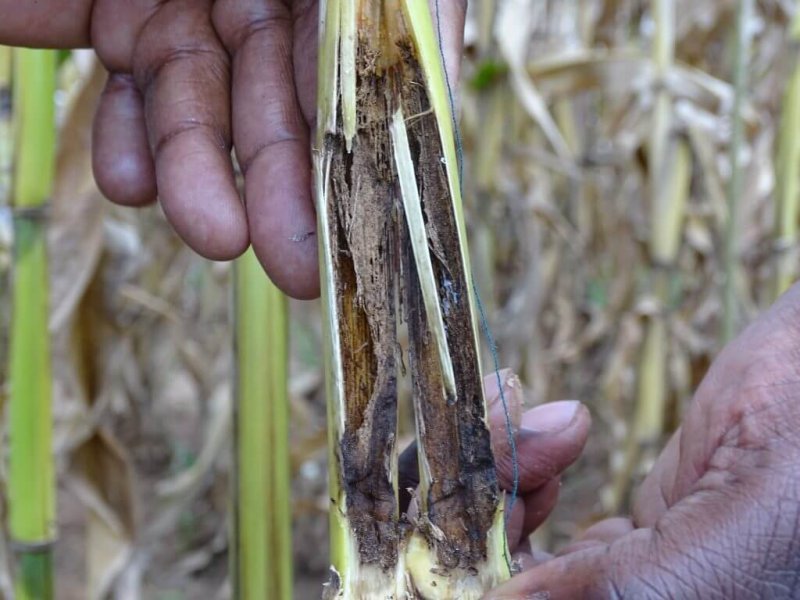
Ugandan field trials demonstrate significant economic benefits for farmers growing insect-resistant Bt maize

Credit: CIMMYT
Credit: CIMMYT

African scientists have demonstrated that genetically modified Bt maize offers much higher yields and better pest resistance than conventional varieties — traits that could greatly improve food security on the continent.

In their study, published in Science Direct, the researchers show that Bt maize hybrids significantly reduced stemborer damage, which is a principal drawback to maize production in Uganda and many parts of Africa.

Follow the latest news and policy debates on sustainable agriculture, biomedicine, and other ‘disruptive’ innovations. Subscribe to our newsletter.

Adopting Bt maize could help Uganda’s farmers guard against grain yield losses associated with stem borers, which would help improve household food security, incomes and livelihoods, the study finds.

And by growing Bt maize, Uganda would also eliminate or reduce the costs associated with the use of insecticides and lessen the dangers to humans and the environment due to pesticide misuse or overuse.

Conventional methods of controlling the stem borer range from using a rotational cropping system to applying chemical and biological pest-control products. The scientists deem these methods ineffective, particularly in the African smallholder context, due to financial challenges and the labor and knowledge-intensive nature of the mitigations.


This is an excerpt. Read the original post here.

{{ reviewsTotal }}{{ options.labels.singularReviewCountLabel }}
{{ reviewsTotal }}{{ options.labels.pluralReviewCountLabel }}
{{ options.labels.newReviewButton }}
{{ userData.canReview.message }}

Related Articles

Infographic: Global regulatory and health research agencies on whether glyphosate causes cancer

Infographic: Global regulatory and health research agencies on whether glyphosate causes cancer

Does glyphosate—the world's most heavily-used herbicide—pose serious harm to humans? Is it carcinogenic? Those issues are of both legal and ...

Most Popular

ChatGPT-Image-Mar-10-2026-01_39_01-PM
Viewpoint—“Miracle molecule” debunked: Why acemannan supplements don’t work
afb-a-b
As the EU loosens restrictions on agricultural gene editing, it remains years behind the rest of the world on equally-safe GMO foods
ChatGPT-Image-Jul-8-2026-12_32_48-PM
Viewpoint: SCOTUS strikes a blow against junk science in Bayer glyphosate case. Will it deter mass tort litigators?
ChatGPT-Image-Jul-7-2026-01_57_55-PM
Viewpoint: Europe’s rejection of air conditioning is the poster child for misunderstanding how to mitigate the impact of climate change
Screenshot-2026-07-10-at-2.02.54-PM
Viewpoint: In abortion-restricting Florida, misinformation abounds when Republican congresswoman faces an ectopic pregnancy
ChatGPT-Image-Jun-25-2026-12_23_17-PM
No, Bill Gates did not secretly engineer ticks to promote veganism
Screenshot-2026-07-10-at-3.25.10-PM
Using AI for health questions? Here are 4 tips for the most accurate answers.
Screenshot-2026-07-10-at-3.10.50-PM
Snake-oil cures throughout history
Screen-Shot-at-PM-pe-vra-kipgaprbdo-vd-ms-jpule-n-jqqaxf-l-e
Viewpoint: Will new breeding techniques help make European agriculture more competitive?
Screenshot-2026-07-10-at-12.55.21-PM
Cancer health facts are particularly susceptible to online misinformation
Screenshot-2026-07-08-at-2.14.27-PM
Belief in unproven dietary regimes, vitamins, and crank therapies is putting patients’ health in danger and increasing the risk of getting cancer
ChatGPT-Image-Jul-1-2026-03_33_49-PM
‘Alternative’ cancer treatments that could kill you
glp menu logo outlined

Get news on human & agricultural genetics and biotechnology delivered to your inbox.