How seed gene banks are preserving biodiversity and providing a hedge against climate change

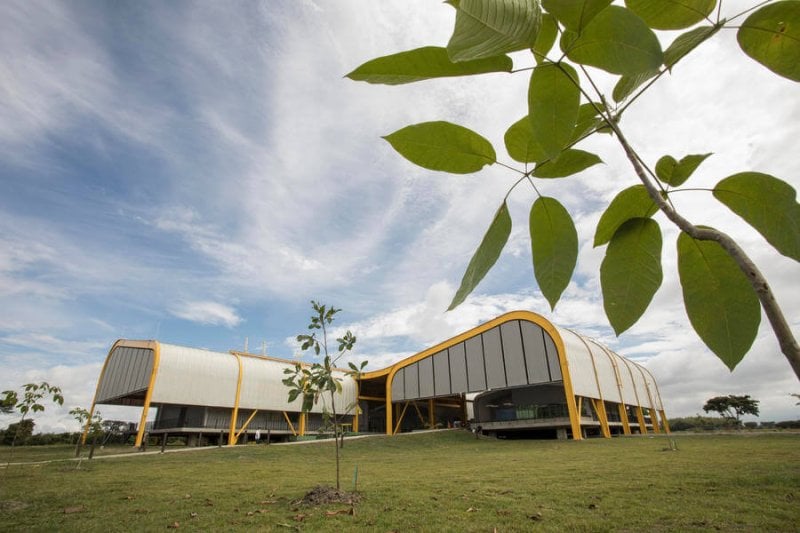
This unusual looking building is home to the world’s largest collections of beans, cassava and tropical forages. Credit: Alliance Biodiversity CIAT

“It’s a tool against extinction — not just biological extinction but, also, the extinction of knowledge.”

The facility at Palmira is one of 11 gene banks around the world overseen by CGIAR, a global research partnership that promotes food security.

Each site specialises in particular crops. The bank in Peru, for example, stores potatoes. In the Philippines, it is rice. The “mother ship” — which, though not run by CGIAR, contains duplicates of all its seeds — is a gene bank built below the frozen mountains of the Svalbard archipelago in Norway, close to the Arctic Circle. There, more than 1mn samples are stored indefinitely, to safeguard the agricultural diversity of the planet.

Follow the latest news and policy debates on sustainable agriculture, biomedicine, and other ‘disruptive’ innovations. Subscribe to our newsletter.

And they are tackling the challenge of climate change. Whereas in the past, their focus was on producing high-yield or pest-resistant crops, these days they are striving to develop varieties that can tolerate heat, drought and flooding.

Despite their successes, gene bankers acknowledge that they are in a race against time to preserve as many varieties of crops as they can. The UN Food and Agriculture Organization estimates that, over the past century, 75 per cent of global crop diversity has been lost as farmers switch to genetically uniform high-yielding varieties.


This is an excerpt. Read the original post here

{{ reviewsTotal }}{{ options.labels.singularReviewCountLabel }}
{{ reviewsTotal }}{{ options.labels.pluralReviewCountLabel }}
{{ options.labels.noReviewsLabel }}
{{ options.labels.newReviewButton }}
{{ userData.canReview.message }}

Related Articles

Infographic: Global regulatory and health research agencies on whether glyphosate causes cancer

Infographic: Global regulatory and health research agencies on whether glyphosate causes cancer

Does glyphosate—the world's most heavily-used herbicide—pose serious harm to humans? Is it carcinogenic? Those issues are of both legal and ...

Most Popular

Screenshot 2026-07-22 at 1.38
Viewpoint: Are the U.S. and Europe headed towards a repudiation of agricultural biotechnology red tape?
ChatGPT-Image-Mar-10-2026-01_39_01-PM
Viewpoint—“Miracle molecule” debunked: Why acemannan supplements don’t work
Screenshot-2026-07-27-at-3.23.14-PM
Prioritizing AI, robotics, and nuclear energy: Trump administration is guiding research funding away from independent universities to private companies
png-terrace-Farm-asia
Europe’s tentative embrace of agricultural gene editing could revolutionize food production and health in Asia
ChatGPT-Image-May-26-2026-11_51_01-AM
Viewpoint: RFK, Jr.’s depressingly misguided (and litigator-funded) crusade against antidepressants
Screenshot-2026-07-09-at-1.09.25-PM
Anti-vaccine myths rattle health care
ChatGPT-Image-Jul-26-2026-05_58_17-PM
Louisiana and Texas bring RFK,Jr.- MAHA-backed restrictions on dyes and other ‘controversial’ ingredients to eight states
ChatGPT-Image-Jul-26-2026-05_35_53-PM
FDA takes up peptide therapies as hype outpaces science
Screenshot 2026-07-28 at 3.22
Hidden hunger: Climate change is speeding up the decline of important nutrients in our food
Screenshot 2026-07-27 at 6.15
No test, no tennis: Women’s Tennis Association becomes first major female sports league to require genetic sex testing
organic scaled
Facts & Fallacies podcast: Organic food cuts pesticide exposure? A response to Dr. Rhonda Patrick
Screenshot 2026-07-28 at 2.04
Viewpoint: How AI supercharges conspiracy theories and oversimplifications to distort online health information
Screenshot 2026-07-28 at 3.03
What is cyberchondria?
glp menu logo outlined

Get news on human & agricultural genetics and biotechnology delivered to your inbox.