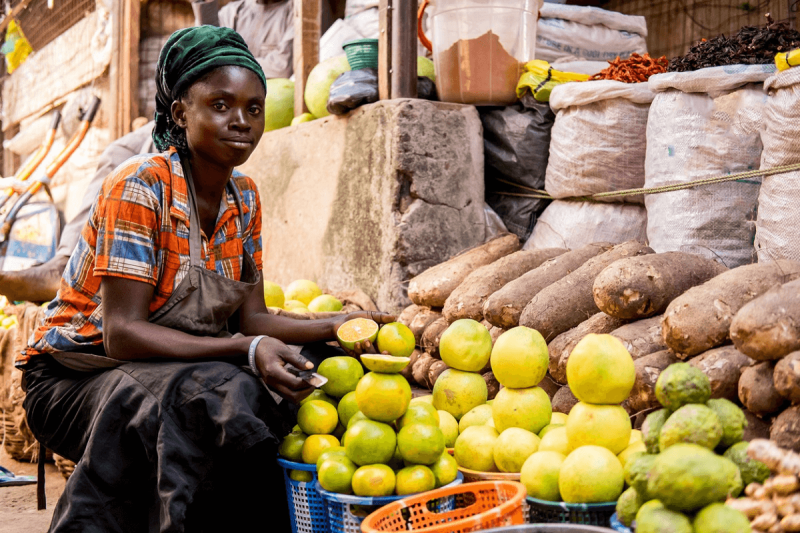
GM seeds likely to be in the hands of Ghanaian farmers by next year, scientists say

Credit: Sam Makoji/Getty Images/iStockphoto
Ghanaian scientists say genetically modified seeds will most likely be in the hands of farmers by the start of the next planting season.

The prediction was made during a recent AfS Live webinar featuring four public sector scientists who are using cutting edge tools  to improve food security and agricultural sustainability in Ghana.

The country’s cowpea productivity has been generally very low, said Dr. John Eleblu, head of cowpea and soybean projects at the West African Center for Crop Improvement (WACCI). It has been stagnate for years, with diseases, pests and drought affecting the yield of small holder farmers. This has made farmers over-reliant on chemicals, which are expensive, bad for their health and labor intensive, he noted.
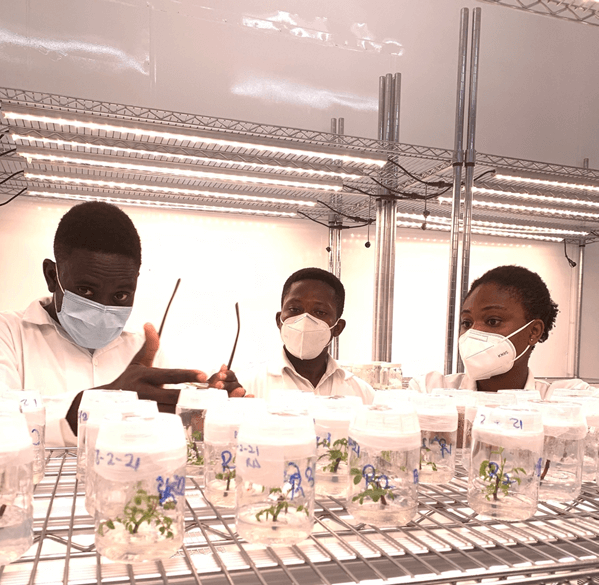
Dr. John Eleblu (left) showing Technologist (Mr Reynolds Samuel, in the middle) and Research Assistant (Miss Grace Markin, on the right) plantlets developed in vitro at the WACCI Tissue Culture Lab Credit: University of Ghana

“My research focuses on developing cowpea varieties that can tolerate these environmental stresses, using a combination of tools such as conventional breeding, mutagenesis, tissue culture and genetic modification,” Eleblu continued.  “This will ultimately contribute to yield improvement for smallholder farmers in Ghana.”
Follow the latest news and policy debates on sustainable agriculture, biomedicine, and other ‘disruptive’ innovations. Subscribe to our newsletter.
Another boost to production is expected from the pod borer-resistant (PBR) cowpea, which is genetically modified to resist  Maruca, an insect pest that causes over 80 percent yield loss. The insect-resistant cowpea will be the country’s first GM crop if the National Biosafety Authority green lights its environmental release, which means farmers can grow the seeds.“When the PBR cowpea is commercialized, farmers will have options for sustainable farming and environmental biodiversity because of less use of chemicals,” said Dr. Daniel Ofosu, research scientist, Biotechnology and Nuclear Agriculture Research Institute (BNARI), Ghana. “Ultimately, this will give us new opportunities to transform our agriculture into more sustainable agriculture to ensure we have food, nutrition, and economic security.”

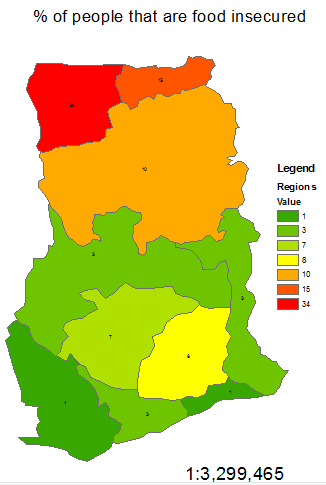
Food security in Ghana. Credit: Ministry of Food and Agriculture

In addressing the issue of nutrition insecurity, Dr. Agyemang Danquah, head of the tomato genetics program at WACCI, spoke about his efforts to improve access to healthy and nutritious vegetables using innovative tools.

“Tomatoes are one of the widely consumed vegetables in Ghana, especially among smallholder families,” he said. “However, its production faces many challenges like bacterial wilt disease, which has caused a lot of farming families in the north to stop tomato cultivation. Similarly, there’s the issue of drought and extreme heat in these northern climates.” Due to these challenges, Ghana has relied heavily on importation from neighboring countries, leading to a 10-fold increase in costs,  Agyemang said.

“We are developing varieties that can adapt to these challenges, using a traditional breeding approach which involves screening several germ plasms for specific traits and then making new crosses to generate new varieties,” he explained. “But this takes a lot of years to develop, which is why tools like gene editing will help us address these issues within a shorter time frame.  We need new and improved tomato varieties to not only improve the income of small holder farmers, but also improve nutrition among consumers.”
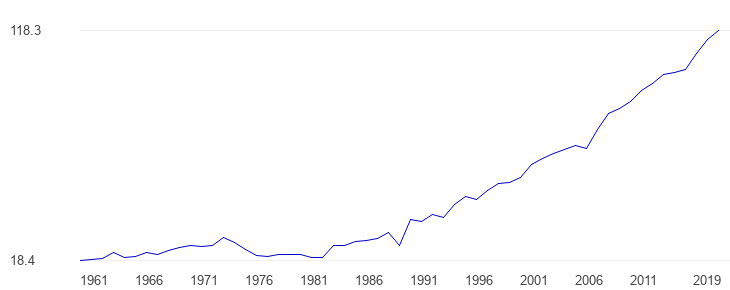
Food production in Ghana has been steadily rising. Credit: Global Economy

Ofosu noted that while improved technology is good, the adoption of new crop varieties also requires a favorable policy environment. “Ghana has recognized the potentials of biotechnology and new plant breeding methods techniques to improve food and nutrition security in the country,” he said.  “So, what we’ve been doing is to build a system where a state institution can understand the technology better to enable them implement policies that would facilitate technology uptake.”

“The future of Ghana depends on these policies, especially the biosafety law,” said Dr. Mavis Owusuaa, molecular biotechnologist at the University of Energy and Natural Resources (UENR). “Once the door is open to GM crops, food insecurity will be a thing of the past. We will be able to feed the population and export more food, which will go a long way in improving the economic lives of Ghanaians.”

Owusuaa also noted that given the number of projects ongoing in Ghana, “it is obvious that we are ready to embrace the gene revolution.”  Scientists are also ready to support it, she said, and “the farmers are welcoming. All they want is a good product, and the scientists are ready to work. We only need the government’s support in terms of funding and policy to make Ghana a better place for everyone,” she concluded.

Modesta  Abugu is a 2015 Alliance for Science Global Leadership Fellow and a doctoral student of horticultural sciences at North Carolina State University. Follow Modesta on Twitter @modestannedi


A version of this article was posted at Cornell Alliance for Science and is used here with permission. Check out Cornell Alliance for Science on Twitter @ScienceAlly
{{ reviewsTotal }}{{ options.labels.singularReviewCountLabel }}
{{ reviewsTotal }}{{ options.labels.pluralReviewCountLabel }}
{{ options.labels.newReviewButton }}
{{ userData.canReview.message }}

Related Articles

Infographic: Global regulatory and health research agencies on whether glyphosate causes cancer

Infographic: Global regulatory and health research agencies on whether glyphosate causes cancer

Does glyphosate—the world's most heavily-used herbicide—pose serious harm to humans? Is it carcinogenic? Those issues are of both legal and ...

Most Popular

ChatGPT-Image-Jun-16-2026-10_29_11-AM
What’s behind Anthropic’s warning about the accelerating development of AI
Screenshot-2026-06-16-at-10.02.22-PM
Viewpoint: ‘Industrial food’ primer—Challenging the dangerous delusions of the alternative food movement
ChatGPT-Image-Jun-16-2026-10_01_45-AM-2
Viewpoint—Recursive self-improvement: AI leader Anthropic calls for AI slowdown
ChatGPT-Image-Jun-9-2026-01_11_37-PM
Turmeric supplements: More risks than benefits
Screenshot-2026-06-17-at-11.57.12-AM
Viewpoint: Raw milk and the myth of safety—ProPublica exposes the growing anti-homogenization movement
ChatGPT-Image-Jun-15-2026-02_31_28-PM-2
Trump-appointed cancer panel head backed by supplement and anti-vaccine companies promotes discredited support for ivermectin as a potential cure
newborn infant baby mother
Facts & Fallacies Podcast: The truth about vitamin K shots
ChatGPT-Image-Jun-4-2026-03_07_27-PM
AAP v. Kennedy: While a court challenge grinds on, RFK Jr. quietly advances his anti-vaccine conspiracy agenda
ChatGPT-Image-Mar-10-2026-01_39_01-PM
Viewpoint—“Miracle molecule” debunked: Why acemannan supplements don’t work
ChatGPT Image Jun 16, 2026, 12_03_37 PM
Kennedy accused of trying to ‘bully’ science journal that retracted study linking vaccines to infant deaths
Screenshot-2026-06-16-at-11.23.32-AM
In a rebuke to RFK, Jr.’s anti-vax crusade, journal retracts study claiming hepatitis B vaccine–autism link
Screenshot-2026-06-05-at-2.12.30-PM
Some plants can poison you. So how did humans figure out what is safe to eat?
Screenshot 2025-07-30 at 10.48
Can gene editing eliminate Down syndrome? Scientists have done it in lab-grown cells
glp menu logo outlined

Get news on human & agricultural genetics and biotechnology delivered to your inbox.