For more than two decades, anti-GMO groups have resorted to the same dishonest claims about the risks of genetically engineered crops. One of their favorite tropes goes like this: “the surge in genetically engineered crops in the past few decades is one the main drivers of increased pesticide use and chemicals in agriculture.” That particular example comes from Greenpeace, though other activist outlets have used the same rhetoric to attack gene editing, a more recent class of breeding techniques used to enhance our food crops in all sorts of useful ways.
You know how the #GMO industry and its supporters keep telling us we need to deregulate new #GMOs in order to reduce pesticide use and make farming more sustainable? Well here’s what they tell investors (it’s going to be an absolute gold rush for pesticide-promoting crops)…
“Big if true,” as the kids say. What evidence does GM Watch have here? They linked to yet another tweet to support this claim about the “GMO industry:”
CIBUS is a leader in the development of new #GMOs. They say, ‘Our goal is a whole new generation of herbicide traits across the major crop platforms’ and ‘the approval of gene editing techs will open up one of the biggest opportunities in agriculture’—new markets for these crops.
Increasing numbers of enhanced crop species. Rather than promoting monocultures, gene editing promotes biodiversity. Credit: Ian Heap via WeedScience.org
Mis- and disinformation are distorting science and public policy. Subscribe to our Daily and Weekly Digests for incisive coverage of ‘disruptive’ innovations in AI, agricultural biotechnology, food, chemicals, nuclear energy, vaccines, and other disruptive innovations.
I count two significant errors. Let’s take them in turn. First, there is no such thing as a “new GMO.” There are instead various plant-breeding techniques, each with its strengths and weaknesses. To develop crops with certain traits, scientists may use gene editing to modify or delete a segment of DNA from an organism’s genome; more complex characteristics, for example, drought resistance, may require shuffling genes between different species.
Selective breeding started some 10,000 years ago. Credit: plantbreeding.eu
Using “new” and “GMO” as pejoratives is nonsensical because all breeding techniques “genetically modify” the plants and animals we eat, and there’s nothing novel about it. The European wine industry was saved many years ago by growers who grafted grape vines to insect-tolerant American rootstock; nearly every wine on the market today comes from these “GMO” grapes. There are reports of growers using grafting going back to 1560 BC in China. History aside, scientists today don’t employ grafting because it’s an ancient technique; they use it because it’s the best tool to produce the desired trait. As this recent literature review explained:
Some commercial fruit trees are difficult to propagate by other methods, such as by cuttings or air layering, yet they respond well to grafting. In addition, many cultivars with superior fruit characteristics possess poor rooting systems or susceptibility to nematodes or disease, so scion vigour may be improved by grafting.
Pesticide-promoting crops?
The other fallacy embedded in GM Watch’s reasoning is that Cibus’s gene-edited seeds are designed to boost pesticide use. [1] Think like a farmer for just a second and you can see why this accusation is baseless. Weed killers are relatively expensive. Farmers, like all businessmen, want to reduce their production costs. Why would they buy seeds that increase their use of costly inputs without conferring an additional benefit? Answer: they wouldn’t.
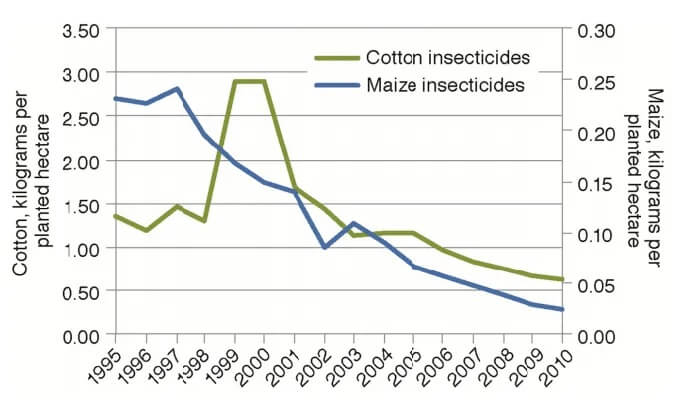
Rates of insecticide application on cotton and maize from 1995 to 2010. Credit: National Academies of Sciences
Growers buy herbicide-tolerant seeds because they enable better weed control and often generate greater crop yields as a result; they also tend to reduce the volume of herbicide farmers require. Between 1996 and 2015, overall herbicide use declined by 226.3 million kg, an eight percent reduction. Had the bloggers at GM Watch spent a little more time on Cibus’ website, they could have discovered these economic facts for themselves:
Crop Protection Traits are important because they directly impact the yield and the cost associated with producing a crop. [One example] would be Roundup resistant crops that allow producers to spray Roundup for weed control without damaging crop plants … the trait materially improved yields and materially lowered or eliminated the use and cost of crop protection chemicals such as herbicides … and materially lowered the fuel/manpower used in crop protection.
I was going to write a witty conclusion to this article, just a few words explaining that GM Watch can only deny the facts for so long before everyone starts ignoring them. But I think Twitter user Sea Witch aptly summarized anything I would’ve said:
[1] According to the EPA, “pesticide” describes “any substance or mixture of substances intended for preventing, destroying, repelling, or mitigating any pest.” This is why I use “herbicide” and “pesticide” interchangeably.
Cameron English is a writer, editor and co-host of the Science Facts and Fallacies Podcast. Before joining ACSH, he was managing editor at the Genetic Literacy Project, a nonprofit committed to aiding the public, media, and policymakers by promoting science literacy. You can visit Cameron’s website here
A version of this article was posted at American Council on Science and Health and is used here with permission. You can check out the American Council on Science and Health on Twitter @ACSHorg