Zambia’s traditional pig farmers are poised to further embrace reproductive biotechnology, including advanced forms of artificial insemination as an alternative to natural mating. This is a hopeful sign of increasing awareness of biotech benefits in a country that still largely exercises European-inspired precautions.
In the country’s pro-biotechnology circles, the development could trigger a narrative shift from strong established anti-biotechnology arguments to more pro-biotechnology narratives.
Changing attitudes among farmers who increasingly view the technology more favorably could influence ongoing discussions in Zambia on a newly revised draft biotechnology and biosafety Policy.
If recent findings from a study conducted by researchers Pharaoh Collins Sianangama, Progress Nyanga, Wilson Mwenya and Edwell Mwaanga from the University of Zambia and Rubaijaniza Abigaba from Uganda’s Makerere University are correct, there is an increasing awareness about the virtues of reproductive biotechnology and appetite to employ them.
The study tracked 622 Zambian traditional farmers who were open to using new techniques such as in vitro fertilization and embryo transfer, artificial insemination, semen quality evaluation, semen preservation, estrus induction and synchronization to improve and augment their on-farm production. These practices are already widely used by colleagues in the SADC (Southern African Development Community) region, such as South Africa.
“Many of the farmers viewed the harnessing of genetic technologies like artificial insemination in other SADC countries to expand pig production as a good reference point because they were more advanced in regard to biotechnology application,” Rubaijaniza Abigaba, one of the researchers said.
36-year-old Dominic Chipasha of Petauke in Zambia’s Eastern province is one of the pig farmers hoping for better prospects:
We support the idea of employing reproductive biotechnologies If other countries are using them, we can also do the same to expand our pig production business. When we start, other farmers will follow suit. The upshot of that will be increased pig production, better food security and better livelihoods.
I am upbeat. I believe reproductive biotechnologies specifically artificial insemination will significantly boost pig productivity in Zambia. I also believe it will help farmers reduce their carbon footprint.
Many farmers also expressed hope that the adoption of the biotechnologies would help keep at baby African swine fever, which is endemic in the Eastern province. The fever, which the Food and Agriculture Organisation declared a worldwide priority in 2019, has become a major crisis for the global pork industry in recent years.
The World Organisation for Animal Health says African Swine Fever, which has no effective vaccine, is currently affecting several regions around the world. It is not only impeding animal health and welfare but also having detrimental impacts on biodiversity and the livelihoods of farmers.
Several animal scientists believe the adoption of reproductive biotechnologies in Zambia would be a game changer.
“It will enable farmers like Chipasha and others to achieve the full genetic and reproductive potential of their animals,” Fred Miyanda, an animal scientist, said.
The study also indicated that traditional pig farmers, most of whom are women, were optimistic that artificial insemination would help them improve indigenous pig sizes through cross-breeding, reduce reproductive losses by reducing the farrowing interval, facilitate breeding of sows and allow breeding anytime and when it was needed. Zambia’s new government under President Hakainde Hichilema is keen on promoting this innovation.

Hichilema recently mentioned in a speech that his government seeks to promote and increase other livestock production and artificial insemination as well as enhanced disease surveillance and control.
Animal scientist Miyanda foresees dramatically more efficient production as a result:



Over the past decade, reproductive biotechnologies like in vitro fertilization have contributed significantly towards improving livestock production across the globe. In vitro fertilization enables the production of many embryos of superior breeds in various livestock animals. Harnessing in vitro fertilization and other reproductive biotechnologies will allow Zambian farmers to achieve healthier and more productive animals, contributing to the reduction of malnutrition and food insecurity in their communities.
Pig production remains crucial to the livelihood of farmers in Zambia, but low productivity often means many are hard pressed to make ends meet. Low productivity also means Zambia’s growing demand for pig products is seldom met.

Zambia trails Malawi and South Africa in terms of pork production in Southern Africa. Its pork production two years ago was 65,224 metric tons, which translated into a pork consumption per capita of 3.5 kg.
In 2019, the Food and Agriculture Organisation (FAO) advised African livestock producers to work to expand the scope of their operations and to invest in productivity-enhancing technologies in order to meet the growing demands for livestock products.
According to the FAO, the demand for livestock products including beef, milk and poultry, will double to triple in the African continent by 2050.
The organization noted that about 70 per cent of the demand for livestock products will be in urban areas, where the majority of Africans will reside.
Among the traditional pig farmers who expressed optimism that biotechnology would reverse their low-income subsistence present, artificial insemination was the most favored biotechnology (66.2%), whereas in vitro fertilization (IVF) and embryo transfer were the least preferred.
Artificial insemination which involves the mechanical deposition of semen from superior males in the uterus of an estrus female is the most widely used reproductive biotechnology in Africa, according to the Food and Agriculture Organisation (FAO).
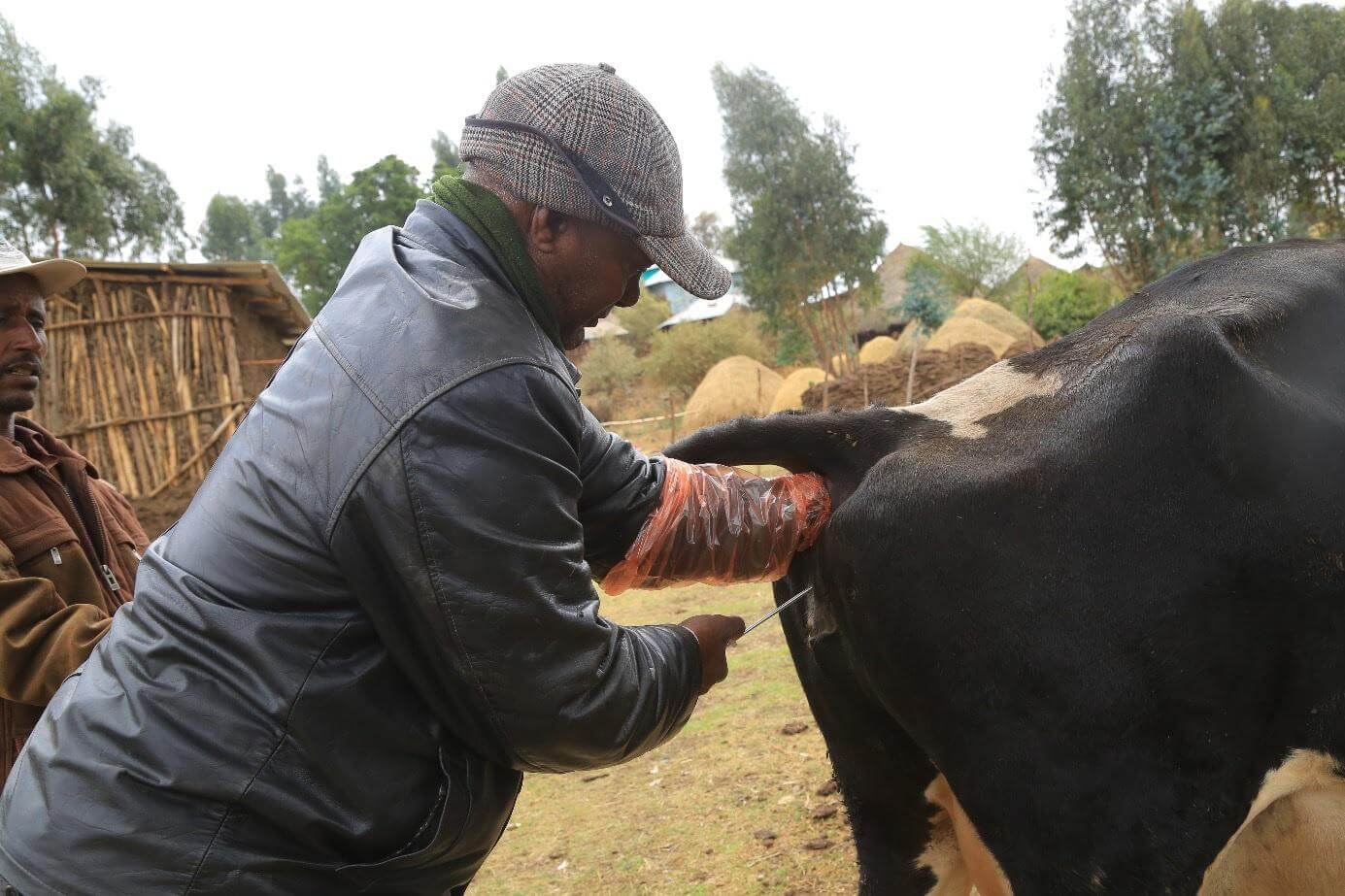
FAO statistics show that about 100 million cattle, 40 million pigs, 3.3 million sheep and 0.5 million goats are bred by artificial insemination, annually across the globe.
Zambia’s National Biotechnology and Biosafety Policy and the Biosafety Act of 2007 acknowledges that biotechnology and its products have the potential to contribute significantly to the economic development of Zambia, especially in areas of agriculture, health and industry.
Earlier this year, the Zambian government through the National Biosafety Authority issued three licenses to companies for the importation of GMO foodstuffs into the country; reform in the livestock sector might be next.
Richard Wetaya is an award-winning Ugandan freelance Journalist who contributes regularly to the New Vision-Uganda’s leading daily and the Alliance for Science. Follow him at @Masaabachronicle.com or on Twitter @rwetaya