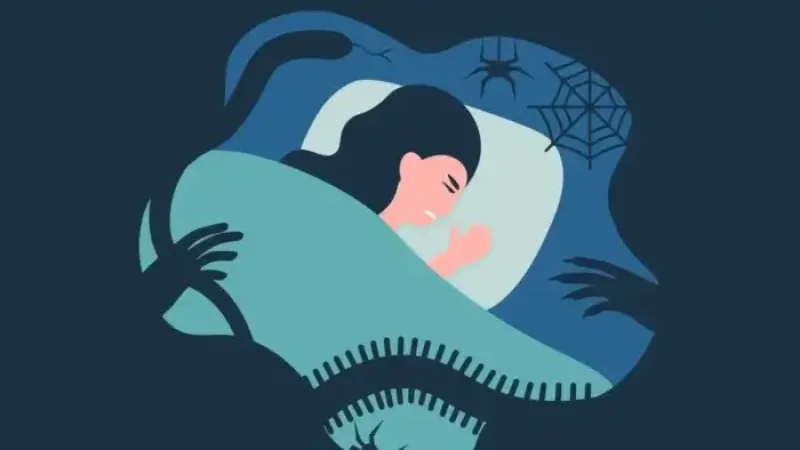
Fever dreams are part of our shared human experience, but elude scientific explanation

fever drean
Credit: Mental Floss

Fever dreams are difficult to study. (You can’t easily visit a sleep lab when you have the flu, after all.) But in 2020, dream researchers Michael Schredl of Heidelberg University in Germany and Daniel Erlacher of the University of Bern in Switzerland surveyed 164 people. They found that fever dreams live up to their reputation for being beyond weird, but they and included more negative and fewer positive emotions than other dreams.

“Normal” dreams often feature interactions with people, while in fever dreams, people appear less often. Unsurprisingly, fever dreams are also more likely to feature health-related topics and a keen awareness of temperature.

Mis- and disinformation are distorting science and public policy. Subscribe to our Daily and Weekly Digests for incisive coverage of ‘disruptive’ innovations in AI, agricultural biotechnology, food, chemicals, nuclear energy, vaccines, and other disruptive innovations.

Being chased by a giant ball of lava may seem a little extreme but other research has shown that dreams often incorporate bits and pieces of the waking experience. They call this the continuity hypothesis. So, if you’re burning with fever, dreaming of a lava ball is keeping with the concerns of your waking life.


Schredl and Erlacher also raise the possibility that the cognitive impairment brought on by fever might contribute to the strangeness of dreams. “The basic idea is that the ‘over-heated’ brain is not functioning properly and therefore dreams are more bizarre,” they write, pointing to previous research by Schredl showing that the severity of psychotic symptoms in schizophrenic patients during the day is relative to the degree of weirdness of their dreams at night.


This is an excerpt. Read the full article here

Related Articles

Infographic: Global regulatory and health research agencies on whether glyphosate causes cancer

Infographic: Global regulatory and health research agencies on whether glyphosate causes cancer

Does glyphosate—the world's most heavily-used herbicide—pose serious harm to humans? Is it carcinogenic? Those issues are of both legal and ...

Most Popular

Screenshot-2026-09-16-at-2.26.42-PM
Viewpoint: How to ecologically damage America’s forests: Ban glyphosate
Screenshot-2026-09-20-at-9.03.54-AM
From Malaysia to the world: A pioneering science communicator reimagines global science communication for a digital age
ChatGPT-Image-Mar-10-2026-01_39_01-PM
Viewpoint—“Miracle molecule” debunked: Why acemannan supplements don’t work
ChatGPT-Image-Sep-17-2026-12_28_43-PM
Vitamin D, omega-3 fish oil and glucosamine supplements could cause brain damage 
Screenshot-2026-09-20-at-4.31.28-PM
White House drafting executive order to control what OMB Director Vought claims are “woke” NIH science grants
ChatGPT-Image-Sep-20-2026-04_22_32-PM
What’s Trump’s ‘AI Force’? Administration rushes to announce ill-defined watchdog agency and czar amid criticism of its resistance to curb AI acceleration
Screenshot-2026-08-12-at-11.31.46-AM
AI is helping develop new vaccines
Screenshot-2026-09-14-at-4.31.14-PM
Viewpoint: What’s the likely impact when the EPA loosens rules limiting methane pollution from oil and gas wells?
Screenshot-2026-08-19-at-6.19.42-PM
Facts & Fallacies podcast: 'Regenerative farming'? RFK Jr.’s federal push romanticizes the past and risks food security
ChatGPT-Image-Sep-18-2026-10_49_24-AM
‘Symptom borrowing’: Young people are copying health problems they see on TikTok
ChatGPT-Image-Aug-28-2026-03_33_46-PM
Viewpoint: Bad science—Five bogus Trump administration claims about vaccines and autism
ChatGPT-Image-Sep-11-2026-01_53_42-PM
Should doctors engage in social media to counter misinformation?
ChatGPT-Image-Sep-9-2026-02_48_24-PM
Viewpoint: Trump-RFK Jr. report on “Gender Ideology & Left-wing Ideology’ targets LGBTQ community—and science
glp menu logo outlined

Get news on human & agricultural genetics and biotechnology delivered to your inbox.