
‘Apex predators’: For 2.5 million years, early humans stood atop the food chain, eating mostly meat

Homo Sapiens were the apex predators as indicated by their diet of primarily meat
Credit: Zdenek Burian

Paleolithic cuisine was anything but lean and green, according to a study on the diets of our Pleistocene ancestors.

For a good 2 million years, Homo sapiens and their ancestors ditched the salad and dined heavily on meat, putting them at the top of the food chain.

Follow the latest news and policy debates on sustainable agriculture, biomedicine, and other ‘disruptive’ innovations. Subscribe to our newsletter.

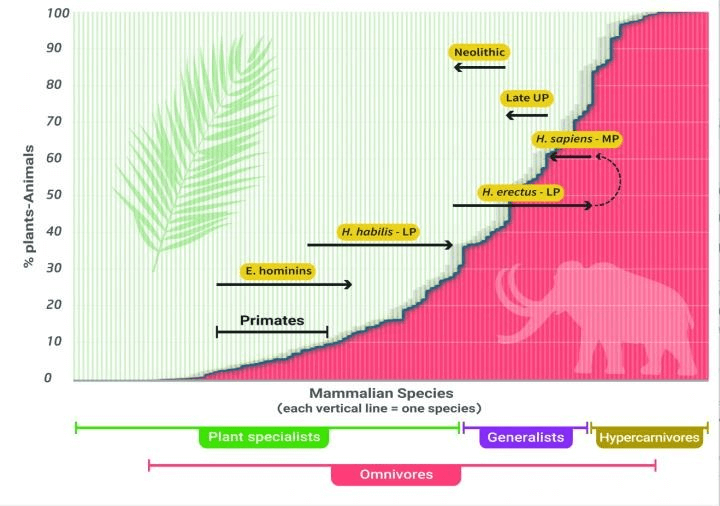
A look through hundreds of previous studies – on everything from modern human anatomy and physiology to measures of the isotopes inside ancient human bones and teeth – suggests we were primarily apex predators until roughly 12,000 years ago.

[C]ompared with other primates, our bodies need more energy per unit of body mass. Especially when it comes to our energy-hungry brains. Our social time, such as when it comes to raising children, also limits the amount of time we can spend looking for food.



We have higher fat reserves, and can make use of them by rapidly turning fats into ketones when the need arises. Unlike other omnivores, where fat cells are few but large, ours are small and numerous, echoing those of a predator.

Our digestive systems are also suspiciously like that of animals higher up the food chain. Having unusually strong stomach acid is just the thing we might need for breaking down proteins and killing harmful bacteria you’d expect to find on a week-old mammoth chop.

web

This is an excerpt. Read the full article here

{{ reviewsTotal }}{{ options.labels.singularReviewCountLabel }}
{{ reviewsTotal }}{{ options.labels.pluralReviewCountLabel }}
{{ options.labels.newReviewButton }}
{{ userData.canReview.message }}

Related Articles

Infographic: Global regulatory and health research agencies on whether glyphosate causes cancer

Infographic: Global regulatory and health research agencies on whether glyphosate causes cancer

Does glyphosate—the world's most heavily-used herbicide—pose serious harm to humans? Is it carcinogenic? Those issues are of both legal and ...

Most Popular

Screenshot-PM-24
Viewpoint: The herbicide glyphosate isn’t perfect. Banning it would be far worse.
d-b
Blocked arteries, kidney stones, nausea, constipation, fatigue: Long list of health problems caused by too much vitamin D 
Screenshot-2026-04-27-at-12.22.38-PM
Running ‘wild’: Last year, RFK, Jr. was given a green light to ‘reform’ chemical policies. Glyphosate illustrates how Trump now has him on a tight leash, and MAHA is furious
ChatGPT-Image-Apr-22-2026-11_06_18-AM
Wellness influencer nonsense: No, nicotine does not boost cognition and productivity, but it can damage your health 
bayer-supremecourt-lt
EPA concludes glyphosate is not carcinogenic. Missouri courts say Monsanto failed to warn it might be. SCOTUS weighs in.
ChatGPT-Image-Feb-16-2026-01_57_31-PM
Viewpoint: ‘Science-as-Satan’ unites the MAHA—MAGA movements. Is a breakup in the works?
Screenshot-2026-04-27-at-1.40.55-PM
With federal funding for scientific research already reeling, Trump fires the entire apolitical National Science Board
Screenshot-2026-04-13-at-3.54.04-PM
AI disinformation stress test: Challenges and response strategies
ChatGPT-Image-Feb-16-2026-01_04_32-PM
Raw milk myth wake-up call
Screenshot-2026-04-12-135256
Bixonimania: The fake disease scam that AI swallowed whole
glp menu logo outlined

Get news on human & agricultural genetics and biotechnology delivered to your inbox.