Viewpoint: Our personalities are genetically shaped but not hardwired

Genetics doesn't cement your personality traits.
Credit: Xcode Life

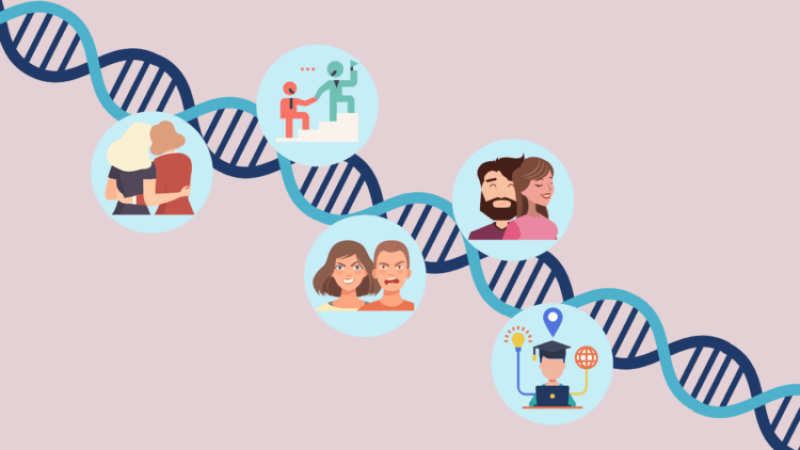
Unless people are identical twins, their genetic make-ups are slightly different; hence their organisms, including their brains, are somewhat different (even identical twins’ are, in fact). To thrive with the quirks of their organisms and brains, they often have to behave, think and feel differently. Hence, their personalities are slightly different.

The more people differ genetically, the more unique their organisms and brains are, and the more likely they are to rely on different patterns of behavior, thinking, and feeling to find the snuggest possible fits with the circumstances available to them.

Follow the latest news and policy debates on sustainable agriculture, biomedicine, and other ‘disruptive’ innovations. Subscribe to our newsletter.

It is not uncommon to assume this statistical trend to mean that there must be specific genes for certain traits, making us somehow hardwired for our traits. And of course many find this conclusion controversial.

But there is no evidence for any of this. For example, although people’s different extraversion levels are partly due to their genetic differences, we know of no genes specifically responsible for extraversion—or any other personality trait, for that matter. Likewise, it is common for people’s personality trait levels to change, either spontaneously, as a result of their experiences, or even because they deliberately want to change.

As a result, there is no direct link between genes and traits. Any trait level can correspond to innumerable gene combinations and the other way around: The same genetic background can lead to different levels of many traits.


This is an excerpt. Read the full article here

{{ reviewsTotal }}{{ options.labels.singularReviewCountLabel }}
{{ reviewsTotal }}{{ options.labels.pluralReviewCountLabel }}
{{ options.labels.newReviewButton }}
{{ userData.canReview.message }}

Related Articles

Infographic: Global regulatory and health research agencies on whether glyphosate causes cancer

Infographic: Global regulatory and health research agencies on whether glyphosate causes cancer

Does glyphosate—the world's most heavily-used herbicide—pose serious harm to humans? Is it carcinogenic? Those issues are of both legal and ...

Most Popular

Screenshot-2026-04-20-at-2.26.27-PM
Viewpoint — Food-fear world: The latest activist scientists campaign: Cancer-causing additives
Screenshot-2026-03-13-at-12.14.04-PM
The FDA wants to make many popular prescription drugs OTC—a great idea. Here’s why it’s unlikely to happen
Screenshot-2026-05-04-at-12.54.32-PM
How Utah became the country’s supplement capital  — and a haven for unregulated, ineffective and fake products
Screenshot-PM-24
Viewpoint: The herbicide glyphosate isn’t perfect. Banning it would be far worse.
Screenshot-2026-04-30-at-2.19.37-PM
5 myths about summer dehydration that could damage your health — or even kill you
Screenshot-2026-05-01-at-11.56.24-AM
‘Science moves forward when people are willing to think differently’: Memories of DNA maverick Craig Venter
Screenshot-2026-04-03-at-11.15.51-AM
Paraben panic: How a flawed study, media hype, and chemophobia convinced the public of the danger of one of the safest classes of preservatives
ChatGPT-Image-Mar-27-2026-11_27_05-AM
The myths of “process”: What science says about the “dangers’ of synthetic products and ultra-processed foods
ChatGPT-Image-May-1-2026-02_20_13-PM
How RFK, Jr.’s false vaccine claims are holding up $600 million to fight diseases in poor countries
glp menu logo outlined

Get news on human & agricultural genetics and biotechnology delivered to your inbox.