


The research answers fundamental questions about mechanisms that shape this defining human characteristic. The scientists suspect it could eventually lead to new ways to recover hair after balding and chemotherapy — or in people with disorders that cause hair loss.
The study goes on to show that nature has deployed the same strategy at least nine times in mammals that sit on different branches of the evolutionary tree. Ancestors of rhinos, naked mole rats, dolphins, and other hairless mammals stomped, scuttled, and swam along the same path to deactivate a common set of genes in order to shed their hair and fur.
“We have taken the creative approach of using biological diversity to learn about our own genetics,” says Nathan Clark, Ph.D., a human geneticist at U of U Health who carried out much of the research while at the University of Pittsburgh with Amanda Kowalczyk, Ph.D., and Maria Chikina, Ph.D. “This is helping us to pinpoint regions of our genome that contribute to something important to us.”
The benefits of being hairless
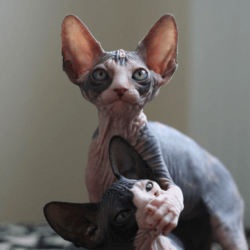
Whether talking about a monkey’s coarse body hair or a cat’s soft fur, hairiness looks different across the animal kingdom. The same goes for hairlessness. Humans have a characteristic tuft of hair on our heads, but because our body hair is less conspicuous, we fall into the “hairless” category. Joining us are other mammals with hints of hair like elephants with their sparse covering, sheer-coated pigs, and mustachioed walruses.
There are benefits to having a receding hairline. Without dense hair, elephants cool off more easily in hot climates and walruses glide effortlessly in the water. Despite the varied reasons, analysis by Kowalczyk found that these and the other hairless mammals analyzed have accumulated mutations in many of the same genes. These include genes that code for keratin and additional elements that build the hair shaft and facilitate hair growth.

Regulatory regions of the genome appear to be equally important, the research additionally showed. These regions don’t code for structures that make hair but rather influence the process indirectly. They guide when and where certain genes turn on and how much is made.
Further, the screen uncovered genes for which a role in sprouting hair had not yet been defined. Combined with additional evidence — such as signs of being active in the skin — these findings highlight a new set of genes that could be involved in growing hair.
“There are a good number of genes where we don’t know much about them,” Kowalczyk says. “We think they could have roles in hair growth and maintenance.”



Untangling hair loss
To detangle the mystery of mammalian hair loss, Clark, Kowalczyk, and Chikina searched for genes in hairless animals that evolved at faster rates compared to their counterparts in hairy animals.
“As animals are under evolutionary pressure to lose hair, the genes encoding hair become less important,” Clark says. “That’s why they speed up the rate of genetic changes that are permitted by natural selection. Some genetic changes might be responsible for loss of hair. Others could be collateral damage after hair stops growing.”
To perform the search, they developed computational methods that could compare hundreds of regions of the genome at once. They surveyed 19,149 genes and 343,598 regulatory regions that were conserved across the dozens of mammalian species analyzed. In the process, they took steps to discount genetic regions responsible for evolving other species-specific traits, such as adapting to aquatic life.
The fact that the unbiased screen identified known hair genes demonstrated that the approach worked, Clark explains. It also suggests that the genes identified in the screen that are less well-defined could be just as important for having hair — or not having it.
Clark and colleagues are now using the same approach to define genetic regions involved in preventing cancer, extending lifespan, and understanding other health conditions.
“This is a way to determine global genetic mechanisms underlying different characteristics,” Clark says.
The research was supported by the National Institutes of Health.




























