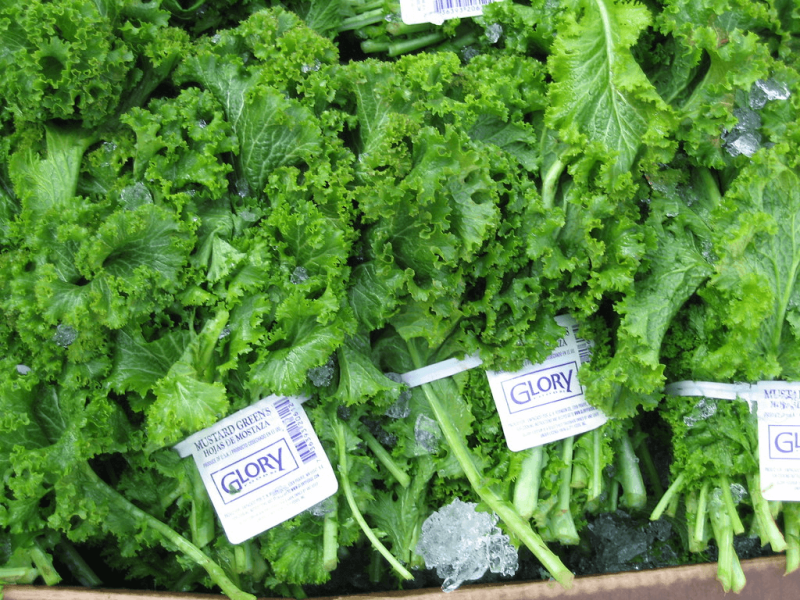
Mustard greens genetically tweaked to be less bitter will be the first CRISPR edited food available in the US when they reach supermarkets this summer

dd c b
Curly mustard greens. Credit: Glory Foods/Flickr (CC BY 2.0)

North Carolina–based Pairwise is rolling out a new type of mustard greens engineered to be less bitter than the original plant. The vegetable is the first Crispr-edited food to hit the US market.

Mustard greens are packed with vitamins and minerals but have a strong peppery flavor when eaten raw. … Pairwise wanted to retain the health benefits of mustard greens but make them tastier to the average shopper, so scientists at the company used the DNA-editing tool Crispr to remove a gene responsible for their pungency. The company hopes consumers will opt for its greens over less nutritious ones like iceberg and butter lettuce.

“We basically created a new category of salad,” says Tom Adams, cofounder and CEO of Pairwise. The greens will initially be available in select restaurants and other outlets in the Minneapolis–St. Paul region, St. Louis, and Springfield, Massachusetts. The company plans to start stocking the greens in grocery stores this summer, likely in the Pacific Northwest first.

Follow the latest news and policy debates on sustainable agriculture, biomedicine, and other ‘disruptive’ innovations. Subscribe to our newsletter.

Beyond mustard greens, the company is also trying to improve fruits. It’s using Crispr to develop seedless blackberries and pitless cherries. … [T]he new mustard greens aren’t a genetically modified organism, or GMO. … Crispr involves tweaking an organism’s own genes; no foreign DNA is added.


This is an excerpt. Read the original post here

{{ reviewsTotal }}{{ options.labels.singularReviewCountLabel }}
{{ reviewsTotal }}{{ options.labels.pluralReviewCountLabel }}
{{ options.labels.newReviewButton }}
{{ userData.canReview.message }}

Related Articles

Infographic: Global regulatory and health research agencies on whether glyphosate causes cancer

Infographic: Global regulatory and health research agencies on whether glyphosate causes cancer

Does glyphosate—the world's most heavily-used herbicide—pose serious harm to humans? Is it carcinogenic? Those issues are of both legal and ...

Most Popular

ChatGPT-Image-Jun-25-2026-12_23_17-PM
No, Bill Gates did not secretly engineer ticks to promote veganism
ChatGPT-Image-Jun-23-2026-03_12_23-PM
Is cellular reprogramming junk science? Nearly 20 patients are getting eye injections in the first FDA-cleared cellular trial
ChatGPT-Image-Jun-24-2026-11_36_47-AM
Why the human genome is less a script than a puzzle
Screenshot-2026-06-15-at-1.55.27-PM
America's trust in Trump-Kennedy's CDC health recommendations is plunging
ChatGPT-Image-Jun-17-2026-10_52_43-AM
Anguished parents, doctors in tears: Utah’s long measles outbreak takes a toll
Screenshot 2026-06-25 at 10.55
Leading OB-GYN group challenges RFK, Jr. gutting of maternal vaccine schedule
ChatGPT-Image-Mar-10-2026-01_39_01-PM
Viewpoint—“Miracle molecule” debunked: Why acemannan supplements don’t work
Screenshot-2026-06-22-at-9.04.46-PM
Kennedy's nutrition prescription for medical schools: Real problem, bad cure
Screenshot-2026-06-24-at-2.57.41-PM
Viewpoint: Trump’s Reflecting Pool algae fiasco points to a bigger culprit: Climate change
Screenshot-2026-06-25-at-1.48.40-PM
Glyphosate affirmed as safe: Supreme Court rejects lawsuit claiming Roundup herbicide causes cancer, upholding EPA determination
Screenshot-2026-06-24-at-2.40.46-PM
Hegseth reversal: As Air Force flu outbreak continues to surge, military reinstitutes mandatory vaccines for recruits

Sorry. No data so far.

glp menu logo outlined

Get news on human & agricultural genetics and biotechnology delivered to your inbox.