What kick-started the evolution of our complex human brains?

htchnmWhat kick-started the evolution of complex human brains?
Credit: Pixabay/ htchnm

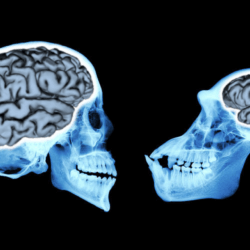
A chance rearrangement of the human genome over a million years ago probably kick-started the evolution of modern humans from our primate ancestors. A recent study explains why human DNA contains sections, many of which are involved in brain development, that are unique to us and are not shared with even our closest relatives, chimpanzees.

These stretches of human-specific DNA are called human accelerated regions (HARs). They were discovered almost 20 years ago by Dr Katie Pollard, now director of the Gladstone Institute of Data Science and Biotechnology, who led the new study to try to figure out where they came from.

Mis- and disinformation are distorting science and public policy. Subscribe to our Daily and Weekly Digests for incisive coverage of ‘disruptive’ innovations in AI, agricultural biotechnology, food, chemicals, nuclear energy, vaccines, and other disruptive innovations.

To find out which specific genes were being affected by the HARs, the team performed experiments in human and chimpanzee stem cells. As it turned out, many of the genes they identified are known to play a role in brain development. Exactly how this contributed to the evolution of the human brain is a question the team is keen to answer next.
The findings also chime with those of another recent study from the team. They reported that many of the early changes in HARs had opposing effects: an original mutation might have “turned up” associated gene activity too much, and so a further change would have been needed down the line to tweak this.


This is an excerpt. Read the full article here

Related Articles

Infographic: Global regulatory and health research agencies on whether glyphosate causes cancer

Infographic: Global regulatory and health research agencies on whether glyphosate causes cancer

Does glyphosate—the world's most heavily-used herbicide—pose serious harm to humans? Is it carcinogenic? Those issues are of both legal and ...

Most Popular

ChatGPT-Image-Sep-2-2026-02_03_32-PM
AI data centers and water usage: It’s a genuine and growing problem
ChatGPT-Image-Mar-10-2026-01_39_01-PM
Viewpoint—“Miracle molecule” debunked: Why acemannan supplements don’t work
ChatGPT-Image-Sep-16-2026-11_28_54-AM
Viewpoint: Study links childhood vaccination to autism!!! Here’s how anti-vaxxers twist evidence to corrupt science
Screenshot-2026-09-16-at-2.26.42-PM
Viewpoint: How to ecologically damage America’s forests: Ban glyphosate
Screenshot-2026-09-20-at-9.03.54-AM
From Malaysia to the world: A pioneering science communicator reimagines global science communication for a digital age
Screenshot-2026-09-18-at-11.35.25-AM
RFK Jr.’s latest crank obsession: Protecting Americans from perfectly safe electromagnetic radiation
ChatGPT-Image-Sep-21-2026-10_18_59-AM-2
Viewpoint: Is corporate embrace of regenerative agriculture greenwashing?
ChatGPT-Image-Sep-20-2026-09_47_55-AM
Trump says he’ll require drugmakers to end multiple vaccine doses, reviving discredited autism claims
Screenshot 2026-09-18 at 10.26
Slowdown AI development? China acknowledges serious risks but sees warnings as U.S. ploy to control the technology
ChatGPT-Image-Sep-17-2026-12_28_43-PM
Vitamin D, omega-3 fish oil and glucosamine supplements could cause brain damage 
ChatGPT-Image-Sep-18-2026-10_49_24-AM
‘Symptom borrowing’: Young people are copying health problems they see on TikTok
Screenshot-2026-09-20-at-4.31.28-PM
White House drafting executive order to control what OMB Director Vought claims are “woke” NIH science grants
glp menu logo outlined

Get news on human & agricultural genetics and biotechnology delivered to your inbox.