The signaling pathways of both embryonic development and regeneration are common to many animal species, and are therefore ancient. The genes in control have intriguing names: Grainy Head, Notch, Wingless, Sonic Hedgehog, and even Hippo.
I remember reading about elegant experiments that moved the cells at the interface of an amputation in a model organism, such as the cockroach poster-child for regeneration. When a researcher rotated the cells at a cut site, a turned-around limb unfurled.
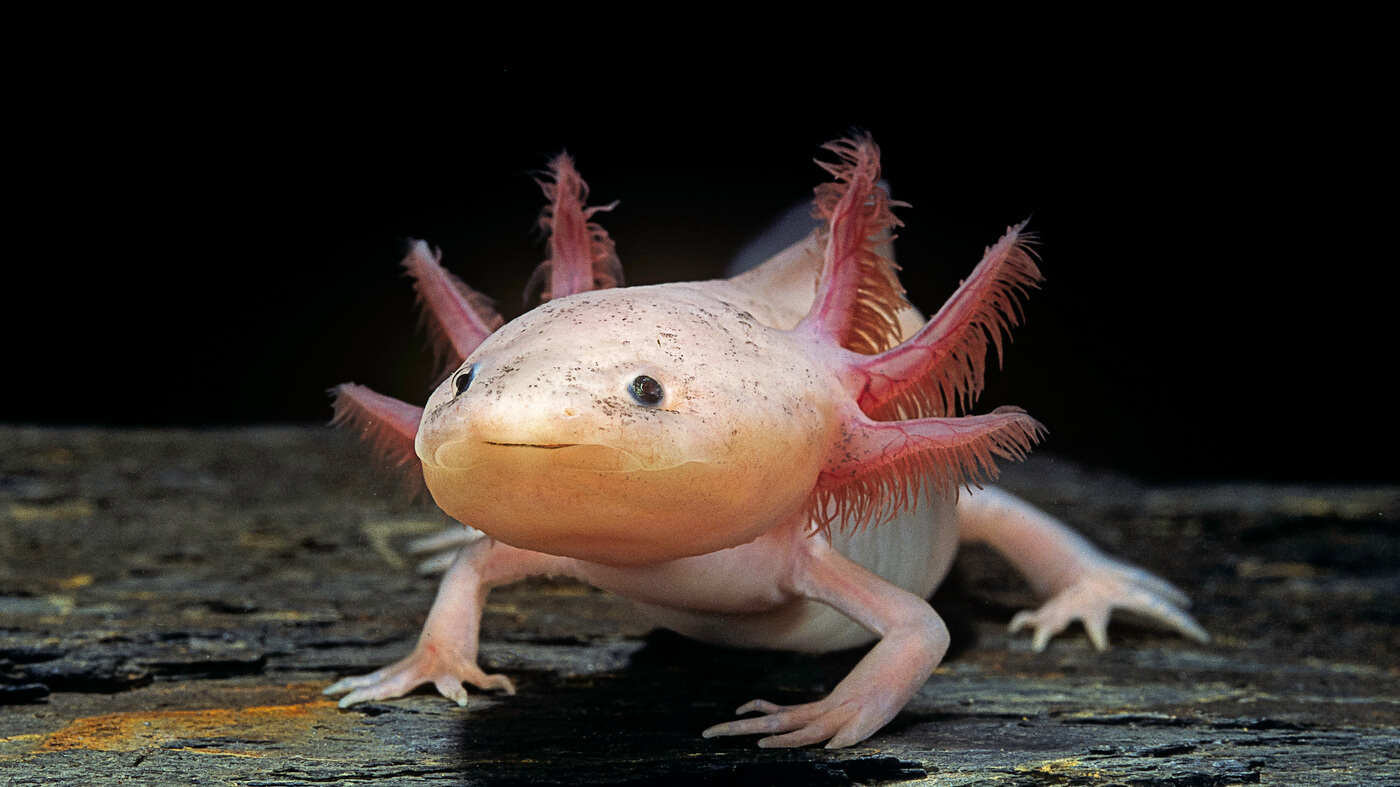
Salamanders can regenerate limbs too. Back in graduate school in Thom Kaufman’s lab at Indiana University, we had two pet Mexican axolotls from the developmental biology group upstairs. Sally and Gerry Mander lived in a large rectangular tank above the vials of fruit flies, happily swimming, as amphibians do. And if a bit of a leg broke off from crashing into the side, the salamander could regrow it.
Of course humans can’t regenerate missing limbs, or even toes. Our closest relatives that can are lizards (reptiles, not amphibians).
In a new report in Nature Communications, researchers from the Keck School of Medicine of USC and the University of Pittsburgh describe teaming the gene-editing tool CRISPR with neural stem cells to enable mourning geckos to regrow functional tails. Without the intervention, the lizards regrow tails that are bands of soft cartilage, good for little more than balance. A working tail is built of a distinctive top and bottom that spatially distributes nervous and muscle tissue in a pattern that enables the animal to move. The research has implications for regenerative medicine.
Signals sculpt a gecko’s tail
Growing a tail is complicated, and embryos are the experts.
Undulating levels of biochemical signals bathe the dividing cells of early embryos of any species. This highly regulated brew turns specific genes on and off in ways that direct the emergence of tissues that then interact and fold into organs.
In an animal species that has an amniote egg (surrounded by air, fluid, and membranes), the embryo’s tail develops from a bump called a tail bud. The cells then sort themselves into a top (dorsal) layer of roof plates and a bottom (ventral) layer of floor plates.
That’s what happens in an embryo as the choreography of development unfolds. But replacing a body part after injury to an adult isn’t the same as the origin of the corresponding part in an embryo. And so an injured lizard can regrow something from an amputated tail, but it’s not the real deal. Instead, it’s a tube of cartilage that doesn’t do much. (Imagine replacing a dog’s wagging tail with a static cardboard tube.) The adult lizard’s replacement tail lacks the nuances that distinguish top from bottom, what developmental biologists call dorsoventral patterning. (“Dorso” refers to the back and “ventral” to the belly portion of a structure.)

The wounded lizard makes a cartilage tail because it inappropriately activates Sonic Hedgehog signaling. In the embryo, this signaling normally fades and that triggers harder bone to replace the bendy tail cartilage. At the same time, the stem cells that occupy the neural tube that forms along the embryo’s back divide and specialize, giving rise to the nerve cells of the spinal cord and dorsal root ganglia. A few stem cells remain in the adult, clinging to the interior of the spinal cord.
What would happen, the researchers wondered, if they blocked Sonic Hedgehog signaling in adult geckos with shortened tails? Would the stem cells step in to regenerate appendages that could enable movement, and not just offer the balance that a cartilage tail provides?
CRISPRing hedgehog
In the experiments, the researchers isolated neural stem cells from lizard embryos, used CRISPR/Cas9 gene editing to knock out the ability of the cells to respond to Sonic Hedgehog signaling. They then injected the disarmed stem cells into the spinal cords of adults that had their tails cut off.
The introduced cells indeed glommed onto the forming cartilage tail tubes and instead oversaw establishment of the dorsal-ventral, aka top-bottom, distinction that enabled the animals to regenerate complete and functioning tails – not the placeholders. The new and improved lizard tails have bone and nerve tissue on the upper or dorsal side, and cartilage on the lower or ventral side.
Said co-author Thomas Lozito, an assistant professor of orthopedic surgery and stem cell biology and regenerative medicine at the Keck School of Medicine,
This is one of the only cases where the regeneration of an appendage has been significantly improved through stem cell-based therapy in any reptile, bird or mammal, and it informs efforts to improve wound healing in humans. Perfecting the imperfect regenerated lizard tail provides us with a blueprint for improving healing in wounds that don’t naturally regenerate, such as severed human limbs and spinal cords. In this way, we hope our lizard research will lead to medical breakthroughs for treating hard-to-heal injuries.
Ricki Lewis has a PhD in genetics and is a science writer and author of several human genetics books. She is an adjunct professor for the Alden March Bioethics Institute at Albany Medical College. Follow her at her website or Twitter @rickilewis
A version of this article was originally posted at PLOS and has been reposted here with permission. PLOS can be found on Twitter @PLOS
This article previously appeared on the GLP December 14, 2021.