98% of Chinese consumers are willing to eat more plant-based foods. What’s holding them back?

Credit: T Chu via CC-BY-2.0

New research shows that health is the priority for Chinese consumers when it comes to plant-based food โ€“ and the more they know about the benefits, the more theyโ€™ll eat it.

When you inform people in China about the benefits of a vegan diet, nearly all of them (98%) would be willing to eat more plant-based foods, according to a new survey.

Follow the latest news and policy debates on sustainable agriculture, biomedicine, and other ‘disruptive’ innovations. Subscribe to our newsletter.

The results are from aย pollย carried out by Kantar for ProVeg International, covering 1,000 consumers from Beijing, Shanghai and Guangzhou. It found that nearly a third (32%) of Chinese people identify as flexitarians, though the incidence of vegetarianism (1.5%) and veganism (0.9%) is low.

They were presented with 15 benefit statements about plant-based foods, 14 of which were based on peer-reviewed research. These included preventing or lowering the risk of type 2 diabetes, breast cancer, and antibiotic resistance; lowering body mass index (BMI); cutting greenhouse gas emissions; reducing global hunger; and being a source of delicious and satisfying meals.

This reflects the emphasis Chinese consumers put on health over the environment. Overall, the main reasons for consuming plant-based food were health (46%), nutrition (39%) and food safety (35%). Only 24% are motivated by the fact that they are climate-friendly.

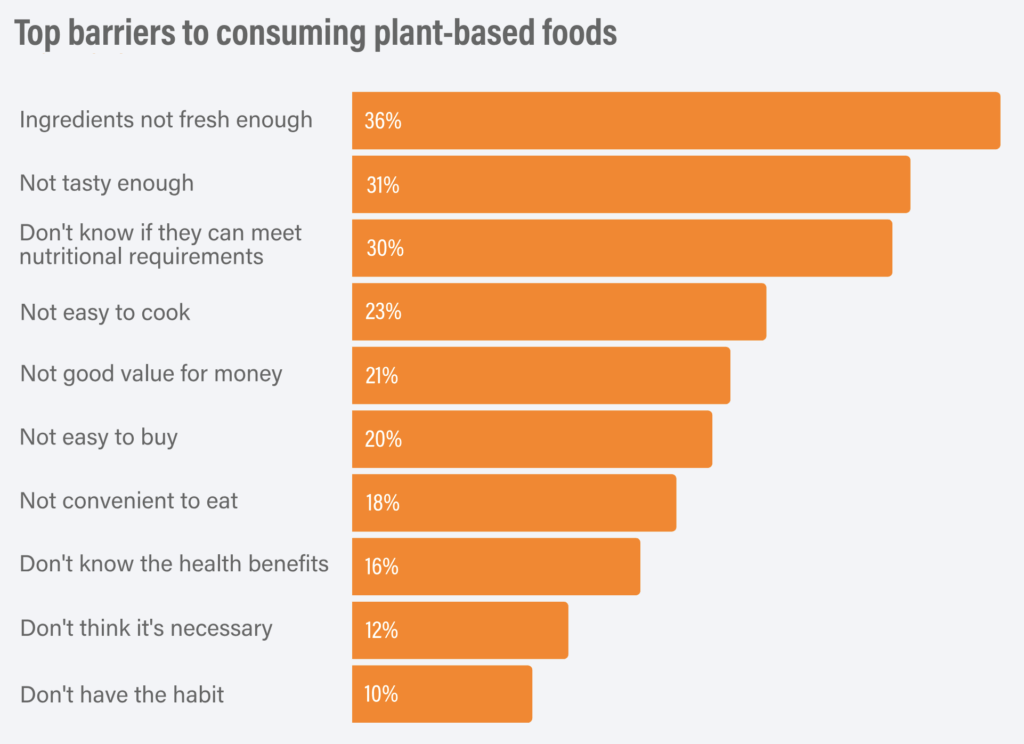
[T]he biggest barriers are dissatisfaction with the freshness of ingredients (cited by 36%) and the taste (31%), and uncertainty about the nutritional completeness (30%).

There are several things industry players can do to help nudge more plant-based consumption. Social media was found to be the most effective marketing tool, while a focus on nutritional transparency and lower price points will go a long way too.

This is an excerpt. Read the original post here

{{ reviewsTotal }}{{ options.labels.singularReviewCountLabel }}
{{ reviewsTotal }}{{ options.labels.pluralReviewCountLabel }}
{{ options.labels.newReviewButton }}
{{ userData.canReview.message }}

Related Articles

Infographic: Global regulatory and health research agencies on whether glyphosate causes cancer

Infographic: Global regulatory and health research agencies on whether glyphosate causes cancer

Does glyphosateโ€”the world's most heavily-used herbicideโ€”pose serious harm to humans? Is it carcinogenic? Those issues are of both legal and ...

Most Popular

ChatGPT-Image-Mar-10-2026-01_39_01-PM
Viewpointโ€”โ€œMiracle moleculeโ€ debunked: Why acemannan supplements donโ€™t work
Screenshot 2025-07-30 at 10.48
Can gene editing eliminate Down syndrome? Scientists have done it in lab-grown cells
Screenshot 2026-05-26 at 10.15
Viewpoint: Double standardโ€”Why does the wellness industry get a free pass while Big Healthcare is treated as morally suspect?
ChatGPT-Image-Jun-4-2026-01_27_58-PM
Viewpointโ€”N.A.D.+: Why Gwenyth Paltrowโ€™s heralded anti-aging supplement doesnโ€™t work
tick-DNA
GLP podcast: Spread meat allergy with gene-edited ticks? Bioethicists pose vile โ€˜thought experimentโ€™
ChatGPT-Image-May-26-2026-07_51_21-AM-2
Viewpoint: There are more than 1,000 chemicals in a cup of coffeeโ€”including many substances that can cause cancer. Why isnโ€™t it banned?
downsyndrome_compilation_MID_1
CRISPR breakthrough that can remove the chromosome responsible for Down syndrome raises ethical questions

Sorry. No data so far.

glp menu logo outlined

Get news on human & agricultural genetics and biotechnology delivered to your inbox.