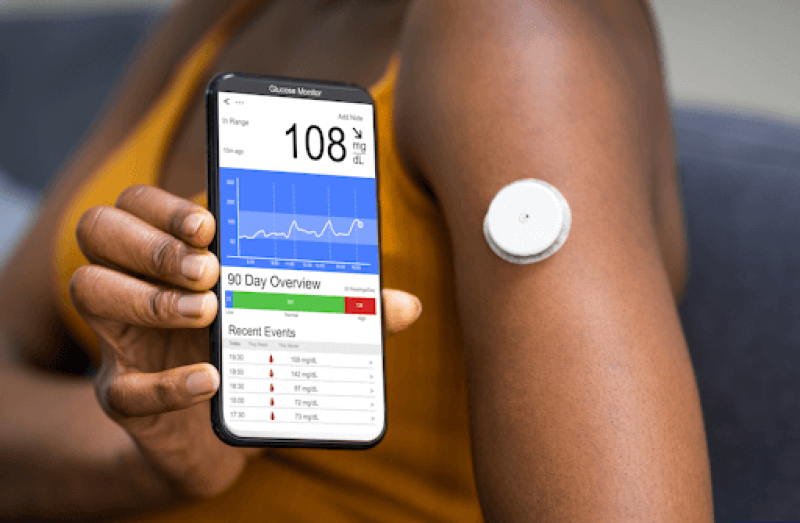
Blood sugar monitors (aka continuous glucose monitors or CGMs) have been ubiquitous for people with diabetes. But now they are a fad for elite athletes and even some weekend warriors without the disease. Endurance athletes in particular have been quick to adopt this new technology to improve training and racing performance. They monitor their glucose levels with a small sensor attached to the arm or belly.
They are now widely used for training and are ubiquitous in triathlon competitions. But in 2021, cycling’s international governing body, the UCI, banned their use during competition. This ban includes, at a minimum, glucose and lactate measurement. Meanwhile, athletes in other sports are experimenting.
The fad has also crossed over to healthy people without diabetes. Fitness enthusiasts have been using smart wearables for years to track a variety of parameters such as sleep, heart rate, stress levels, and step count over the day. According to the companies that are pitching the gadget to workout enthusiasts, CGMs add another dimension, a way to improve metabolic health by optimizing blood glucose levels. Their pitch is that, even in the absence of diabetes, minimizing blood glucose spikes could prevent diabetes or other diseases.
Do CGMs work? Are they safe?
If you suffer from diabetes it’s often difficult to know the cause. Both Type 1 and Type 2 diabetes are linked in part to genetics, although the family connections are murkier in Type 1. In people with diabetes, after eating, their blood sugar, also known as blood glucose, can shoot up. That could cause organ damage if not contained.
In type 1 diabetes the immune system attacks the beta cell that produces insulin in your pancreas. The attack causes permanent damage and leaves your pancreas unable to produce insulin. Unless sufferers have access to insulin pumps and wearable devices that automatically deliver insulin, they need to inject themselves with insulin a couple of times every day.
For many, that requires pricking their finger to evaluate blood glucose levels to avoid injecting insulin when not needed. “I used to prick my fingers a couple of times a day and it was very painful,“ said Siddharth Kankaria, a science communicator who lives with type 1 diabetes.
There are multiple problems with that kind of test. Sufferers like Kankaria could only measure glucose levels up to four times a day. Plus, most monitors impose a ‘one-size-fits-all” standard. However, research has shown that two healthy people can have different responses to the same food; for example, one person’s blood sugar might spike and dip more after eating carbohydrates than another person’s.
Because of these complications, Kankaria has recently started wearing a CGM patch that connects to his phone, so he can track his glucose levels throughout the day.
Are there benefits for individuals with type 1 diabetes?
People with type 1 diabetes need to make dozens of decisions every day to keep their blood glucose in check: what to eat and when, the carbohydrate content of their meals, when to take insulin, whether and how to exercise, and so on. CGMs can reduce the cognitive load for some of these decisions.
Advocates say they are also life-saving devices. If people with diabetes take insulin when their blood glucose level is already low, it can fall below what is healthy for them. These episodes of hypoglycemia (or low blood glucose) can cause drowsiness, anxiety, increased heart rate, and even death in extreme cases. People with diabetes can have multiple episodes per week.
Over time, repeat episodes impair awareness of early symptoms, increasing the risk of severe episodes. A PLOS One study on South Indian patients noted that 44 of 73 patients were unaware of their hypoglycemia.
In the absence of early symptoms, there is some evidence that CGMs can prevent low blood sugar episodes. Conversely, not taking sufficient insulin or eating carb-heavy foods can cause hyperglycemia. While blood sugar levels quickly revert to normal in healthy individuals, they may stay outside the healthy range for a prolonged time in people with type 1 diabetes.
“I use the CGM to check if I have hypoglycemia,” said Kankaria. “I can see it going down in real-time and intervene before the blood glucose level is too low. With a CGM, I can figure out how my body is reacting to different kinds of food, environments, and stimuli.”
Some experts are skeptical of the utility of CGMs
That’s debatable. The use of glucose monitors for those with the disease remains controversial in some medical circles. Hyperglycemia (or high blood glucose) is a symptom of diabetes, not its cause. CGMs also do not measure glucose levels in the blood but in the interstitial fluid surrounding cells. Changes in blood glucose levels reflect changes in interstitial glucose levels after 5-20 minutes. In other words, if a CGM shows higher or lower than normal glucose levels, that’s likely old news. This lag is more pronounced when blood glucose levels change rapidly, such as immediately after large meals or during exercise.




CGM readings can be inaccurate for a variety of other reasons. For example, sleeping on the arm where the sensor is can cause pressure-induced errors, producing false lows. Conversely, drugs like acetaminophen (Tylenol) that cause chemical interference in the interstitial fluid can produce false highs.
These monitors often tell what we already know or do not need to know, some experts say. Digestion breaks down carbohydrates in the food into glucose and other sugars, causing a spike in blood sugar levels in all of us. In response, the body produces insulin which usually brings the glucose levels down to pre-meal levels within two hours. In other words,
Glucose levels straying outside what is considered the normal range for a healthy individual is physiologically typical. In any case, when it occurs it’s for brief periods. In a study published in The Journal of Clinical Endocrinology & Metabolism, researchers found that the blood glucose levels for healthy individuals were normal 96% of the time.
In some people with type 1 diabetes, the anxiety of hypoglycemic episodes can cause excessive focus on correcting glucose levels. This can sometimes lead to orthorexia nervosa, an unhealthy fixation with healthy eating. Almas Fatma, a Mumbai-based diabetologist, added that non-diabetic individuals can also develop orthorexia nervosa if they let glucose readings to obsessively monitor their diet. In one case, a patient avoided all food that would cause even minor spikes in their CGM reading. It grew to a point where this individual ate only salads. “Over time, the restrictive diet led to multiple nutritional deficiencies and a significant loss of muscle mass,” said Fatma.
Use in sports?
Their use by those without diabetes crosses a line for many medical practitioners.
“There is a lack of clinical evidence to support the use of CGM in healthy individuals, Fatima warned. Companies selling CGMs to healthy people are pathologizing clinically insignificant fluctuations. With constant access to blood glucose levels, “even healthy people can get fixated on minor fluctuations and readings and it can have a negative impact on their mental health and quality of life”, she said.
Another example. While weight management is a common fitness goal, obsessing over glucose spikes can ironically impede it. If a user takes corrective steps every time CGM says their glucose is approaching lower or higher than the normal range, they might end up eating more or less than they need to.
Many other health officials agree that the benefits do not clearly outweigh the potential downside. “There is no strong evidence the gadgets help people without the condition,” UK National Health Service diabetes advisor Prof Partha Kar recently said.
Athletes?
But an increasing number of elite athletes and their coaches swear by them. “Having insight into the body’s individual response to carbohydrate and protein intake while racing will help you minimize unneeded fueling and excessive exposure to sugars,” said Suzanne Atkinson, an emergency medicine physician and elite-level triathlon coach.
Supporters maintain that CGMs can tell athletes what carbs they should eat to optimally refuel glycogen reserves. Additionally, pro athletes need to maintain their weight in a narrow range. A persistently low glucose level could hint at insufficient calorie intake before it’s evident as weight loss.
However, just like those with type 1 diabetes, elite athletes who use CGMs are best monitored by physicians, who can contextualize their data. In the absence of this important distinction, CGM use among non-diabetic fitness enthusiasts could cause mental and physical harm that supersedes any potential benefits. In sum, people with type 1 diabetes, episodes of hypoglycemia or hyperglycemia can be a matter of life and death and, understandably, cause significant mental distress. For those individuals, CGM provides one more information resource.
But for non-diabetic users, the measurements from a CGM, more so if they are tracking other vitals, can cause an information overload. Some healthy people using CGMs worry unnecessarily about minor glucose spikes, even if it’s after eating a healthy meal. The use of CGM among healthy people can cause harm if a user tries to obsessively keep the glucose levels in the “healthy” range.
Sachin Rawat is a freelance science and tech writer based in Bangalore. He holds a master’s degree in biotechnology. Follow him on Twitter at @sachinxr.