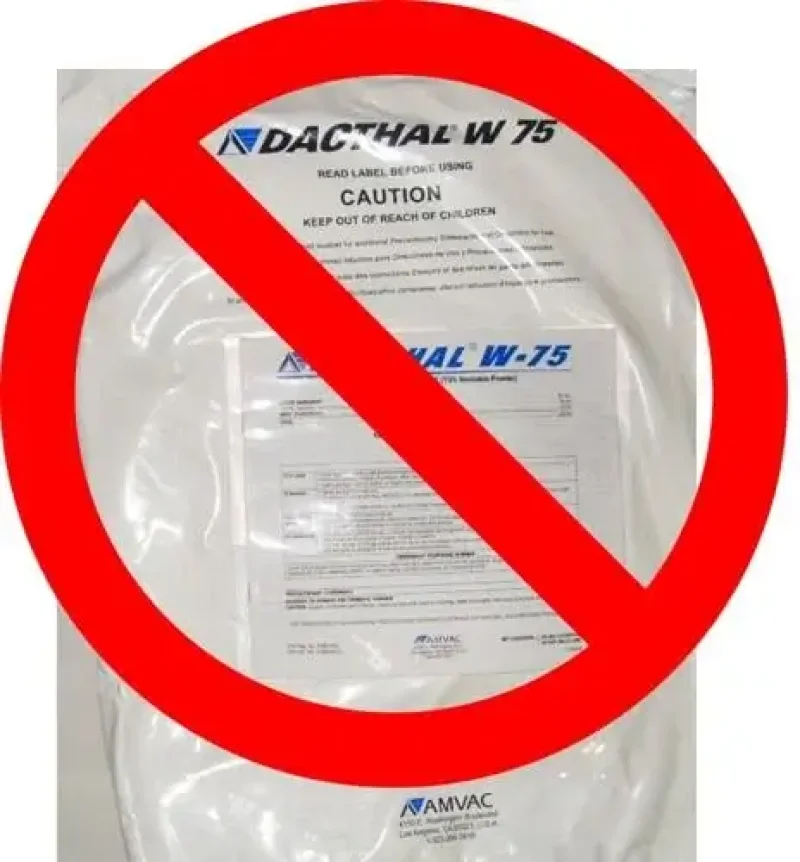
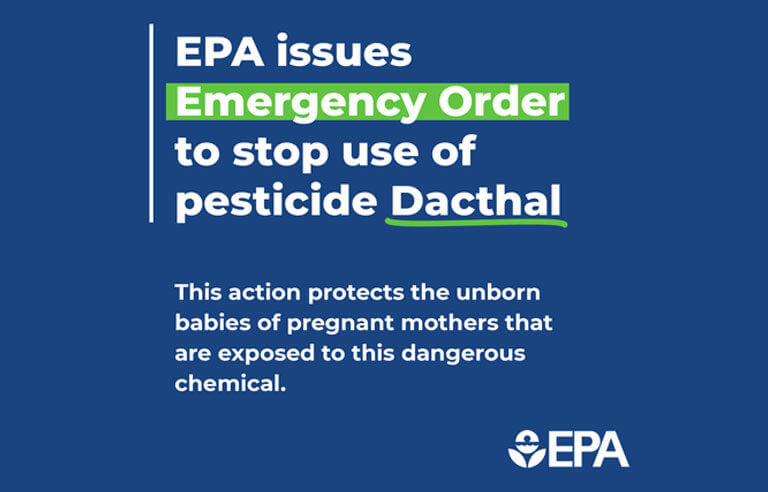
Last month, the EPA issued an emergency suspension of the herbicide Dacthal and has initiated a process to cancel all products containing the chemical after public. This is the first emergency suspension the agency has issued in more than 40 years. The last time the EPA issued an emergency suspension of a pesticide was in 1983 when they suspended the use of ethylene dibromide (EDB) not long after they’d suspended the herbicide 2,4,5-T — the half of the Agent Orange herbicide cocktail that was highly toxic to humans — in 1979.
Does this aggressive emergency suspension indicate a change in policy direction for the EPA?
History of Dachtal
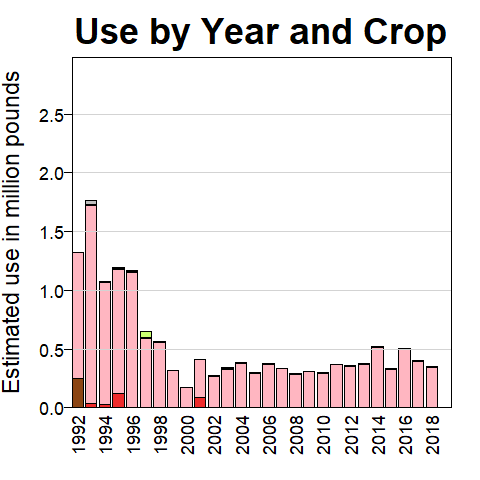
Dacthal, or DCPA is a pre-emergent weedkiller, meaning it prevents germinated weed seedlings from becoming established in farms and non-agricultural settings. Its use was sharply curtained in the 1990s. It is confined mostly to patches in California, Washington, Arizona, Texas and Wisconsin where it’s used on increasingly small plots of vegetable crops such as cauliflower, broccoli, cabbage, and onions. According to Delaware Health and Services, while dacthal is thought to have few health effects, its dioxin ingredients can be harmful.
The EPA found credible evidence that it poses a risk to pregnant women and their fetuses who could experience changes to fetal thyroid hormone levels. Those changes are associated with low birth weight, impaired brain development, decreased IQ, and impaired motor skills later in life, some of which may be irreversible. Primarily at risk are farmworkers, especially pregnant farmworkers, and those living in the vicinity of treated fields.
“DCPA is so dangerous that it needs to be removed from the market immediately,” said Assistant Administrator for the Office of Chemical Safety and Pollution Prevention Michal Freedhoff. “It’s EPA’s job to protect people from exposure to dangerous chemicals. In this case, pregnant women who may never even know they were exposed could give birth to babies that experience irreversible lifelong health problems. That’s why for the first time in almost 40 years, EPA is using its emergency suspension authority to stop the use of a pesticide.”
Despite the known dangers of this agrochemical, this action has been too long in coming. Most industrial chemicals that made their way into the food system during the post-WWII war years — mostly food colorings and pesticides such as Agent Orange — were winnowed out by the newly created EPA during the 1970’s and early 80’s. Somehow, DCPA survived that scrutiny. It wasn’t until the 1990s that the EPA identified the herbicide as potentially causing harm to the thyroid. Many farmers got the message when research started to emerge that it posed risks and began phasing it out. That’s why this current ban affects so few farms. (see map below)

Stonewalling the EPA
The EPA has been politely asking for research and safety evaluations from its manufacturer, AMVAC since 2013 during the Obama Administration. The company successfully stonewalled the accessing of company documents. The Biden Administration finally served AMVAC with a Notice of Intent to Suspend DCPA in 2022, requesting the company’s studies on the chemical. Following an analysis of a thyroid study submitted by AMVAC. in May 2023, the EPA released its assessment on the risks of occupational and residential exposure to products containing the herbicide. Last December, AMVAC voluntarily suspended use of the herbicide on turf while trying to maintain the market for vegetable crops. That bid failed with the release of the EPA’s assessment in early August.
The assessment found health risks associated with DCPA use and application even when personal protective equipment and engineering controls are used. The most serious risks are to the unborn babies of pregnant women, who could be subjected to exposures four to 20 times greater than what EPA has estimated is safe for unborn babies. Such exposure is common in weeding and harvesting, although the chemical is almost solely applied before planting.
Current product labels specify that entry into treated fields must be restricted for 12 hours after application. However, the evidence indicates that for many crops and tasks, levels of DCPA in a treated field remain at unsafe levels for 25 days or more. Spray drift (the movement of pesticide through the air at the time of application or soon after, to any site other than the area intended) from pesticide application could also put at risk the unborn babies of pregnant women living near areas where DCPA is used.
The part of the underlying science that signaled the need to ban DCPA came from a paper produced in 2020 by what’s known as the CHAMACOS study. Based in Salinas, CA, the CHAMACOS study follows hundreds of farmworkers and relatives in various ways to detect exposure to pesticides in the farmworker’s community. The region is the hub of commercial produce farming in America. During the Obama administration, the EPA banned the insecticide chlorpyrifos, produced largely by Dow Chemical, due to neurological risks to the children of farm workers. It was a significant action. Chlorpyrifos produced by the industrial behemoth Dow Chemical was a hugely popular insecticide. Early in the Trump administration, the ban was reversed but then restored by the Biden administration.

EPA distinguishes between harmful vs. safe and effective crop chemicals
Here’s what’s interesting for people who follow the debates about the role of biotechnology and chemistry in agriculture: Despite the messaging from large and loud corners of the environmental movement, the EPA has indicated it will ban pesticides when there is evidence of real risk — if given the political leeway to act independently — but it won’t act irrationally just to satisfy the claims by anti-chemical activists which fund-raise by scaring people about the US’s ‘chemical soaked” food supply.
Noisy voices are insinuating that the EPA should but won’t ban herbicides like atrazine, chlormequat, or glyphosate; the fact is when there is solid evidence it will move to take dangerous chemicals off the market, but it won’t knee-jerk react to pressure from activist groups if science does not support their campaigns.
The most controversial agricultural chemical is the weedkiller glyphosate. It commonly known as Roundup, is the most widely used herbicide globally, often targeted by groups exploiting public fears of chemicals. The controversy intensified when the World Health Organization’s International Agency for Research on Cancer (IARC) labeled glyphosate as a “probable carcinogen” in 2015. This designation was misleadingly interpreted by environmental groups and tort lawyers, fueling lawsuits against Monsanto, now part of Bayer, for allegedly causing non-Hodgkin’s lymphoma. The scientific term “probable carcinogen” refers to high exposure levels that could potentially cause cancer, not that glyphosate is causing cancer at typical exposure levels.

IARC put glyphosate in the same ‘harm’ category as working at a hairdresser or as a nightshift worker, drinking a hot beverage or eating meat — goodbye grilled steaks. To provide some context as to why every regulatory agency in the world ignores many of IARC’s monographs, it ranks eating bacon-and-egg sandwiches as more likely to cause cancer than glyphosate. Much worse: drinking wine and beer regularly or eating bacon (along with eating salted fish). They are all in the same “harmful” category as plutonium (along with tobacco and asbestos) under IARC’s bizarre rating system. In other words, IARC’s “probably carcinogenic” rating for glyphosate is entirely meaningless without addressing exposure: the dose makes the poison. In the case of glyphosate, exposure levels in our food are in the parts per billion or parts per trillion — meaningless amounts and certainly not cancer-causing.
Twenty independent international risk-evaluation agencies — including the EPA, Food Safety Commission of Japan, European Food Safety Authority, and multiple UN agencies including WHO — have assessed claims by environmental groups and tort lawyers that glyphosate microtraces in food pose a cancer risk. Not one agency — not even IARC — claims our food supply is at risk. [Click here for a downloadable .pdf version of this infographic.]
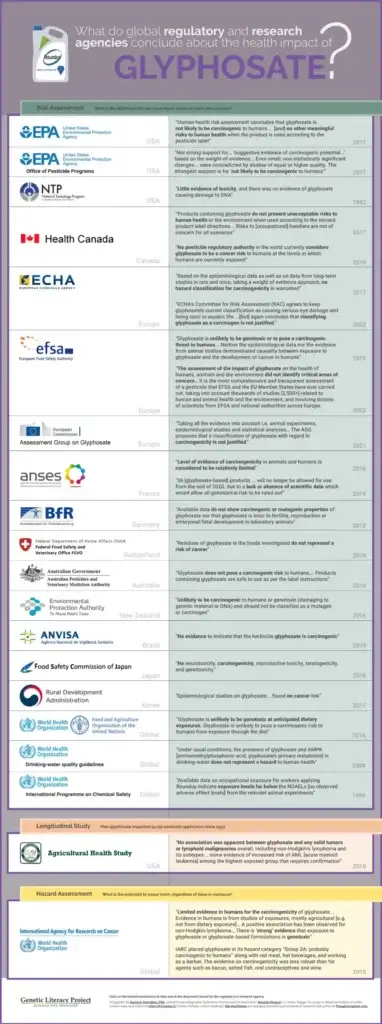
Health Canada twice reviewed glyphosate in the wake of IARC’s 2015 monograph, assessing real-world risk rather than hypothetical (no assessment of exposure, or “dose”), writing;
No pesticide regulatory authority in the world currently considers glyphosate to be a cancer risk to humans at the levels at which humans are currently exposed.

Challenges to EPA reform
The EPA has demonstrated that it can and has banned chemicals when the dangers are acute. That’s the good news. However, as was reaffirmed by the DCPA decision, action depends on who is in charge of the EPA. In addition to lobbying from the chemical companies, large produce farmers and the groups that represent them rarely, if ever, accept the loss of chemicals without lobbying and a media fight.
One example is Griffin Family Farms LLC based in Yuma, AZ. Using DCPA, by their estimate, they produce 80-90% of the nation’s winter vegetables and leafy greens. This is not a small operation of a family of five sharing in the work of running a farm. That falls to farmworkers, a group without significant organized representation in Arizona. Here is how the owners responded to the emergency order when it still was being debated.
Griffin Family Farms regularly uses Dacthal in its growing operations. Dacthal Flowable is an essential tool for controlling yield-robbing grasses and broadleaf weeds and also delivers high crop safety. Few other options are currently available for these crops and new herbicides are rare. Additionally, there have been advancements in mechanical weeding but the method has not yet fully matured. In many cases, the crop-safe alternative would be hand-weeding, which would entail bringing on additional labor. This method is expensive, and in some cases, is economically unviable – labor is currently in very short supply and availability can be sporadic. Consequently, Griffin Family Farms would be disadvantaged both agronomically and economically if it were to lose access to Dacthal Flowable.
They are correct that new herbicides are few and far between. They are also correct that labor shortages are common in agriculture, and that can’t be solved by raising wages like in most other sectors. But a line must be drawn when the evidence is overwhelming, as has been done with DCPA. And let’s not forget that removing old, dangerous technologies from the market creates pressure for innovation.
“It shouldn’t have taken this long, but we are glad that they did it finally, said Jeannie Economos, coordinator of the pesticide safety and environmental health program at the Farmworker Association of Florida. “How many people got sick in the meantime? How many babies were born with low birth weight? We don’t know.”
Marc Brazeau is the GLP’s senior contributing writer focusing on agricultural biotechnology. He is also the editor of the Food and Farm Discussion Lab. Marc served as project editor and assistant researcher on this series. Follow him on Twitter @eatcookwrite