Sustainable forestry: CRISPR-edited trees could boost fiber production efficiency and reduce the paper industry’s carbon footprint

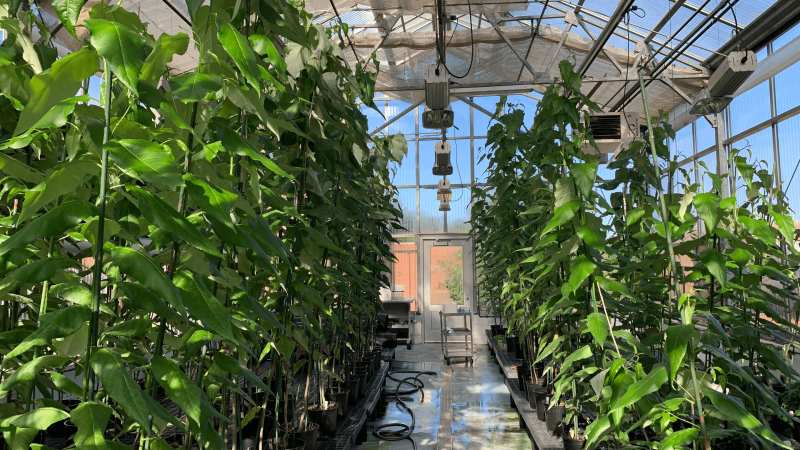
CRISPR-modified poplar trees and wild poplar trees grow in an NC State greenhouse. Credit: Chenmin Yang, NC State University

Humans have domesticated numerous crops, but trees have largely escaped us. This is because breeding new tree varieties takes many decades. Now, a team has combined machine learning and advanced CRISPR technology to create trees with desirable traits for both industry and the environment in a fraction of the time.

[Rodolphe Barrangou at North Carolina State University] and his colleagues used a predictive machine learning model to identify genes in poplar trees (Populus trichocarpa) that they could modify to create ideal traits for fiber productions, including increased cellulose-to-lignin ratio….

Follow the latest news and policy debates on sustainable agriculture, biomedicine, and other ‘disruptive’ innovations. Subscribe to our newsletter.

To test the strategies experimentally, the team used multiplex CRISPR, a genetic engineering technique that targets multiple genes simultaneously to generate 174 engineered tree lines….

The genetic changes, however, meant that many of the edited trees grew much slower. Nevertheless, the team’s analysis suggested that the CRISPR-edited wood would likely boost fiber production efficiency and reduce the carbon footprint since the energetic and chemical input required to remove excess lignin would decrease.


This is an excerpt. Read the original post here

{{ reviewsTotal }}{{ options.labels.singularReviewCountLabel }}
{{ reviewsTotal }}{{ options.labels.pluralReviewCountLabel }}
{{ options.labels.newReviewButton }}
{{ userData.canReview.message }}

Related Articles

Infographic: Global regulatory and health research agencies on whether glyphosate causes cancer

Infographic: Global regulatory and health research agencies on whether glyphosate causes cancer

Does glyphosate—the world's most heavily-used herbicide—pose serious harm to humans? Is it carcinogenic? Those issues are of both legal and ...

Most Popular

Picture1
The Orange Bowl without oranges: Can CRISPR save Florida citrus?
global warming
‘Implausible’: Top climate scientists reject worst-case scenario—soaring temperatures and fast-rising sea levels
vax-misinformation-main
Facts & Fallacies Podcast: Limit free speech to blunt social media misinfo?
ChatGPT-Image-May-1-2026-11_42_59-AM-2
Viewpoint: NAD is the wellness grifters latest evidence-lite longevity fad. At least the mice are impressed.
Screenshot 2026-05-22 at 11.31
‘Realistic and durable’: EPA proposes loosening restrictions on some PFAS ‘forever chemicals.’
Screenshot-2026-04-22-at-12.21.32-PM
Viewpoint: Why the retracted Monsanto glyphosate study doesn’t change the science—the world’s most popular herbicide is safe 
ChatGPT Image May 26, 2026, 12_06_53 PM
Fake Ebola cure promoters already cashing in as disinformation videos flood social media
Screenshot-2026-05-21-at-12.15.17-PM
UK gene-editing milestone: Livestock barley that increases ruminant value and reduces methane emissions is first-approved CRISPR crop
ChatGPT Image May 24, 2026, 03_16_36 PM
Here come the biohackers' Enhanced Games—The Olympics for athletes doping up on steroids, hormones and peptides. What’s wrong with that?
Picture1
The FDA couldn’t find a vaccine safety crisis, so it buried its own research
glp menu logo outlined

Get news on human & agricultural genetics and biotechnology delivered to your inbox.