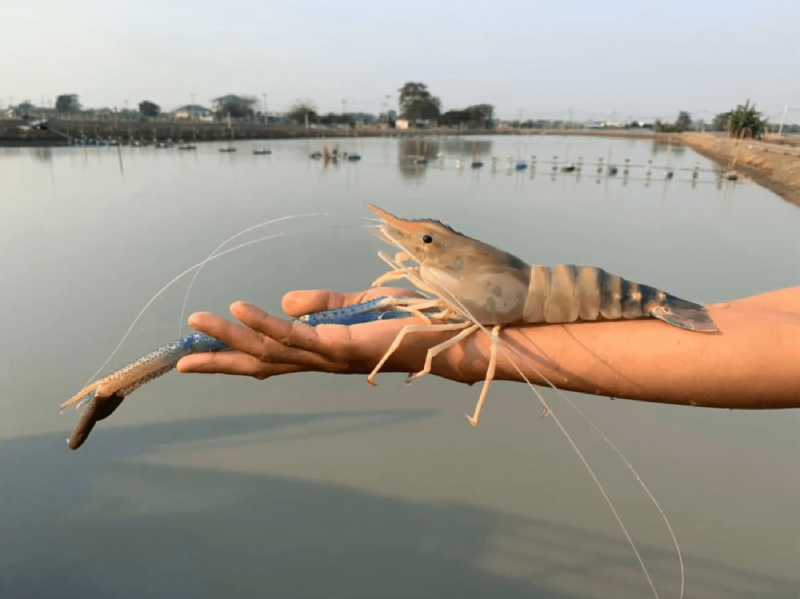
Prawn lover? Gene edited giant crustacean should soon be widespread

Credit: Nation Thailand

Researchers in Israel claim to have bred the world’s first gene-edited giant river prawn.

The breakthrough was made by researchers at Watershed AC, Evogene Ltd and Ben-Gurion University (BGU), who used CRISPR to breed the crustacean for improved key traits, such as growth rate, disease resistance, and environmental adaptation. The announcement coincides with the organisations’ approval from Israeli authorities for a second year grant to continue developing CRISPR technology for crustaceans.

The collaboration aims to provide a sustainable solution to existing limitations in gene editing for non-model organisms with sparse genomic data and protocols, focusing on improving key traits such as growth rate, disease resistance, and environmental adaptation in crustaceans, targeting giant river prawns, whiteleg shrimp and red swamp crayfish.

Mis- and disinformation are distorting science and public policy. Subscribe to our Daily and Weekly Digests for incisive coverage of ‘disruptive’ innovations in AI, agricultural biotechnology, food, chemicals, nuclear energy, vaccines, and other disruptive innovations.

During the first year the partners successfully met the collaboration’s planned goals. Evogene leveraged its advanced GeneRator AI tech-engine and provided predictions for optimal guide RNAs (gRNAs), through several novel features: utilisation of un-annotated genomes (lacking gene models), consideration of natural DNA variance in gRNAs design, and off-target prediction to increase editing specificity. This allowed Watershed and BGU to successfully produce the first edited giant river prawn (Macrobrachium rosenbergii) with a selected target trait of coloured eye, post-larvae at advanced life stages, thereby achieving the main milestone in the utilisation of CRISPR technology in crustaceans.


In the second year, the collaboration’s main target is to industrially scale-up CRISPR technology for giant river prawn and expand the obtained application to the additional crustacean species, whiteleg shrimp (Litopenaeus vannamei) and red swamp crayfish (Procambarus clarkia).

Read the original post here

Related Articles

Infographic: Global regulatory and health research agencies on whether glyphosate causes cancer

Infographic: Global regulatory and health research agencies on whether glyphosate causes cancer

Does glyphosate—the world's most heavily-used herbicide—pose serious harm to humans? Is it carcinogenic? Those issues are of both legal and ...

Most Popular

ChatGPT-Image-Sep-23-2026-02_36_39-PM
Viewpoint: After firing the entire National Science Board, Trump reshapes funding initiatives. Here’s the good and the bad.
ChatGPT-Image-Mar-10-2026-01_39_01-PM
Viewpoint—“Miracle molecule” debunked: Why acemannan supplements don’t work
sorghum farmers in kenya FARMERS TREND
Here are all the ways CRISPR gene editing is transforming Africa’s staple crops—and there’s a lot more innovation to come
ChatGPT-Image-Sep-10-2026-10_36_07-AM
Viewpoint: Even lousy scientific articles can shield authors when they hype dubious health claims and products
ChatGPT-Image-Sep-30-2026-01_38_36-PM
Viewpoint: Died “with measles” vs. died “from measles”: RFK, Jr.’s dangerously subversive word games
ChatGPT-Image-Sep-30-2026-01_25_34-PM
Blood tests for Alzheimer’s? The latest grifter, social media scam.
ChatGPT-Image-Sep-30-2026-01_11_07-PM
How U.S. teamed with Russia to block global human AI weapons oversight
Screenshot-2026-10-01-at-11.21.27-AM
Vaccine hesitancy, like malaria, surges globally, topping 35% in some countries
ChatGPT-Image-Sep-21-2026-03_15_09-PM
Viewpoint: Chipotle-inspired lesson: 10,000 sick customers suggest that processed foods can be safer than fresh ones
Screenshot 2025-10-15 at 1.00
What you probably don’t know: For most fast-food fans, bioengineering isn’t a choice — it’s the norm
glp menu logo outlined

Get news on human & agricultural genetics and biotechnology delivered to your inbox.