Photoacoustic imaging: Newly-developed scanner that produces 3-D images that show our blood vessels

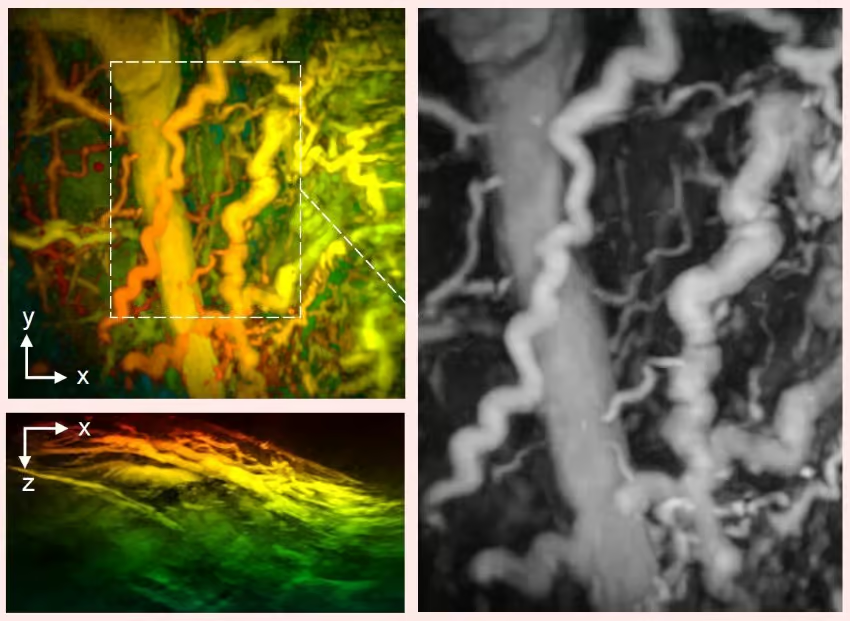
Disease captured by UCL hand-held 3D scanner. Credit: Dr Nam Huynh

It’s not the famous Star Trek tricorder but it’s close: researchers have developed a hand-held scanner that can generate highly detailed 3D images of body parts in almost real-time. The technology can accurately image blood vessels up to 15mm deep in human tissue, which the researchers say could help to diagnose conditions such as cancer, cardiovascular disease, and arthritis.

Follow the latest news and policy debates on sustainable agriculture, biomedicine, and other ‘disruptive’ innovations. Subscribe to our newsletter.

“We’ve come a long way with photoacoustic imaging in recent years, but there were still barriers to using it in the clinic,” says Paul Beard of University College London (UCL), UK, corresponding author of the new Nature Biomedical Engineering paper.

“The breakthrough in this study is the acceleration in the time it takes to acquire images, which is between 100 and 1,000 times faster than previous scanners…. These technical advances make the system suitable for clinical use for the first time, allowing us to look at aspects of human biology and disease that we haven’t been able to before.”


This is an excerpt. Read the original post here

{{ reviewsTotal }}{{ options.labels.singularReviewCountLabel }}
{{ reviewsTotal }}{{ options.labels.pluralReviewCountLabel }}
{{ options.labels.newReviewButton }}
{{ userData.canReview.message }}

Related Articles

Infographic: Global regulatory and health research agencies on whether glyphosate causes cancer

Infographic: Global regulatory and health research agencies on whether glyphosate causes cancer

Does glyphosate—the world's most heavily-used herbicide—pose serious harm to humans? Is it carcinogenic? Those issues are of both legal and ...

Most Popular

ChatGPT-Image-Mar-10-2026-01_39_01-PM
Viewpoint—“Miracle molecule” debunked: Why acemannan supplements don’t work
Screenshot 2025-07-30 at 10.48
Can gene editing eliminate Down syndrome? Scientists have done it in lab-grown cells
ChatGPT-Image-May-26-2026-07_51_21-AM-2
Viewpoint: There are more than 1,000 chemicals in a cup of coffee—including many substances that can cause cancer. Why isn’t it banned?
Screenshot 2026-05-26 at 10.15
Viewpoint: Double standard—Why does the wellness industry get a free pass while Big Healthcare is treated as morally suspect?
tick-DNA
GLP podcast: Spread meat allergy with gene-edited ticks? Bioethicists pose vile ‘thought experiment’

Sorry. No data so far.

glp menu logo outlined

Get news on human & agricultural genetics and biotechnology delivered to your inbox.