The first neural bypass implant powered by AI has helped a patient recover from near-full-body paralysis

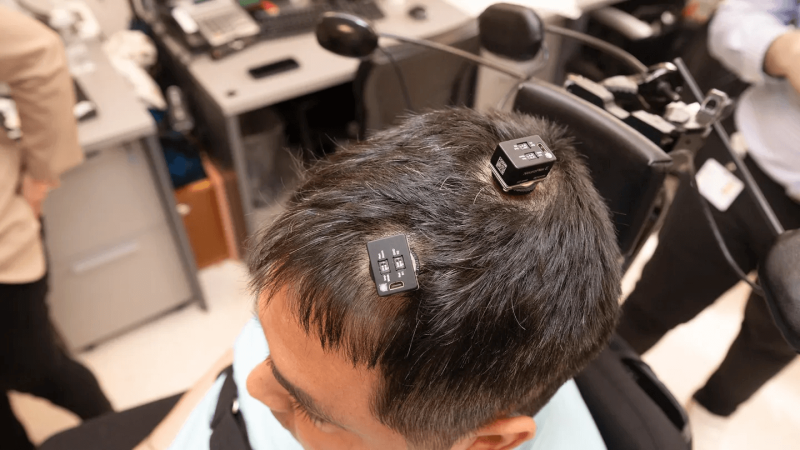
Thomas had five tiny microchips implanted in his brain, forming a critical portion of a first-of-its-kind "double neural bypass." The technology uses artificial intelligence to decode and translate his thoughts into action. Credit: Northwell Health’s The Feinstein Institutes for Medical Research/Fox News

A New York man who was left paralyzed after a diving accident is starting to regain movement a year after receiving an artificial intelligence-powered implant in his brain. A year ago, Keith Thomas, 46, was only able to move his arms an inch.

Follow the latest news and policy debates on sustainable agriculture, biomedicine, and other ‘disruptive’ innovations. Subscribe to our newsletter.
[I]n 2023, he underwent a grueling 15-hour surgery, during which the first AI-powered double neural bypass implant was placed in his brain at Feinstein Institutes for Medical Research at Northwell Health in New York.

“This groundbreaking clinical trial marks the first time the brain, body, and spinal cord have been electronically linked in a paralyzed human to restore lasting movement and sensation,” Chad Bouton, the study’s principal investigator, and professor [at] the Institute of Bioelectronic Medicine at The Feinstein Institutes, told Fox News Digital.

This is an excerpt. Read the original post here

{{ reviewsTotal }}{{ options.labels.singularReviewCountLabel }}
{{ reviewsTotal }}{{ options.labels.pluralReviewCountLabel }}
{{ options.labels.newReviewButton }}
{{ userData.canReview.message }}

Related Articles

Infographic: Global regulatory and health research agencies on whether glyphosate causes cancer

Infographic: Global regulatory and health research agencies on whether glyphosate causes cancer

Does glyphosate—the world's most heavily-used herbicide—pose serious harm to humans? Is it carcinogenic? Those issues are of both legal and ...

Most Popular

ChatGPT-Image-May-7-2026-12_16_37-PM-2
Viewpoint: Are cancer rates ‘skyrocketing’ as RFK, Jr. and MAHA claims? The evidence says mostly the opposite
ChatGPT-Image-May-13-2026-11_56_08-AM
After slashing global health aid by $19 Billion, Trump moves to tap $2.1 billion more—to cover shutdown costs
Screenshot-2026-04-22-at-10.46.29-AM
Viewpoint: How to counter science disinformation? Science journalist offers 12 practical tips
Screenshot-2026-04-23-at-11.00.36-AM
Regulators' dilemma: Thalidomide, Metformin, and the cost of getting drug approvals wrong
ChatGPT-Image-May-12-2026-08_39_41-PM
GLP podcast: Big Pharma, Big Ag, Big Food—health harming industries or life-saving innovators?
png-pill-omega-Supp-fish-oil
Millions take omega-3 fish oil for brain health. New research suggests it may do the opposite.
Picture1-5
Science Disinformation Gap: The transatlantic battle over social media and censorship
Screenshot-2026-02-20-at-10.48.04-AM
Deepfakes raise profound ethical questions in science
Picture1-1
Cooling the planet with balloons: Could a geoengineering gamble slow global warming?
Screenshot-2026-05-08-at-3.40.33-PM
Seeds of power: China turns to genetic engineering to become global superpower
ChatGPT-Image-May-12-2026-01_41_42-PM
Viewpoint: ‘Measles is a canary in the healthcare coal mine’: Challenging RFK, Jr.’s scare campaign
donut-decorated-with-e-food-additives-tablets
RFK, Jr. is targeting chemical food additives. What does science tell us?
glp menu logo outlined

Get news on human & agricultural genetics and biotechnology delivered to your inbox.