 Much of that converges around the discussion of organic farming, conventional farming, and GMOs. You’re right: the MAHA crew, including RFK Jr. and Vani Hari (“Food Babe”), have made a lot of money demonizing perfectly safe, nutritious, and in many instances, beneficial food crops while they have zero understanding and expertise in these topics.
And yes, this applies to people of ALL ideologies who spread misinformation about pesticides and “chemicals” (right now, I am ALSO looking at you, Cory Booker, Gavin Newsom, and the Pod Save America guys).
It’s time to do some fact-checking.
The organic farming movement grew from chemophobia and the appeal to nature fallacy.
Almost every time anyone with expertise tries to discuss the nuance between organic and conventional foods – topics get conflated. Let’s clarify the details.
Organic and conventional are terms that describe agricultural practices: that is, farming methods and technologies. Well, at least in this context (organic has a very different meaning when we use it in the field of chemistry).
The organic farming industry grew legs as chemophobia spread among the public, unfortunately, as a result of conflation with legitimate chemical issues (for example, after the Love Canal incident in the 1970s) with [chemicals] at large.
There is a major difference between largescale exposures to various chemicals, including industrial spills, and trace exposures when the same chemicals are not misused. This is a persistent misconception, and it has been leveraged to spread fear and disinformation.
What grew from these instances though, was fear and demonization of synthetic chemicals, facilitated by the appeal to nature fallacy. For a great piece on the history of key events that drove this, read Katie MacBride’s article in Slate, here.
This also coincided with the push for medical freedom, the anti-vaccine movement, and the removal of the FDA’s oversight on dietary supplements, also driven by the appeal to nature fallacy and the false belief that supplements, because they claim they use “natural” ingredients, are not only safe but beneficial.
Anyway, I digress. You’ll notice I try to insert history and context because I think it is critical to understand not just what is false about these claims but why they are so entrenched – and often it is a function of who is making money off of it.
The U.S. Organic Foods Production Act of 1990 was passed, establishing the National Organic Program (NOP).
The National Organic Program is a program managed by the USDA that sets standards for what qualifies as organic farming. This means that what it does is set rules and criteria for what farming and crop-growing practices count if a farm wants to get the USDA Organic label. That’s it. It does not mean the practices are better, safer, more eco-friendly, more nutritious, pesticide-free, etc. In fact, there is an extensive list of permitted pesticides and fertilizers for organic farming.
The 1990 OFPA and NOP [were] lobbied for by farmers and organizations like the Rodale Institute and the Organic Trade Association (OTA) who wanted a way to legitimize their farming methods, promote [them] to the public, and increase profits. Remember, organic farming practices are only 5-13% more expensive but [are] 22-35% more profitable than conventional farming. It is lucrative. It is also not driven by scientific evidence.
Organic certification has criteria for:
- Allowed and prohibited substances (e.g. pesticides and fertilizers).
- Farming practices (e.g. tilling methods)
- Livestock management (e.g., organic feed must be provided, no antibiotics for sick animals, no synthetic hormones).
- Processing (e.g. GMOs are prohibited in organic farming)
Organic certification has NO criteria for safety or nutrition.
The NOP is an ideological program, not a scientific one. It centers around personal beliefs and perceived values, often focusing on “natural” substances that are perceived by consumers as “clean” – all of which are marketing ploys to mislead consumers. As a result, people believe that organic is superior, uses fewer chemicals, leads to improved products, and is safer.
Unfortunately, none of that is true. In fact, many modern synthetic pesticides have taken natural chemicals (that are used as organic pesticides) and improved upon them using science to reduce environmental harm, off-target effects, and overall safety.
Organic pesticides are not as rigorously monitored and regulated compared to conventional pesticides
So, the NOP is a certification that grants farms the “USDA Organic” label. It also creates a false perception that organic is “pesticide-free” or safer. But all it means is that organic-approved pesticides are “natural” chemicals – yet we know, since we don’t fall for the appeal to nature fallacy – that the source of a chemical has no bearing on its potential harm or safety.
Pesticides used in conventional farming that are synthetic chemicals are regulated by the EPA and must require extensive data on toxicity, environmental impact, and efficacy before approval.
The USDA also manages the Pesticide Data Program (PDP) which publishes an annual residue report, which is regulated by the Federal Food, Drug, and Cosmetic Act. The PDP is a monitoring program that assesses trace residuals of synthetic pesticides used in conventional farming, created in 1991 because of public outcry and misinformation about synthetic versus natural pesticides.

Fun fact: organic pesticides are excluded from this regulatory oversight.
So, because of growing chemophobia and this false belief that “natural chemicals” are superior, the USDA PDP residue report only includes synthetic pesticide residues that are used in conventional farming.
Weird, right? Almost like the entire NOP program is based on personal beliefs, since we know that there are plenty of natural chemicals that can be harmful at low exposures (read about fungicides used in organic versus conventional farming for a key example, here).
Residual synthetic pesticides on finished food items are monitored and reported, and every year, the report demonstrates the safety of conventionally-grown produce.
So, organic pesticides are not as rigorously regulated, but ironically, the report that comes out every year that actually demonstrates that your conventionally-grown produce is safe is also manipulated to claim the opposite by anti-science activist groups like the Environmental Working Group (EWG) with their “Dirty Dozen” list and Consumer Reports, which echo much of the same talking points.
So let’s clear the air: these levels that are tested for and reported by the USDA are not levels that should concern you. If anything, the USDA report should give you confidence that not only are farmers as little pesticide application as possible to grow your foods and post-harvest processing of crops reduces any trace levels to miniscule quantities.
How do we know that? The residual levels are tested for, every year, compared to the EPA’s safety thresholds, and published in the USDA’s annual Pesticide Data Program (PDP) annual report.
Pretty much every year, over 99% of all samples tested are below safety thresholds for each of the pesticides in question (that are regulated and monitored by EPA and USDA). [2023]’s report was just published, and the same is true there.
Not only did over 99% of [the] samples tested meet all safety criteria, but 38.8% of the thousands of samples monitored had no detectable pesticide residues.
Let’s take a look at an example, to illustrate.
Malathion controls crop pests. Applications are regulated to limit potential adverse effects to non-target species and humans.
Malathion is a broad-spectrum insecticide that is used to control many crop pests and also insects that can cause vector-borne diseases in animals and humans (like mosquitoes, flies, and ticks).
In farming, it is primarily used to control pests like aphids, thrips, leafhoppers, whiteflies, cucumber beetles, and grasshoppers. It is also used to control stored grain pests like weevils and grain beetles. Not only do these insects directly damage food crops, but many of them are vectors for plant diseases – they can also transmit viruses that can harm plants or facilitate the growth of fungal pathogens that harm plants.

So obviously, it is important that we control these insects that threaten our food supplies.
In last year’s PDP, malathion was detected in 1.3% of all samples, using highly sensitive analytical chemistry methods assessing levels in the parts per trillion to parts per million. (detection doesn’t equal relevance, but we will get to that).
For context: a part per million is like 1 second of time in 11.6 days, a part per billion is 1 second of time in 31.7 years, and a part per trillion is 1 second of time in 31,700 years.
Of the samples with detected malathion levels, all of them were below the EPA tolerance level for that food (for the ones in question, the tolerance is 8 ppm).
In fact, the maximum level of malathion detected in ANY sample was 0.45 ppm, which is nearly 18 times lower than the tolerance threshold.
Do you need to be concerned about these detections? NO.
In reality, they should give you confidence in the safety of conventionally-grown produce.
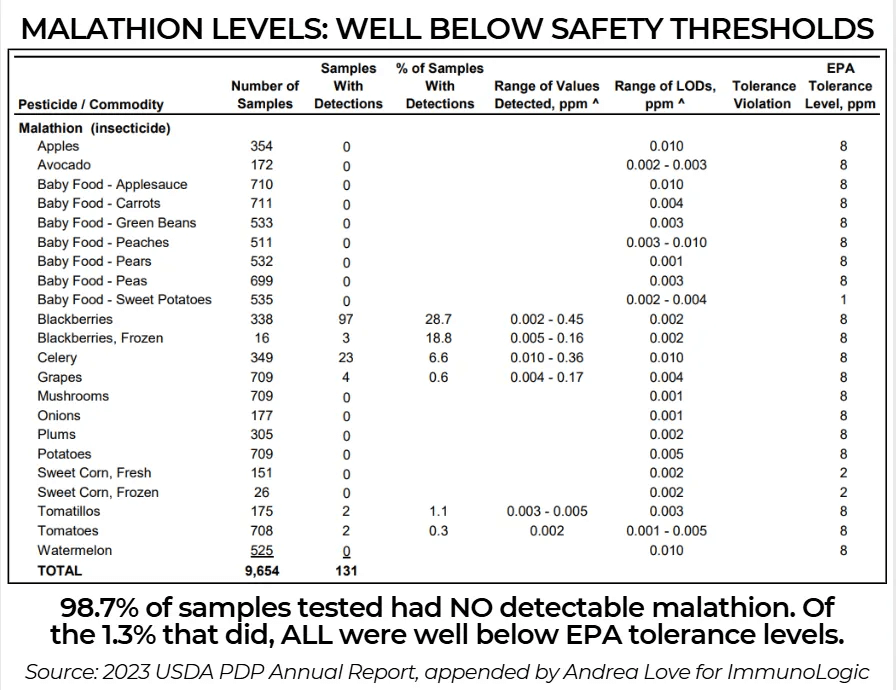
Let’s do a little hypothetical. Say you see the EWG’s Dirty Dozen list and they claim blackberries are “dirty” according to their wildly misleading and anti-science methods.
How many blackberries would you need to eat to even pose a risk?
In this instance, you have to convert the pesticide tolerance level to the acceptable daily intake (ADI); the amount of a substance that a human could ingest, every day for their entire life and experience no adverse effects.
The ADI level set by the World Health Organization for malathion is 0.3 mg/kg/day.
A person weighing 70 kg (154 lbs) would have to ingest 21 milligrams of malathion per day to reach the ADI. Let’s say we have the blackberries with the highest level detected: 0.45 ppm, which is 0.45 milligrams of malathion per 1,000 grams (kg) of blackberries.
That means a person weighing 70 kg would need to ingest 46.7 kilograms of blackberries per day to reach the ADI for malathion.
So, with some context, do you see why this is not a concern?
ADI levels are well below levels that would pose a risk.
The WHO level uses a factor of 100 compared to the No-Observed-Adverse-Effect Level (NOAEL) determined by toxicology studies. That means the ADI level is 100-times lower than any level that led to some sort of adverse effect in a comprehensive array of studies.
Detection doesn’t equal harm.
Every chemical has a toxicity threshold dependent on dose, even water.
Pesticides might be detected in food, but that means the most sensitive analytical chemistry tools can find them. We can detect levels of substances that are irrelevant to our health, measured in units like parts per million, parts per billion, or parts per trillion. We have to compare those detected levels to potential risk, and the exposure in which you might experience that risk.
This is a fundamental challenge when discussing pesticides or really, any chemical (even though everything is chemicals).
The challenge is made worse when groups like the EWG take these miniscule quantities of pesticides that are detected and manipulate them to scare people from perfectly safe and more affordable conventional foods.
Of course, EWG is funded by large organic farming industry partners, so they have an obvious profit motive to drive consumers to spend more money on products that are less regulated and offer no benefit.
And that doesn’t even mention the fact that many organic pesticides can be more damaging to the environment than conventional options for the same pest control, organic farming yields less food by area of land, and organic is nothing more than a marketing-related certification for people to upcharge consumers.
What’s particularly funny about the EWG’s Dirty Dozen list is that their whole schtick is to undermine safety agencies, like the EPA and USDA, yet they are using the USDA’s data (and lying about it) to scare people! So I guess you can’t trust the safety agencies unless you’re taking their data and spreading disinformation about it.
The TL;DR?
Conventionally-grown food items are safe, nutritious, and their farming methods and pest control practices are regulated, monitored, and reported to the public.
Demonizing affordable and nutritious conventional produce is the harmful thing, not the trace levels of pesticides on them.
The false dichotomy between conventional and organic isn’t just misleading, it’s dangerous. Our constant attention [to] natural versus synthetic only causes fear and distrust, when in actuality, our food has never been safer.
What is the thing we should be concerned about? Ensuring everyone, including those of lower income, [is] assured of the nutrition and safety of fresh foods.
Indeed, negative messaging about [the] purported harms of “pesticides” on foods causes lower-income individuals to purchase and consume fewer fruits and vegetables. Under-consumption of produce items, high in nutrients and fiber, poses a legitimate risk to many aspects of our health. Only about 12% of Americans meet fruit and vegetable intake recommendations. While much of that is because of food equity and social determinants of health, a major exacerbating factor is harmful disinformation about the safety of more affordable produce.
If you want to improve access [to] and consumption of healthy foods, stop spreading lies about conventional farming.
Dr. Andrea Love, a microbiologist and immunologist, provides the facts (and the data!) on science and health topics. Follow Andrea on X @dr_andrealove
A version of this article was originally posted at Immunologic and has been reposted here with permission. Any reposting should credit the original author and provide links to both the GLP and the original article.