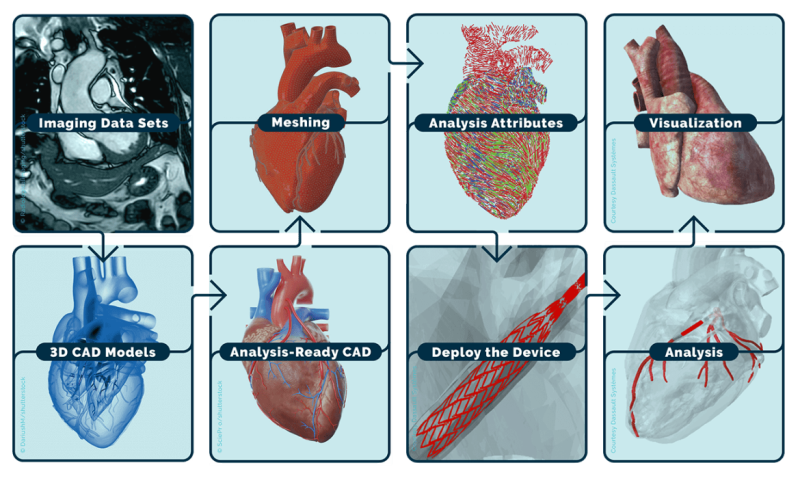

“Digital twins” are the same size and shape as the real thing. They work in the same way. But they exist only virtually. Scientists can do virtual surgery on these virtual hearts, figuring out the best course of action for a patient’s condition.
Virtual replicas of many … organs are also being developed. Engineers are working on digital twins of people’s brains, guts, livers, nervous systems, and more. They’re creating virtual replicas of people’s faces, which could be used to try out surgeries or analyze facial features, and testing drugs on digital cancers. The eventual goal is to create digital versions of our bodies—computer copies that could help researchers and doctors figure out our risk of developing various diseases and determine which treatments might work best. They’d be our own personal guinea pigs for testing out medicines before we subject our real bodies to them.
We can think of a digital twin as having three separate components, says El-Bouri, a biomedical engineer at the University of Liverpool in the UK. The first is the thing being modeled. That might be a jet engine or a bridge, or it could be a person’s heart. Essentially, it’s what we want to test or study. The second component is the digital replica of that object, which can be created by taking lots of measurements from the real thing and entering them into a computer. For a heart, that might mean blood pressure recordings as well as MRI and CT scans. The third is new data that’s fed into the model. A true digital twin should be updated in real time—for example, with information collected from wearable sensors, if it’s a model of someone’s heart.
…




When I looked at those anonymous plastic hearts, stored in a cardboard box tucked away on a shelf in the corner of an office, they felt completely divorced from the people whose real, beating hearts they were modeled on. But digital twins seem different somehow. They’re animated replicas, digital copies that certainly appear to have some sort of life.