Viewpoint: Trump is pushing ‘America FIrst’ across policy sectors including food and farming. Why that’s not a great idea

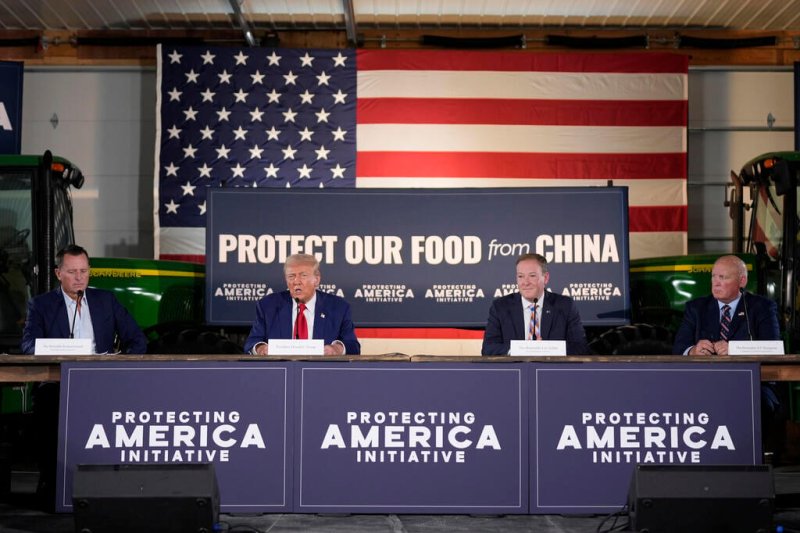
Republican presidential nominee former President Donald Trump speaks at a campaign event at a farm, Monday, Sept. 23, 2024, in Smithton, Pa, as from left, Richard Grenell, Lee Zeldin and Rep. Glenn Thompson, R-Pa., listen. (AP Photo/Alex Brandon)

An America First food system would promote eating seasonally and locally, supporting more small farmers in the process. But that is not how most people eat now. Eating America First would restrict the variety that shoppers have come to expect; eating fresh blueberries year-round would be impossible. Barring the overhaul of all U.S. agriculture, it would mean a less healthy diet, too. The guac-ocalypse near miss was a reminder of the precarious state of our food system: Much of the food we want is not produced at home.

Mis- and disinformation are distorting science and public policy. Subscribe to our Daily and Weekly Digests for incisive coverage of ‘disruptive’ innovations in AI, agricultural biotechnology, food, chemicals, nuclear energy, vaccines, and other disruptive innovations.
[T] he U.S. does already produce enough food to feed itself, and then some. About 4,000 calories’ worth of food a day were available for each person in 2010, according to the USDA’s most recent estimate; that year, the average person consumed 2,500 calories a day. But food is more than just calories. The U.S. produces plenty of grains, oils, sweeteners, and meat, but far less fresh produce and legumes; in recent years, the country has become a net importer of food. “The food group that we produce the least of to meet our dietary needs is fruits and vegetables,” Conrad said. In 2022, 69 percent of the fresh vegetables and 51 percent of the fresh fruits imported by the U.S. came from Mexico. Meat, canola oil, and, uh, biscuits and wafers account for most of the U.S. imports from Canada, but 20 percent of this country’s fresh-vegetable imports come from there, too.

…

The problems with an America First food system wouldn’t just be about cost. It would lack diversity….


This is an excerpt. Read the original post here

Related Articles

Infographic: Global regulatory and health research agencies on whether glyphosate causes cancer

Infographic: Global regulatory and health research agencies on whether glyphosate causes cancer

Does glyphosate—the world's most heavily-used herbicide—pose serious harm to humans? Is it carcinogenic? Those issues are of both legal and ...

Most Popular

ChatGPT-Image-Mar-10-2026-01_39_01-PM
Viewpoint—“Miracle molecule” debunked: Why acemannan supplements don’t work
Screenshot-2026-10-06-at-11.13.59-AM
RFK Jr.’s plan to curb America’s appetite for ultra-processed foods and artificial dyes blocked by the White House
Screenshot-2026-09-22-at-12.26.15-PM
‘Forever chemical’ concerns: Separating hysteria from reasonable concern in the debate over PFAS danger
Screenshot 2026-10-08 at 1.34
Hooked on kratom: The unregulated, natural, alcohol-free “social tonic” that is destroying lives 
Screenshot-2026-10-06-at-2.36.47-PM
Is organic farming really more sustainable? 100 recent studies say ‘no’
Resolute-Portrait-with-Injured-Teddy-Bear
Anti-vax Texas Senate candidate Ken Paxton alleges conspiracy by doctors, drugmakers, and insurers to push childhood vaccination for profit
Screenshot-2026-09-28-at-11.26.17-AM
Viewpoint: Wellness movement activists reposition nicotine from a killer addictive drug into a cure-all for brain ills
AI-Force-Uniform-Insignia-Close-Up
Trump wants an AI Force like Space Force, but that could make AI’s risks harder to manage
Radioactive-Americana-Collage-2
The kooky logic behind the raft of spurious cancer claims from Harvard’s T.H. Chan School of Public Health
No-Data-Center-Farm-Protest-Sign-2
Rural revival or corporate windfall? Trump’s One Big Beautiful Bill tax law opens the door to big breaks for data centers—but tech giants aren’t cashing in
ChatGPT-Image-Sep-21-2026-11_21_39-AM
Viewpoint: Food cults: Online ‘nutrition communities’ can pose unique dangers
strand of dna genetics
No, GMO foods do not “damage genes, natural disposition and hormones, or decrease physical health and intelligence”
Supreme-Court-Amid-Climate-Crisis
Should fossil fuel companies be shielded from lawsuits over climate change damage? The Supreme Court takes up the question
glp menu logo outlined

Get news on human & agricultural genetics and biotechnology delivered to your inbox.