Humans probably did not domesticate wolves into dogs—canines did it themselves

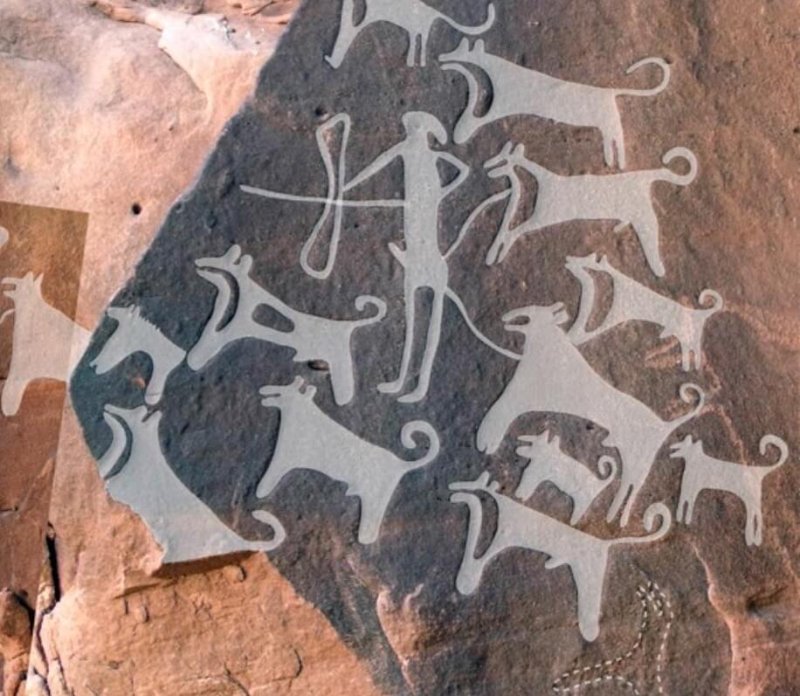
This composite image of a panel of rock art discovered in Saudi Arabia shows a hunter with 13 dogs (right side) and a few possible leashes extending from the hunter's waist, and a scene with a hunter, a large equid and eight dogs (left side). The top image shows the engravings traced in white. Credit: Journal of Anthropological Archaeology/Maria Guagnin/Max Planck Institute for the Science of Human History

Scientists don’t know exactly how wolves were domesticated into early dogs, but it’s possible that they domesticated themselves by choosing to coexist with humans so that, a new study finds, they could be fed consistently. Then, these snackish canines likely selected mates that did the same.

While the theory is nothing new…new research shows it’s statistically possible for the wolves to have driven their own domestication into dogs through natural selection.

Mis- and disinformation are distorting science and public policy. Subscribe to our Daily and Weekly Digests for incisive coverage of ‘disruptive’ innovations in AI, agricultural biotechnology, food, chemicals, nuclear energy, vaccines, and other disruptive innovations.

The model showed that over 15,000 years, natural selection could potentially drive dog self-domestication. But for this to happen, two conditions had to be met: Wolves had to choose to stay near humans to eat food scraps, and they had to select mates with a similar temperament.

“When females were selecting mates, they also had to select males that had a similar tameness to themselves,” study co-author Alex Capaldi, a mathematician and statistician at James Madison University in Virginia, told Live Science. “So if both of those processes are in play, then it is possible for the self-domestication hypothesis to beat the time constraint critique.”


This is an excerpt. Read the original post here

Related Articles

Infographic: Global regulatory and health research agencies on whether glyphosate causes cancer

Infographic: Global regulatory and health research agencies on whether glyphosate causes cancer

Does glyphosate—the world's most heavily-used herbicide—pose serious harm to humans? Is it carcinogenic? Those issues are of both legal and ...

Most Popular

ChatGPT-Image-Mar-10-2026-01_39_01-PM
Viewpoint—“Miracle molecule” debunked: Why acemannan supplements don’t work
Prescription Capsules Scattered on Twenty-Dollar Bills
Facts & Fallacies podcast: America's health care system is broken. A doctor explains how to fix it, Part 2
MAHA-MOMS-Supporters-at-the-Rally
Viewpoint: How 'MAHA men' hijacked the female-built food and wellness movement
Dissolving-Tablets-in-Waves
Viewpoint: How the anti-abortion movement twists medical facts and promotes science misinformation
Executive-Greeting-in-a-Futuristic-Boardroom
Viewpoint: RFK Jr. touts AI to guide health care…but searches using the technology he champions expose him as scientifically illiterate
Screenshot-2026-10-12-at-10.44.38-AM
Widely condemned as unethical, hepatitis B vaccine study funded by RFK Jr’s CDC gets a final greenlight
Deepfake Democracy Media Mosaic
31 states have passed a patchwork of laws to limit election deepfake commercials. They’re not working very well.
Personalized-Cancer-mRNA-Vaccine-Vial
Personalized mRNA vaccines are poised to revolutionize cancer treatments. Here are the barriers.
Golden Wheat Under a Starry Sky
Viewpoint: ‘Bureaucratic and economic obstacles’ to agricultural biotechnology: Europe creeps into the 21st century, but blocks remain
Caution-Taped-Fresh-Produce-Aisle
Should we be afraid of our food?
Cross and Syringe Standoff
Viewpoint: Hijacking Jesus: How anti-vaccine fanatics are exploiting religious exemptions and killing children
Screenshot-2026-09-22-at-12.26.15-PM
‘Forever chemical’ concerns: Separating hysteria from reasonable concern in the debate over PFAS danger
Screenshot-2026-09-22-at-10.54.12-AM
‘They misunderstand science’: Research attempting to tie autism to changes in the gut microbiome comes under fire
glp menu logo outlined

Get news on human & agricultural genetics and biotechnology delivered to your inbox.