Viewpoint: Here’s why almost all sports supplements are a risky scam

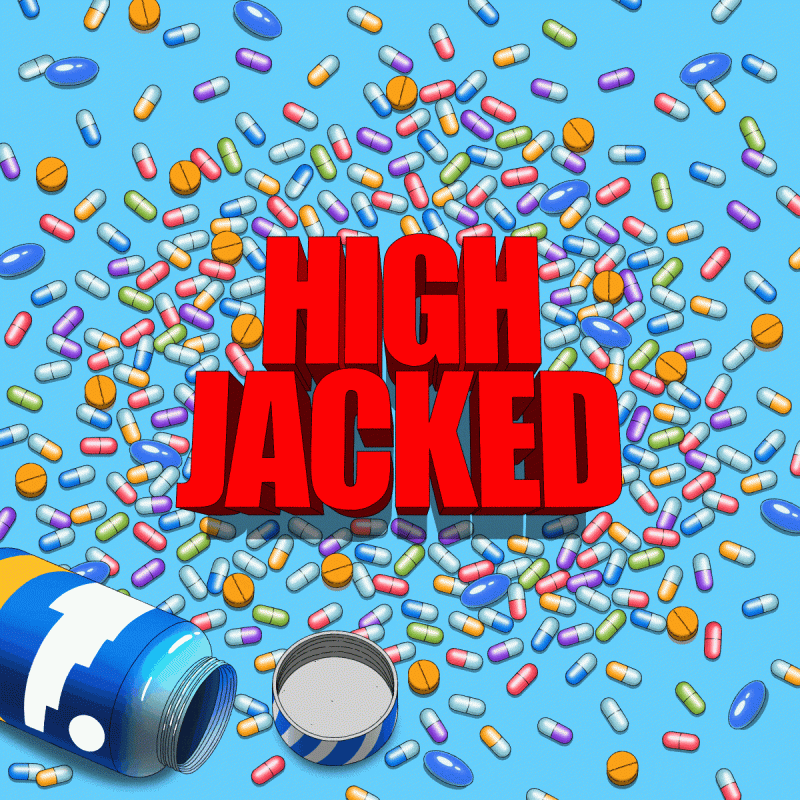
Credit: Illustration by Jaedoo Lee

Supplements are not benign. We think they are, but they aren’t. Some promise to boost muscle mass or improve sports performance and are popular with young men. But multiple studies have shown that these products often have inaccurate labels, contain ingredients they shouldn’t, are missing the ingredients they should, and pose a potential safety risk. They might also be the first step along the path toward the use of anabolic steroids.

Mis- and disinformation are distorting science and public policy. Subscribe to our Daily and Weekly Digests for incisive coverage of ‘disruptive’ innovations in AI, agricultural biotechnology, food, chemicals, nuclear energy, vaccines, and other disruptive innovations.
[In a] 2023 analysis, 40 per cent of the 57 products tested did not contain any of the labelled ingredients. Many others contained incorrect doses and 12 per cent contained at least one FDA-prohibited ingredient. Only 11 per cent had ingredient doses that matched what was on the label.

…

Not every supplement is dangerous or contaminated with unlabeled ingredients, and most people will not go on to abuse anabolic steroids. But the issue is pervasive enough that it puts young athletes and aspiring athletes at risk. They believe these supplements will improve their sports performance when they probably won’t. They believe they are safe when they may not be. They believe they are necessary to achieve some masculine ideal, when such ideals are a fantasy. They are fundamentally unnecessary.


This is an excerpt. Read the original post here

Related Articles

Infographic: Global regulatory and health research agencies on whether glyphosate causes cancer

Infographic: Global regulatory and health research agencies on whether glyphosate causes cancer

Does glyphosate—the world's most heavily-used herbicide—pose serious harm to humans? Is it carcinogenic? Those issues are of both legal and ...

Most Popular

Personalized-Cancer-mRNA-Vaccine-Vial
Personalized mRNA vaccines are poised to revolutionize cancer treatments. Here are the barriers.
ChatGPT-Image-Mar-10-2026-01_39_01-PM
Viewpoint—“Miracle molecule” debunked: Why acemannan supplements don’t work
Screenshot-2026-10-11-at-10.24.21-AM
Viewpoint: RFK Jr.’s new CDC head Erica Schwartz greenlights hepatitis B vaccine study critics call “unethical and designed to cast doubts on its safety”
Screenshot-2026-10-05-at-11.57.44-AM
Scaremongering or legitimate safety concerns? The political dogfight over America’s food safety system
Screenshot-2026-09-22-at-12.26.15-PM
‘Forever chemical’ concerns: Separating hysteria from reasonable concern in the debate over PFAS danger
Deepfake Democracy Media Mosaic
31 states have passed a patchwork of laws to limit election deepfake commercials. They’re not working very well.
Screenshot 2026-10-12 at 12.25
Tearful onions? CRISPR has a solution for that
Eating Nuts Adds up to Longer Life x
For millions with peanut allergies, Nurtured Nuts’ CRISPR gene-edited peanuts could ease the fear of accidental exposure
AI-Force-Uniform-Insignia-Close-Up
Trump wants an AI Force like Space Force, but that could make AI’s risks harder to manage
Screenshot-2026-10-08-at-1.23.28-PM
Countries around the world are rushing to pass teenage social media bans. Could they backfire?
generated-1790707585414
Facts & Fallacies podcast: America's health care system is broken. A doctor explains how to fix it
Radioactive-Americana-Collage-2
The kooky logic behind the raft of spurious cancer claims from Harvard’s T.H. Chan School of Public Health
Screenshot-2026-09-22-at-10.54.12-AM
‘They misunderstand science’: Research attempting to tie autism to changes in the gut microbiome comes under fire
glp menu logo outlined

Get news on human & agricultural genetics and biotechnology delivered to your inbox.