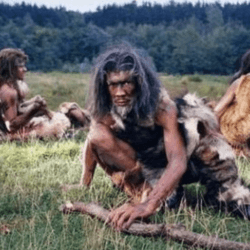
Putting faces on the human tree of life: From Hobbit to 300,000 year old humans, here’s what we looked like

'The Hobbit'  | Credit: Smithsonian
'The Hobbit' | Credit: Smithsonian

Now, scientists have revealed the most scientifically accurate reconstructions of what those ancient humans would have looked like.

This includes the face of an elusive ancient species known as ‘The Hobbit’.

[Scientists] have combined cutting-edge digital modelling techniques with the latest fossil evidence.

Follow the latest news and policy debates on sustainable agriculture, biomedicine, and other ‘disruptive’ innovations. Subscribe to our newsletter.

Home erectus was the first human species to exclusively walk upright on two legs like humans do today.

Anthropologists believe they lived between 1.89 million and 110,000 years ago.

Homo Erectus | Credit: Smithsonian

Homo floresiensis … was a tiny, island-dwelling human species which stood at no more than three and a half feet tall and lived between 700,000 and 50,000 years ago.

Homo Floresiensis | Credit: Smithsonian

Homo neanderthalensis, also known as the Neanderthal, is our closest human relative. These species lived between 430,000 and 40,000 years ago and often interbred with humans.

Neanderthal | Credit: Smithsonian

After emerging in Africa, a small group of around 10,000 Homo sapiens crossed into Europe around 60,000 years ago and managed to establish a population.

Everyone outside of Africa is descended from those first few thousand humans ….

Homo Sapiens | Credit: Smithsonian

This is an excerpt. Read the original post here

{{ reviewsTotal }}{{ options.labels.singularReviewCountLabel }}
{{ reviewsTotal }}{{ options.labels.pluralReviewCountLabel }}
{{ options.labels.newReviewButton }}
{{ userData.canReview.message }}

Related Articles

Infographic: Global regulatory and health research agencies on whether glyphosate causes cancer

Infographic: Global regulatory and health research agencies on whether glyphosate causes cancer

Does glyphosate—the world's most heavily-used herbicide—pose serious harm to humans? Is it carcinogenic? Those issues are of both legal and ...

Most Popular

Screenshot-2026-04-22-at-12.21.32-PM
Viewpoint: Why the retracted Monsanto glyphosate study doesn’t change the science—the world’s most popular herbicide is safe 
ChatGPT-Image-Apr-16-2026-02_56_53-PM
Financial incentives, over diagnosis, and weak oversight: Autism claims are driving up Medicare costs
Picture1
The FDA couldn’t find a vaccine safety crisis, so it buried its own research
global warming
‘Implausible’: Top climate scientists reject worst-case scenario—soaring temperatures and fast-rising sea levels

Sorry. No data so far.

glp menu logo outlined

Get news on human & agricultural genetics and biotechnology delivered to your inbox.