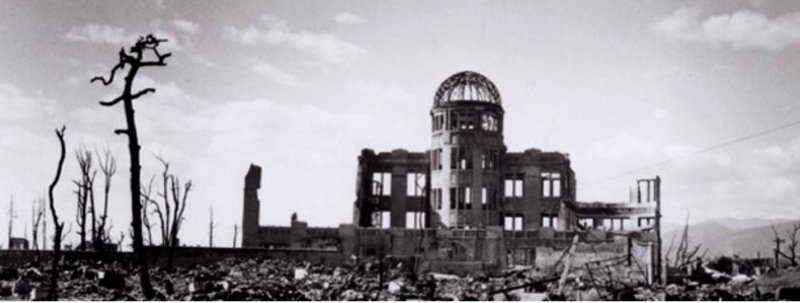
But it is far more than that. Victory was celebratory and somber. The bombings marked a cosmic tragedy, revealing the terrifying extremes of human capability. In mushroom clouds and firestorms, entire cities were reduced to shadows burned into walls, bodies vaporized, time itself frozen in an instant of utter devastation. It was more than destruction; it was otherworldly, awesome in the full meaning of that word. The legacy is not merely one of victory, but of an enduring reckoning with the monstrous potential born of human ingenuity.
Was it worth it? The bombings killed upwards of 200,000 people—and brought a swift end to the war, averting a brutal Allied invasion of Japan that could have cost millions more lives. Beyond the immediate death toll, the bombs unleashed an era of existential dread, nuclear arms races, and the continuing, looming threat of global annihilation. (Remember the “duck and cover” drills in elementary schools?) The “was it worth it” question persists not only because of what happened in 1945, but because the consequences are still with us.
Americans are no strangers to “times that try men’s souls,” to borrow a phrase from Thomas Paine. By summer 1945, the United States had been at war for three-and-a-half years, enduring separation from loved ones, mounting numbers of casualties, and rationing, with no end in sight.
By the time Colonel Paul Tibbets took off from a U.S.-controlled Pacific island airbase, Japan was the last major Axis power still fighting. At 8:15 AM local time his B-29 Superfortress bomber dropped Little Boy, a uranium-based atomic bomb, on the Japanese city of Hiroshima.
The wisdom of the decisions made over the next few days is still debated. The U.S. waited anxiously for Japan to signal it was prepared to surrender, but heard nothing. On August 8, the Soviet Union declared war on Japan, unnerving the Allies who feared the Communist behemoth would move swiftly to claim a role in postwar Japan and across Asia. The next day, the U.S. detonated Fat Man, a plutonium-based bomb, over Nagasaki, blocking the Soviets and assuring American dominance in the new world order.
They were the only two nuclear weapons ever used in warfare.
Reflections
Although the bombings occurred before I was born, I have several personal connections to those events. When Little Boy was dropped on Hiroshima, my father, a staff sergeant in the U.S. Army infantry who had fought in the Italian campaigns of WWII, was on a troopship, expecting to be deployed to the Pacific theater of operations. (The major European Axis powers had surrendered three months earlier.) Neither he nor his fellow soldiers relished the prospect of participating in the impending invasion of the Japanese main islands. When the Japanese surrendered on August 14, the ship headed, instead, for Virginia, where the division was disbanded. Dad headed home to Philadelphia, and I was born two years later.
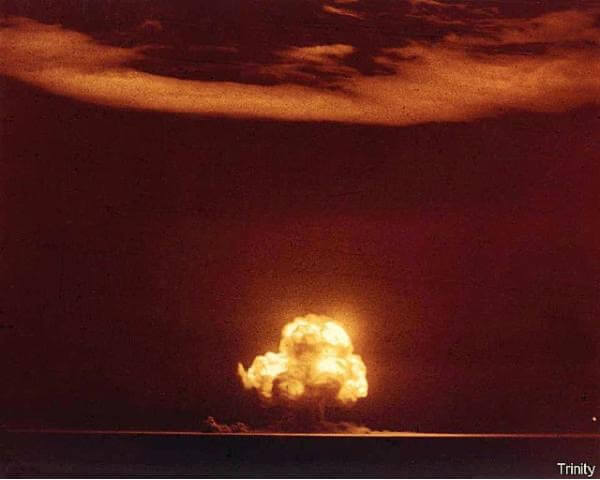
Three of my physics professors at M.I.T., where I was an undergraduate, had participated in the Manhattan Project to develop the atomic bombs almost three decades earlier. They sometimes related stories about their experiences. One of them was on assignment in Alamogordo, NM, about 200 miles southeast of Los Alamos, when the world’s first atomic bomb, code-named “Trinity” — was exploded on July 16.
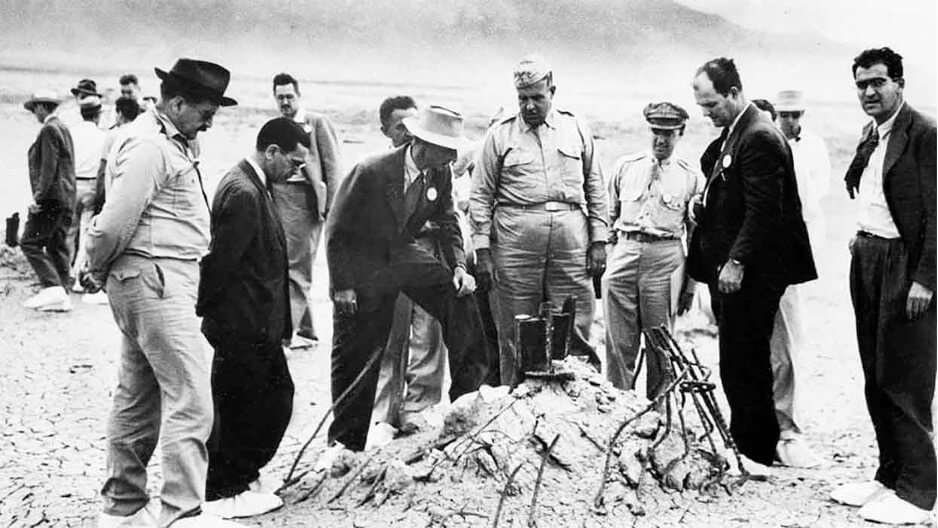
He was assigned to drive Army Major General Leslie Groves, the director of the project, to view the result. They arrived to find a crater 1,000 feet in diameter and six feet deep, with the desert sand inside turned by the intense heat into glass – which became known as “trinitite.” General Groves’ response was, “Is that all?”
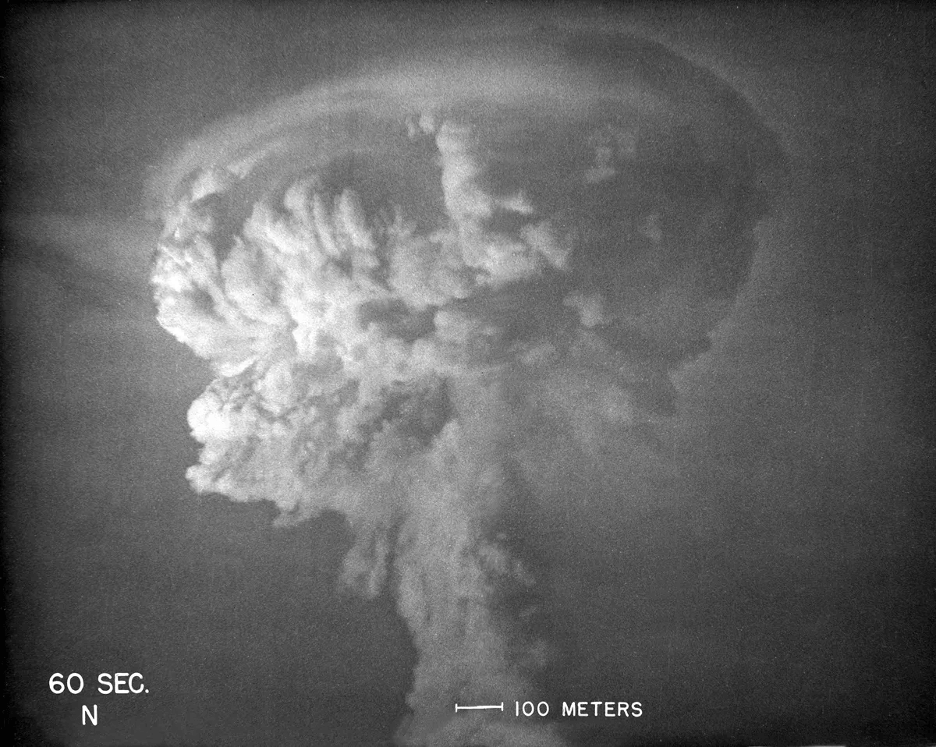
No, that was far from “all”. The blast was visible up to 160 miles away. Witnesses from as far as Albuquerque and El Paso described a huge fireball and mushroom cloud. The radioactive fallout extended over thousands of square miles.
Reflections and second-guesses
Approximately 66,000 are thought to have died in Hiroshima from the acute effects of Little Boy and about 39,000 in Nagasaki from Fat Man. In addition, within months, there was a significant subsequent death toll because of radiation and wounds.
Shortly after, the “Was it necessary?” questions began. Many people struggled with the morality and military necessity of using nuclear weapons on Japanese civilians. Even nuclear physicist Leo Szilard, who in 1939 had composed the letter for Albert Einstein‘s signature that resulted in the formation of the Manhattan Project, characterized the use of the bombs as “one of the greatest blunders of history.”
The historical context and military realities of 1945 are often forgotten when judging whether it was “necessary” for the United States to use nuclear weapons. The Japanese had been the aggressors, launching the war with a sneak attack on Pearl Harbor in 1941. Over the course of the war, Japan systematically and flagrantly violated many international agreements and norms.
By 1944–45, the Japanese military was notorious for widespread atrocities that violated international norms and fueled Allied outrage. They brutally mistreated prisoners of war—through starvation, torture, forced labor, and execution—such as the Bataan Death March and the construction of the Burma Railway. In occupied territories, they brutalized innocent civilians, most infamously in the Nanjing Massacre. Tens of thousands of women and girls across Asia were forcibly conscripted into sexual slavery as “comfort women,” a practice that became one of the war’s most bitterly condemned crimes. Japan also used chemical and biological weapons and conducted deadly human experiments through Unit 731. These actions, combined with fanatical resistance and mass civilian suicides during battles like Okinawa and Saipan, solidified Japan’s image as a uniquely brutal enemy.
Operation Downfall: A deadly path not taken
Many who question the U.S. decision to usher in the Atomic Age in such a devastating fashion often downplay the humanitarian and strategic aspects of the decision to use them.The bombings of Hiroshima and Nagasaki precluded the implementation of “Operation Downfall” – the massive Allied (primarily American) invasion of the Japanese home islands that was being planned.
As Allied forces closed in on the main islands, the strategies of Japan’s senior military leaders ranged from “fighting to the last man” to inflicting heavy enough losses on invading American ground forces that the U.S. would be forced to agree to a conditional peace. Operation Downfall was being pursued primarily because U.S. strategists knew, from having broken the Japanese military and diplomatic codes, that there was virtually no inclination on the part of the Japanese to surrender unconditionally.
Because the Allied military planners assumed that “operations in this area will be opposed not only by the available organized military forces of the Empire [of Japan], but also by a fanatically hostile population,” astronomical casualties on both sides were thought to be inevitable. Battling the dogged and ruthless Japanese military was nasty work. The losses between February and June 1945, just from the Allied invasions of the Japanese-held islands of Iwo Jima and Okinawa, had been staggering: 18,000 dead and 78,000 wounded. That harrowing experience led to the expectation that there would be heavy losses during Operation Downfall. A friend, a distinguished military historian and retired Marine four-star general, shared this with me:

[F]ollowing Okinawa and Iwo Jima, all six Marine divisions were being refitted for the attack on the home islands. None of the divisions had post-assault missions, because the casualty estimates were so high that they would initially be combat inoperable until they were again remanned and refitted. Basically, the Marines were to land six divisions [of approximately 23,000 Marines each] abreast on Honshu, then the Army would pass through for the big fight on the plains inland.
The general continued:
What made this different was, unlike the Pacific campaign to date other than Guadalcanal back in 1942, this would be the first time the Japanese could reinforce their units. After Guadalcanal, in the fights across the ocean, the U.S. Navy isolated the objectives so the Japanese could not reinforce. The home islands would be a different sort of fight, hence the anticipated heavy casualties.
In a study for the War Department in 1945, physicist (and future Nobel Laureate, for inventing the transistor) William Shockley estimated that the invasion of Japan could have cost 1.7-4 million American casualties, including 400,000-800,000 fatalities, and between 5 and 10 million Japanese deaths.
These fatality estimates were, of course, in addition to the members of the military who had already perished during almost four long years of war; American deaths were already about 292,000. The implications of those numbers are staggering: The invasion of Japan could have resulted in the death of more than twice as many Americans as had already been killed in the European and Pacific theaters of WWII up to that time.
Little Boy and Fat Man reshaped the course of history, swiftly ending the war and avoiding Operation Downfall, with its almost certain horrific death toll.
Glitches along the way
Monumental technological breakthroughs like the Manhattan Project are never without glitches. The plans, before and after the dropping of the bombs, had to overcome numerous blunders and obstacles.
Two months before the Trinity test, U.S. Air Force planes dropped bombs on the Trinity base, mistakenly thinking that the illuminated buildings were the targets for their practice mission:
In the middle of May, on two separate nights in one week, the Air Force mistook the Trinity base for their illuminated target. One bomb fell on the barracks building which housed the carpentry shop, another hit the stables, and a small fire started. Fortunately, the barracks occupied by soldiers and civilian scientists were not struck. If the lead plane hit the generator or wires and doused the target lights, then the succeeding planes looked for another illuminated area. This must have been what happened in May of 1945. After all, the crews had come at least a thousand miles to pass their final exam and had probably never been told of anything except targets in the area.
The bombs were almost not finally assembled. Only four days after the USS Indianapolis delivered the Hiroshima and Nagasaki bombs’ components to Tinian Island on July 26, 1945, a Japanese submarine torpedoed and sank her.
The B-29 Superfortress that dropped the Fat Man plutonium bomb on Nagasaki experienced one glitch after another. Many of them are described in the aptly titled “The harrowing story of the Nagasaki bombing mission.” It’s astonishing how much went wrong. Here’s a hint of the many obstacles:
… Schreiber [the scientist entrusted with transporting the plutonium core from Los Alamos to Tinian Island] sat on a hard wooden chair strapped inside the big plane all the way to Tinian. Like everyone working on the Bomb, he was exhausted. So, he slept sitting up, sometimes holding the bomb case in his lap. At one point, over the Pacific, he went up to the cockpit to get a better view of what was causing turbulence. One of the crew came up behind and tapped him on the shoulder: “Whatever that thing is you got, it’s rolling around the back of the plane. Maybe you want to corral it.” The wire container had tipped over, the first in a series of mishaps. Schreiber quickly fetched the nation’s most technologically advanced wartime treasure, tied it to the leg of his chair, and went back to sleep.
Mounting casualties, military and non-military
During the years since WWII, much has been made of the moral boundary breached by the use of nuclear weapons. However, many military historians regard the decisions earlier in the war to adopt widespread urban bombing of civilians as far more problematic. Previously, bombing had focused primarily on military objectives, such as airfields, munitions factories, and oil fields, or critical transportation links, such as train stations and tracks, bridges, and highways. This threshold was initially transgressed by Hitler, who attacked English cities in 1940 and 1941. The practice was later adopted by the Allied forces, which resulted in the devastation of major German cities. More than 22,000 died in Dresden, February 13-15, 1945, and about 20,000 in Hamburg, July 1943.
My former Hoover Institution colleague historian Victor Davis Hanson called attention in an email to two factors that made the case for using America’s nuclear weapons.
“Thousands of Asians and allied prisoners were dying daily throughout the still-occupied Japanese Empire, and would do so as long as Japan was able to pursue the war,” he wrote.
Second, “Maj. Gen. Curtis LeMay (who commanded all strategic air operations against the Japanese home islands) planned to move forces from the Marianas to the newly conquered and much closer Okinawa. The B-29 bombers, likely augmented by European bomber transfers after V-E Day, would have created a gargantuan fire-bombing air force that, with short-distance missions, would have done far more damage than the two nuclear bombs.”
The nighttime fire-bombing of Tokyo by U.S, forces on March 9-10, 1945 is considered by many historians as the most destructive bombing raid of the war, and perhaps in the history of warfare. In three hours, the main bombing force dropped 1,665 tons of incendiary bombs, which caused a firestorm that killed some 100,000 civilians, destroyed a quarter of a million buildings, and incinerated 16 square miles of the city. Tokyo was not the only target: By the war’s end, incendiaries dropped by General LeMay’s bombers had totally or partially consumed 63 Japanese cities, killed half a million people, and left eight million homeless.
During World War I, Europe had lost most of an entire generation of young men; combatant fatalities alone approximated 13 million. Decades later, memories of that calamity were still fresh. In 1945, Allied military planners and political leaders for both strategic and moral reasons, did not want to repeat that history. (And President Harry Truman, who had succeeded Franklin D. Roosevelt upon the latter’s death only four months earlier, would not have wanted his legacy to include causing the unnecessary death of hundreds of thousands of American servicemen.) It was their duty to weigh carefully the costs and benefits for the American people, present and future. Had they been less wise or courageous, my generation of post-war baby boomers would have been much smaller.
These decisions are indeed the stuff of history, but governments perform such balancing acts all the time. As President Truman found in deciding whether to use Little Boy and Fat Man, sometimes you must choose the least bad of the alternatives. And to arrive at that, you need to value data and expert analysis over ideology, politics, or vox populi.
Henry I. Miller is a physician and molecular biologist and the Glenn Swogger Distinguished Scholar at the Science Literacy Project. He was the founding director of the U.S. FDA’s Office of Biotechnology. Follow Henry on X @henryimiller