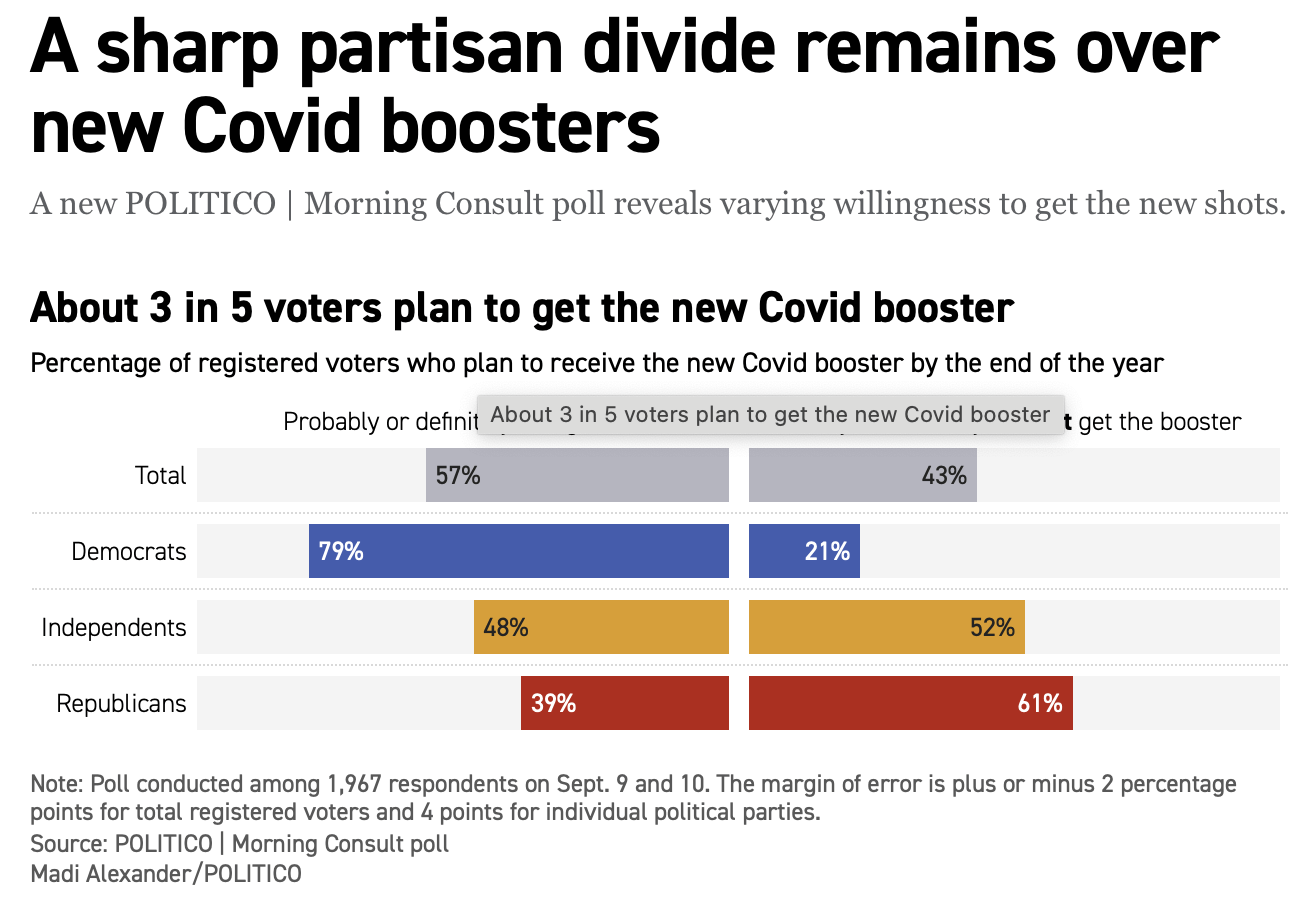
“A sharp partisan divide remains over new Covid boosters,” reads the headline announcing a poll from Politico, as respiratory virus season fast approaches.
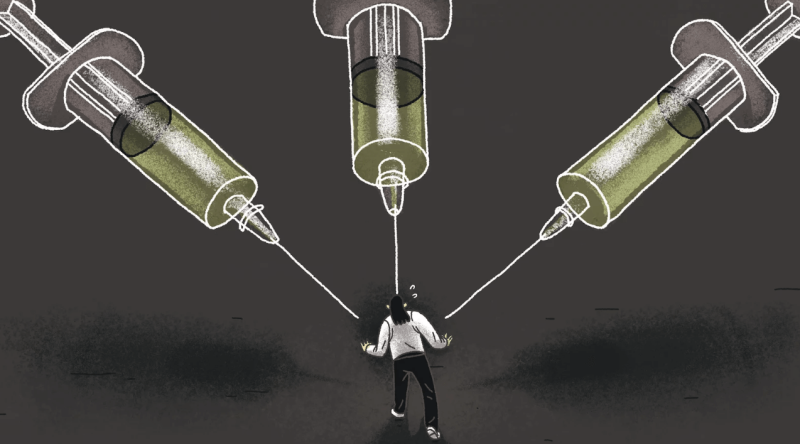
Florida’s surgeon general Joseph Ladapo, whom Ron DeSantis appointed in 2021, is warning healthy adults under the age of 65 to not get a new Covid-19 vaccine. Believe it or not, that’s the good news. HHS Secretary Roberft F. Kennedy, Jr. appears poised to defy the entire medical establishment to challenge the need for most childhood vaccinations
I just don’t get it.
Ill-educated abut science, stubborn and arrogant, RFK, Jr. is a lost cause when it comes to appreciating the life and death value of vaccines. But Dr. Lapado? With his Harvard MD and PhD in Health Policy, he knows all about antibodies, B cells, and T cells. So, I can’t help but wonder exactly how he explains the fact that the overwhelming majority of the many harrowing COVID hospital scenes were among the unvaxxed. For many months, we saw the bar graphs, heard the stories, and may have known someone who died from vaccinaphobia. I lost a friend to COVID whom I pleaded with to be vaccinated – she chose to listen to the anti-vax rhetoric, and paid the price.
Giant step backward
Appreciation of vaccines goes back centuries.
Thomas Jefferson wrote to Edward Jenner, inventor of the smallpox vaccine, in 1806:
Future nations will know by history only that the loathsome smallpox has existed and by you has been extirpated.
The comment followed vaccination of the first person in the US, Daniel Oliver Waterhouse. To test vaccine efficacy, the five-year-old was inoculated with smallpox virus and “found to be fully protected. Such courageous and dramatic demonstrations proved the value of vaccination and brought it to the attention of high officials and the public,” wrote the author of a 1958 textbook that quoted Jefferson.
Many of us can attest to vaccine efficacy by what hasn’t ailed us. Thanks to vaccines, I didn’t have polio, smallpox, tetanus, diphtheria, or pertussis, which I recounted here. I suffered through measles, mumps, rubella and chickenpox – but my daughters didn’t.
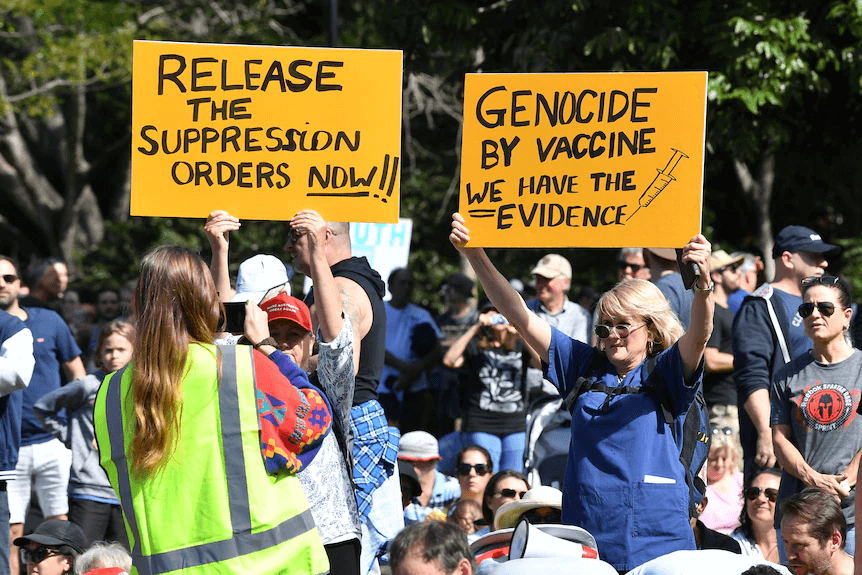
I see vaccinaphobia on display in Facebook posts daily, among people who seem unaware that any FDA-approved treatment, preventative or therapeutic, presents risks to some but benefits to many. I’ve tired of trying to explain what mRNA is (part of middle school science standards) and is not, and that vaccines target viral spike proteins. For knowledge and logic have no chance against fear. And while someone with a known risk factor, like an autoimmune condition, should follow doctors’ advice to avoid vaccines, making such a choice based on politics seems, well, misguided if not plain insane.
Looking ahead: Positively Darwinian
The politicization of vaccines brings to mind Charles Darwin’s concept of evolution through natural selection. Often equated with the phrase “survival of the fittest,” natural selection refers to the preferential survival of individuals who are successful at reproducing – however that happens. It has nothing to do with physical prowess or appearance, unless those are inherited traits that increase the probability of having offspring.
Natural selection is uncontrolled and largely unpredictable. Darwin developed the concept as a driving force of evolution from his practice of artificial selection – which is controlled breeding to perpetuate individuals with particular inherited traits.

In The Origin of Species Darwin described experiments with breeding the domestic rock pigeon. He went to pigeon competitions and joined two pigeon clubs in London, meeting fanciers from all over and learning about the many varieties of the bird.
Like his contemporary Gregor Mendel, who meticulously traced traits in garden peas, Darwin compared lengths of bird bones, variable behaviors, color patterns, and proportions of body parts. Also like Mendel, Darwin set up crosses, confirming that birds that looked quite different were still domestic rock pigeons.
Darwin’s insight and genius in developing the concept of natural selection was to extrapolate the degree of physical and behavioral changes he could see in a few generations of breeding birds, to heritable changes that might naturally occur over millennia as new species arose.
How refusing vaccinations will alter the course of evolution
Populations of sexually reproducing organisms, like humans, are always changing. Over time, natural selection is the predominant force that alters the genetic make-up of populations, with lesser effects from mutation, migration, nonrandom mating, and genetic drift (chance).
The COVID years have already removed gene variants that make the infection deadly from the gene pool, while retaining naturally protective gene variants. (A gene pool is all the variants of a gene in a population). And so, the genetic make-up of the human population, when it comes to COVID susceptibility, has shifted.
But viruses, which are little more than DNA or RNA in a protein coat, change and evolve too. SARS-CoV-2 continues to mutate, and humans continue to group those mutations into variants. The term “evolutionary arms race” is perhaps overused, but it is apt.
Although “herd immunity” is a theoretical term and not absolute, it makes sense that if more vulnerable human hosts are around, the virus has more opportunities to change and spread. That is, the choice not to get a vaccine can indirectly affect the health of others.
What happens when a new mutation or variant arises to which the vaccinated are protected – perhaps with tolerable symptoms but not death – yet the unvaccinated die? With members of one political party more vulnerable to serious infection and death than the other, due to fear of vaccines, will the opposing party be left with more members and prevail in elections of the near future? I can’t fathom that this fact of life has not dawned on men as highly educated as RFK,Jr. and Joseph Ladapo. Should they be offering guidance and setting national policy, on vaccines often in contradiction to CDC policy—at least before RFK, Jr. began gutting it.
Political selection when it comes to vaccines may protect an individual from feeling that the government is controlling their body or their children’s health, but at the same time, raises risks for others. It is a choice that is the ultimate in selfishness.
Ricki Lewis has a PhD in genetics and is a science writer and author of several human genetics books. She is a contributing writer for PLoS.. Follow her at her website or X @rickilewis