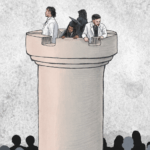
That was a long time ago.
Time was that foundations and family trusts funded research into deadly diseases, humanitarian missions, scholarships and the fine arts.
But foundations have changed from the days of Carnegie and Ford. First, there are a lot more of them, especially following the massive wealth created during the dot.com, tech, and crypto bubbles. And as these bubbles generated much more wealth, existing foundations also grew their coffers immensely.
If money is power, then the dynamics within these foundations have changed from being led by Samaritans to ones led by Samurais aggressively trying to transform political systems. The president of George Soros’ Open Society Foundations, Mark Malloch-Brown, for example, was the former Deputy Secretary-General of the United Nations. And power is network.
Numerous foundations have tilted the balance of power in certain environmental debates by funding an army of activist organizations or directly engaging at political levels. Many of these groups are not sources of good, giving and charity; rather they are manipulating spheres of political influence while creating non-representative activist interference.
Stakeholders or steak-eaters?
A cornucopia of foundations have contributed more than $20 million to The Guardian news organization in return for a certain number of articles that reflect their activist orientation rather than science. This kind of undisclosed deception undermines institutions and the democratic process. That’s not an isolated situation. With a relatively small investment, a single foundation can fund a dozen NGOs tied to a certain campaign and create enough noise to control the public discourse. And since they are considered charitable organizations funding a non-profit that wants to make the world a better place, there is no scrutiny of their activities. They often stay behind the scene while still pulling the strings.
When we speak of stakeholder engagement, a key element of the Western participatory process, we usually mean a dialogue between certain groups like government, the academe, industry and civil society (NGOs). But today we need to consider foundations as an influential stakeholder, if not in place of NGOs, then as a body of its own. If the media is the Fourth Estate, then foundations should be considered as the Fifth or Sixth (if one thinks non-mainstream media still has any real influence).
We’ll see in this series how some foundations, like Bloomberg Philanthropies, not only fund activist groups, they also found them. Their political activism rarely stays below the surface, like the Rockefeller Family Fund organizing and hosting campaign strategy meetings among NGOs and tort lawyers they fund.
Cynically, when I see an NGO today, I don’t look for what they stand for, I look for the foundation whose shoulders they are standing upon. I now have to consider the same when I read an article from a mainstream media source. These well-endowed special interest groups have poisoned the well of public discourse, but in the mainstream, they are trusted as benevolent charities donating funds for the good of humanity.
Raiding the pots of gold
In the early 2000s, when I was involved in setting up a science communications non-profit, GreenFacts, I went to London for a two-day training course on fundraising offered by Blackbaud. Looking back, this was the transition period of non-profits being funded by membership dues to foundation-driven sources (especially as abundant dot.com bubble money was still sloshing about). The trainers advised us in our prospection to focus on foundations, and in particular, to get to know their board members, not just for their networking value, but because the ultimate goal was to get foundation boards filled with “friendly” members.
I was presented with case studies of foundations that had their boards infiltrated by activist networks that shifted a foundation’s strategy and ideology towards certain groups of NGOs. I was surprised how my trainer considered this so positively. A family trust or foundation, two or three generations down the line, can easily lose connection to the original objectives when the founder bequeathed his or her inheritance. We should not be surprised, then, to see a group like the Rockefeller Brothers Fund, built on Standard Oil wealth, as a major donor to Greenpeace America and actively trying to put ExxonMobil out of business.
There is a well-connected profession of foundation administrators who manage other people’s money and, unsurprisingly, have a lot of friends. They usually step in when foundations have issues, but before long, take over the enterprise, appoint new board members and incrementally shift the giving strategies (often to the left).

These board members and directors are likely to be long-term political activists, directing funding strategies much like generals in a war room sliding battalions around on a map. They have their objectives and demand a return on their “investments”.
A world of foundations
There are many different types of foundations or funds. Some, like the ICRC, Lions’ LCIF or the Wellcome Trust, are doing important humanitarian work, well managed and totally transparent. But many are not and are capable of causing significant societal disruption.
IKEA, for example, is not a company but identifies itself as a non-profit called the Stichting INGKA Foundation based in the foundation fiscal paradise of the Netherlands (but this strategy is shamefully only to avoid paying taxes). UN organizations like UNICEF operate like a foundation. World leaders, Hollywood A-listers and governments have even gotten into the game. Anyone can create a foundation or a trust, including families trying to avoid inheritance taxes.
The Giving Pledge has made forming foundations an obligation for most entrepreneurs who got lucky. Some have the active engagement of their founders seeking some sort of legacy, some are based within companies to encourage employee social responsibility but most are created by a billionaire’s donation and left to others to manage along certain guidelines.
There is, though, one type of foundation that pushes the boundaries of charity to rather uncomfortable levels of ethical tolerance. This is known as the donor-advised fund — a type of dark money funding.
Dark money and donor-advised funds
In America, if I want to fund an organization that is acting in my interest, but I don’t want anyone to know, I can give to them via a donor-advised fund. This means I donate to Foundation X, and tell them to administer those funds to NGO Y, and, if it doesn’t go against their ethical guidelines (which is often very vague), they do so, discreetly and non-transparently … minus their commission of around 10%.
The Tides Foundation is perhaps the best-known donor-advised fund, identifying its activities as “partnering with doers and donors to advance social justice”. But as the source of the philanthropy is not disclosed, such funds become tools for dark money to enter into public debates. This is neither transparent nor ethical and should be illegal, but instead, these money mills are tax deductible.
I showed how the film, Into the Weeds, which has become a major force in the anti-glyphosate movement, was funded by a little-known donor-advised fund, the Utah Film Center. They would not disclose the source of the film’s funding or the amount. Given that the film was a homage to the tort law industry’s actions against Monsanto, it is not hard to imagine who has been paying these activists’ bills to conduct a global campaign around the film.
Ironically, U.S. Right to Know, an NGO that demands that industry be more transparent, has much of its funding coming from donor-advised funds. We can only suspect this dark money is also coming from tort law firms or organic food industry lobbyists (but with these jackals, we don’t seem to have a “right to know”).
David Zaruk is the Firebreak editor, and also writes under the pen-name The Risk Monger. David is a retired professor, environmental-health risk analyst, science communicator, promoter of evidence-based policy and philosophical theorist on activists and the media. Find David on X @Zaruk
A version of this article was originally posted at Firebreak and has been reposted here with permission. Any reposting should credit the original author and provide links to both the GLP and the original article. Find Firebreak on X @the_firebreak
This article previously ran in January 2024.