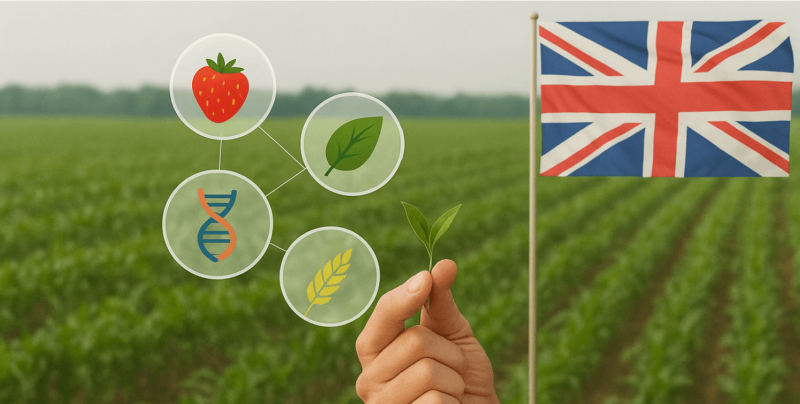

Niab has welcomed the entry into force today (13 November) of the Genetic Technology (Precision Breeding) Act 2023 for plants in England as a landmark moment for British agriculture and crop science.
The new legislation, whose development and implementation spanned five years and a change of government, replaces restrictive rules inherited from the EU. It provides a more proportionate and science-based regulatory framework for scientists, plant breeders and farmers to use precision breeding techniques such as gene editing to improve productivity, climate resilience and sustainability.
Precision breeding techniques allow targeted, precise changes to be made within a plant’s own DNA – changes that could have occurred naturally or through conventional breeding, but which can now be achieved faster and more accurately.
Professor Mario Caccamo, Niab chief executive, described the Act’s implementation as a historic milestone. “This is the first time in a generation that legislation has been brought forward which seeks to enable, rather than restrict, the use of advanced genetic technologies in UK agriculture. It will help accelerate the development of improved crop varieties with potential benefits for farmers, consumers and the environment.”
Potential early applications include higher-yielding strawberries with longer shelf life, nutritionally enhanced tomatoes and oilseeds, disease resistant sugar beet and potatoes, tomatoes bred for robotic harvesting, higher yielding wheat and baby potatoes, non-browning bananas and high-lipid barley designed to cut methane emissions in livestock.
“These innovations are already in the pipeline,” said Professor Caccamo. “They show how precision breeding can help us produce healthier food with fewer inputs, while reducing food waste, tackling climate change and strengthening food security.”



Welcoming the UK Government’s firm commitment to protect the Precision Breeding Act under the terms of any future SPS deal with the EU, Professor Caccamo noted that today’s implementation of the Act – despite a change of Government from Conservative to Labour in 2024 – signals strong, cross-party political support for these new technologies.
He also pointed to a global Ipsos survey released earlier this year which found that 56% of the consuming public support the use of new genomic techniques in agriculture, particularly to develop more climate-resilient crops — with only 12% opposed.
“Public and political opinion is shifting decisively in favour of science-based solutions to global challenges such as food security and climate change. This is a once-in-a-generation opportunity to transform the way we develop and grow crops in Britain. With the Precision Breeding Act now in force, we have the chance to lead the world in sustainable, science-based farming. Let us seize that opportunity with both hands,” said Professor Caccamo.
A version of this article was originally posted at National Institute of Animal Biotechnology and has been reposted here with permission. Any reposting should credit the original author and provide links to both the GLP and the original article. Find National Institute of Animal Biotechnology on X @niabgroup