



This year’s Nobel laureates in Economics affirm that the future of growth models will be driven by innovation. This is both a challenge and an opportunity, and resonates deeply with India’s agricultural ambitions.
The light bulb analogy is a reminder that innovation often begins with hesitation, but its true value lies in what it illuminates over time. The question is no longer whether GM technology works, but how India can use it wisely, ensuring that farmers are benefitted, ecosystems are protected, and decisions are guided by science and trust. After all, the real impact will not be seen in labs, but in the lives of farmers and the resilience of our food systems.
Bt cotton kicked off India’s GM crop journey
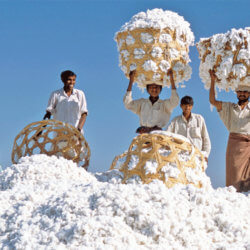
India’s engagement with GM crops began in 2002, when the imported Bt cotton gene (Cry1Ac) engineered to combat the American bollworm was approved for commercial use by inserting it into Indian cotton hybrids. The results were promising as yields improved, pesticide use declined, and many farmers reported better incomes. Within a decade, Bt cotton hybrid spread over 90% of India’s cotton-growing area, and yields surged from a stagnant six quintals per hectare (q/ha) to 16 q/ha by 2013. However, the story didn’t end there.
Initially, Bt cotton brought tangible benefits, but over time the pink bollworm pest began to develop resistance to the Bt toxin, forcing farmers to use pesticides again. Farmers, once relieved from heavy pesticide use, were back to square one. This shift not only increased costs but also reignited concerns about environmental and health impacts. Simultaneously, debates emerged around GM seed pricing, intellectual property rights, and the role of multinational corporations. In response, public sector institutions attempted to develop indigenous Bt cotton hybrids, unlike the pure line GM cotton popular globally. This experiment failed in India due to poor adaptation to uncertain rainfed conditions. Thus, some narratives link high seed costs, rising input costs, and crop failures in rainfed areas to farmer distress. Research suggests that these issues are complex and often rooted not only in biotechnology but also in broader systemic concerns such as market volatility and inadequate support systems.
The need for next-generation GM traits, such as stacked genes and herbicide tolerance, has been recognised. Yet, their approval is pending, reflecting the importance of thorough regulatory review and public scrutiny. India’s regulatory framework for GM crops is overseen by the Genetic Engineering Appraisal Committee under the ministry of environment, forest, and climate change. The committee undertakes rigorous biosafety assessments, multi-location field trials, and public consultations. State governments also play a role in granting final approvals for cultivation. Despite these provisions, the pace of approvals has been slow. For instance, Bt brinjal was approved in 2009, but placed under indefinite moratorium following public opposition. On the other hand, GM mustard, developed by Indian scientists, has passed safety evaluations but awaits final clearance amid ongoing debate. This cautious approach reflects a desire to balance innovation with safety, but it also raises concerns about delays in accessing potentially beneficial technologies. India’s competitiveness in crops such as maize and sugar could improve significantly with GM adoption. For example, GM maize yields in countries like Ukraine, Brazil, and Argentina (average of 6,045 kg/ha) are more than double of India’s conventional maize yield (2,703 kg/ha). Similarly, Brazil’s approval of GM sugarcane has boosted its sugar output per factory to 101,157 tonnes, nearly twice India’s output of 52,336 tonnes using non-GM varieties.



Public opinion of GM crops remains divided
Public perceptions of GM crops in India are shaped by a confluence of scientific discourse, cultural perspectives, and media narratives. While some view GM technology as a tool for progress, others worry about its long-term impacts on health, biodiversity, and traditional farming practices. Therefore, policymakers face a delicate task of ensuring food security and farmer welfare while maintaining public trust and ecological integrity. In addition to technological advancement, this calls for clear and participatory regulation, accessible farmer education, and sustained public engagement.
Rather than viewing GM crops as a binary choice between good and bad, it may be more productive to see them as tools. Like any tool, their value depends on how they are integrated into broader agricultural strategies. As India continues to explore this path, the goal should be to empower farmers, protect ecosystems, and ensure that the light of innovation reaches every corner of the field.
A version of this article was originally posted at Financial Express and is reposted here with permission. Any reposting should credit both the GLP and original article. Find Financial Express on X @FinancialXpress



























