
Viewpoint: Is corporate embrace of regenerative agriculture greenwashing?

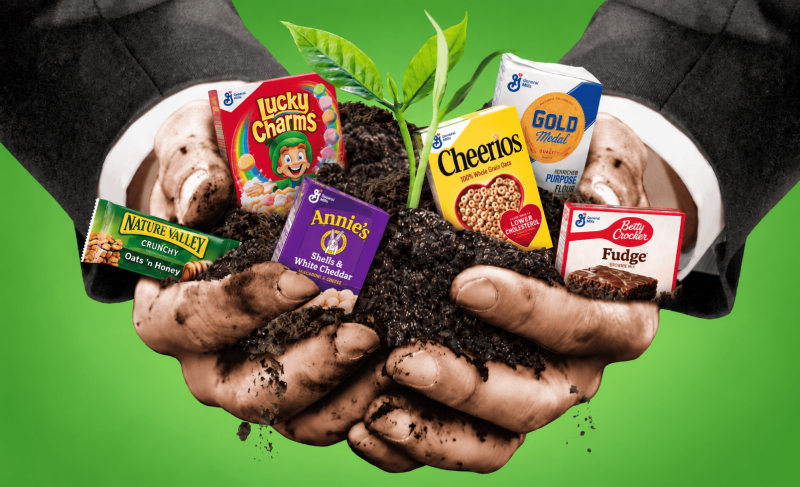
Major food companies are racing to tout “regenerative agriculture,” but the term has no legal definition — and that vagueness is letting some companies claim environmental credit without necessarily changing their operations, as Civil Eats senior staff reporter Lisa Held reports.

Consumer awareness has jumped: a June 2026 Consumer Reports survey found 24 percent of shoppers recognize “regenerative farming,” up from 18 percent three years ago. General Mills has pledged to advance regenerative practices on 1 million acres by 2030, while PepsiCo says it’s already reached 4.7 million acres and has raised its 2030 target to 10 million.

The trouble, critics say, is that “regenerative” commitments often boil down to cover crops and no-till farming — practices that don’t necessarily reduce chemical inputs, and in some cases increase herbicide use, according to a 2025 Friends of the Earth analysis. A 2026 As You Sow report similarly found that major food and agriculture companies have backtracked on earlier pesticide-reduction pledges.

Mis- and disinformation are distorting science and public policy. Subscribe to our Daily and Weekly Digests for incisive coverage of ‘disruptive’ innovations in AI, agricultural biotechnology, food, chemicals, nuclear energy, vaccines, and other disruptive innovations.

“There are actors in the space who I think are doing a lot of good,” said Sarah Starman, senior campaigner for food and agriculture at Friends of the Earth. “There are also a lot of companies that are capitalizing on sort of the loosey-goosey nature of regenerative.”
Not everyone in agriculture is convinced regenerative claims add up to much change on the ground. “Is the goal really a bunch of regenerative corn and soybeans across hundreds of millions of acres in the United States?” asked Brandon Welch, CEO of Mad Capital, adding that even well-intentioned practices raise the question, “who is it driving value for?”

Some farmers who’ve gone further say the payoff is real. Trey Hill of Harborview Farms in Maryland told Held he’s cut herbicide use by 65 percent and insecticide use by 90 percent through regenerative methods — though he’s blunt about trade-offs: “In terms of soil degradation and everything else, the trade-off is I use pesticides. So, I don’t know which is better or worse.”


Read the original article here

Related Articles

Infographic: Global regulatory and health research agencies on whether glyphosate causes cancer

Infographic: Global regulatory and health research agencies on whether glyphosate causes cancer

Does glyphosate—the world's most heavily-used herbicide—pose serious harm to humans? Is it carcinogenic? Those issues are of both legal and ...

Most Popular

Screenshot-2026-10-12-at-10.44.38-AM
Widely condemned as unethical, hepatitis B vaccine study funded by RFK Jr’s CDC gets a final greenlight
Open-Menthol-Cigarette-Pack
How the tobacco industry conspired with conservative activists to kill the Biden administration’s proposed ban on menthol cigarettes 
Cross and Syringe Standoff
Viewpoint: Hijacking Jesus: How anti-vaccine fanatics are exploiting religious exemptions and killing children
ChatGPT-Image-Mar-10-2026-01_39_01-PM
Viewpoint—“Miracle molecule” debunked: Why acemannan supplements don’t work
Caution-Taped-Fresh-Produce-Aisle
Should we be afraid of our food?
Screenshot-2026-10-12-at-12.18.57-PM
5 deaths, 1,000 reported cases: These horrific numbers underestimate the consequences of the anti-vax movement
Profile and Vaccination Portraits
Convinced COVID shots cause widespread harm, Kennedy plans federal initiative to incentivize doctors to report alleged injuries
Screenshot-2026-10-11-at-10.24.21-AM
Viewpoint: RFK Jr.’s new CDC head Erica Schwartz greenlights hepatitis B vaccine study critics call “unethical and designed to cast doubts on its safety”
Personalized-Cancer-mRNA-Vaccine-Vial
Personalized mRNA vaccines are poised to revolutionize cancer treatments. Here are the barriers.
Screenshot 2026-10-12 at 12.25
Tearful onions? CRISPR has a solution for that
Screenshot-2026-10-05-at-11.57.44-AM
Scaremongering or legitimate safety concerns? The political dogfight over America’s food safety system
Deepfake Democracy Media Mosaic
31 states have passed a patchwork of laws to limit election deepfake commercials. They’re not working very well.
glp menu logo outlined

Get news on human & agricultural genetics and biotechnology delivered to your inbox.




















