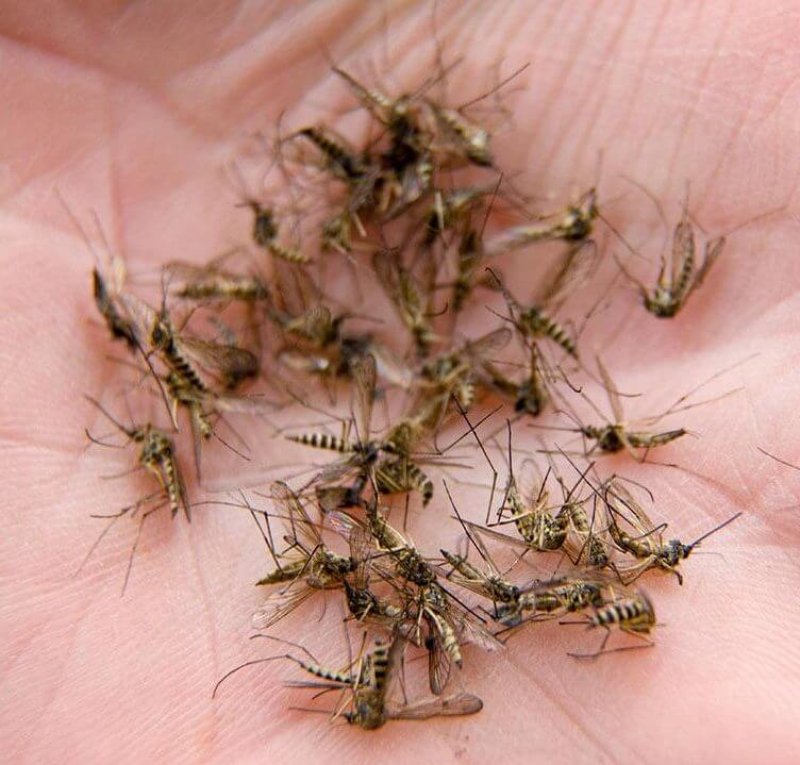
As the end of the winter season approaches, the threat of insect-borne diseases such as Zika will inevitably grow. Longer days and warmer weather will lead to larger populations of mosquitoes, many of which are capable of transmitting West Nile virus, Zika, dengue and other diseases.
Traditional methods of controlling mosquitoes often involve spraying pesticides on foliage to kill the adults, but that can be problematic because the chemicals may also harm beneficial insects that pollinate plants, such as honey bees, or beneficial predators like lady bugs or praying mantises – not to mention the potential to harm human health or the environment if the pesticides are not used according to their label instructions.
Some alternative methods of controlling insect pests work by disrupting their life cycles so they are unable to reproduce new generations. Various techniques have been used, such as releasing millions of sterile male insects into the wild (the sterile insect technique) or using pheromones to disorient or mislead male insects so they are unable to find females (mating disruption). However, each of these has drawbacks from expense to ecological obstacles.
Now scientists at the University of California, Riverside (UCR) have developed a mechanism that may be used in the future to control mosquitoes and other insect pests without the use of chemical pesticides, genetically engineered bugs, pheromones or sterilized males. The research, which appeared in the Proceedings of the National Academy of Sciences, centers around molecules called microRNAs (or miRNAs), which are vital to gene expression. [Read about non-coding RNA in our Epigenetics University here.]
Female mosquitoes and other blood-feeding arthropods, such as bed bugs and ticks, require a bloodmeal in order for their bodies to produce the proteins required to develop eggs. Since microRNAs play a role in protein construction, understanding their role can potentially be used to manipulate the process and disrupt egg development.
Unlike DNA, which is basically an unchanging code or blueprint that contains instructions for genes within the nucleus of a cell, RNA is a replicated copy of DNA that actually interacts with the parts of the cell that create proteins. DNA contains the code, but RNA gets things done.
Specifically, a type called messenger RNA (mRNA) is responsible for transferring the code from the cell’s nucleus to a part of the cell called the ribosome, which is basically the cell’s protein factory. After the protein has been produced, another type of RNA called microRNA shuts down or alters the protein-making process by degrading the messenger RNA.
According to Fedor V. Karginov, an assistant professor of cell biology and neuroscience who co-led the UCR research team, “MicroRNAs control the levels of mRNAs by causing them to be degraded in cells, as well as downregulating how much they will be translated by ribosomes. They are part of the normal and vast regulatory network that makes sure that just the right, appropriate amount of all the various proteins are made in each cell at each developmental/differentiation stage of the cell.”
The UCR scientists analyzed the levels of microRNA expression in Aedes aegypti mosquitoes, which are the primary transmitters of yellow fever, dengue, chikungunya, and Zika. The team specifically looked at the microRNA levels in a part of the mosquito called the “fat body,” because that is where precursors to egg proteins are made, and they focused on levels after females had taken bloodmeals, because that is when the egg-development process begins. The authors wrote:

Identifying which miRNAs are important to fat body functions, and what specific genes they target, can help design ways to manipulate the levels of microRNA or their targets, affect their interactions, disrupt mosquito reproduction, and thus prevent the spread of diseases the mosquitoes transmit.
After the female mosquitoes had their bloodmeals, the researchers observed five major microRNA expression peaks within a 48-hour period, and they found about 100 different miRNAs.
“What we observed is that the levels of many miRNAs change significantly throughout the 48-hour period following a blood meal, indicating that these miRNAs, in turn, may be establishing significant changes in expression of key genes during this time in the fat body,” Karginov said. “Our work has given us a much needed picture of which miRNAs are abundant in the fat body tissue, how each miRNA subgroup changes over time, and we have confirmation that specific up- and down-regulation of miRNA levels takes place during egg development.”
“Now that we know these genes, we are a step closer to controlling the spread of Aedes aegypti by disrupting a key process in the reproductive cycle: egg production,” said Alexander S. Raikhel, a distinguished professor of entomology at UC Riverside who also co-led the team.
According to Karginov, this research could lead to new mosquito-control products in the future.
If appropriate methods of delivery of these reagents into mosquito populations are devised, one can enact control of egg development in the wild,” he said. “More broadly, understanding which microRNAs participate in egg development, and more particularly which mRNAs they target and control, can lead to identifying new genes/mRNAs/proteins that are essential for the process, so small molecule drugs targeting these proteins may be designed.
Richard Levine, co-author of IPM for the Urban Professional: A Study Guide for the Associate Certified Entomologist, is an independent communications consultant and a freelance science writer. Follow him on Twitter at @Rich_Lev.
A version of this article was originally published on the Epigenetic Literacy Project’s website as Targeting mosquito gene expression could provide chemical-free control of Zika, dengue.