Milk without cows: Commercialization of synthetic dairy products in the works

Screen Shot at AM e

Berkeley-based Perfect Day – which is creating ‘vegan’ dairy proteins without cows – is in talks with food industry partners about scaling up production in order to introduce dairy ingredients that vegans, vegetarians and dairy lovers alike can enjoy in products “in every aisle of the grocery store.”

Perfect Day is one of a new breed of companies in the ‘cellular agriculture’ business – using genetically engineered yeasts that have been ‘programmed’ to produce proteins or other ingredients found in plants or animals – on an industrial scale, without raising animals, and with less impact on the environment.

So how are the proteins produced?

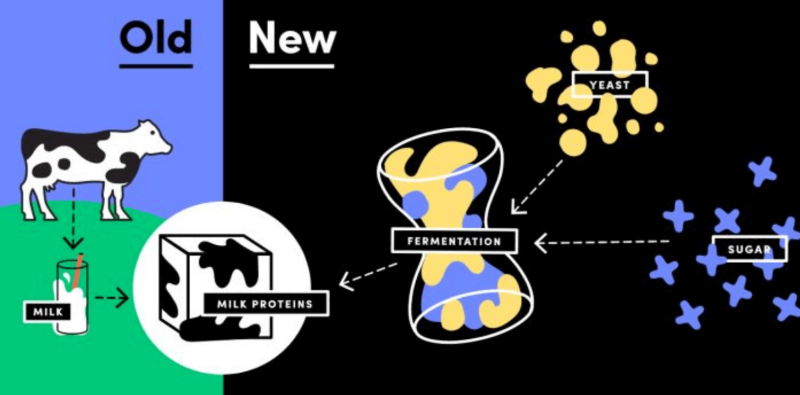
In a nutshell, Perfect Day takes food grade yeast, and adds DNA sequences (which can be 3D printed using DNA synthetic biology techniques) which effectively instruct that yeast to produce the proteins found in milk – predominantly casein, but also lactoglobulin and lactoalbumin, the two proteins that form the bulk of whey protein in milk. It then throws them into big fermentation tanks with corn sugar and other nutrients to feed on and sits back while they get to work.

When the microbes have done their work at the bio-refnery, Perfect Day’s dairy proteins – which have the same organoleptic properties as their animal-based counterparts – are harvested via a mechanical process and can be used in everything from ice cream to branded fluid milk, protein powders and shakes, yogurt, pizza and any other product containing dairy proteins….

Read full, original post: Perfect Day in talks with food industry partners to commercialize animal-free dairy ingredients

{{ reviewsTotal }}{{ options.labels.singularReviewCountLabel }}
{{ reviewsTotal }}{{ options.labels.pluralReviewCountLabel }}
{{ options.labels.newReviewButton }}
{{ userData.canReview.message }}

Related Articles

Infographic: Global regulatory and health research agencies on whether glyphosate causes cancer

Infographic: Global regulatory and health research agencies on whether glyphosate causes cancer

Does glyphosate—the world's most heavily-used herbicide—pose serious harm to humans? Is it carcinogenic? Those issues are of both legal and ...

Most Popular

ChatGPT-Image-Jun-15-2026-11_00_13-AM-2
Glucosamine alert: Alzheimer’s progresses faster among those taking the popular supplement
Screen Shot at AM
Facts & Fallacies Podcast: Right-wing politics bad for your health? Separating speculation from science
ChatGPT-Image-Jun-9-2026-01_11_37-PM
Turmeric supplements: More risks than benefits
ChatGPT-Image-Jun-15-2026-12_13_41-PM
Viewpoint: Behind the effort to re-purpose the tobacco attack strategy to fight ultra-processed foods
ChatGPT-Image-Jun-3-2026-04_29_13-PM
Viewpoint: While unvaccinated children are dying overseas, Congress challenges Trump and Kennedy’s block on aid
Screenshot-2026-06-12-at-2.10.55-PM
Physician warns online statin myths delay care and raise heart risk
ChatGPT-Image-Mar-10-2026-01_39_01-PM
Viewpoint—“Miracle molecule” debunked: Why acemannan supplements don’t work
Screenshot-2026-06-14-at-9.14.26-AM
‘Humanitarian catastrophe’: Trump’s USAID shutdown could help drive nearly 23 million deaths — including 5.4 million children — by 2030, Lancet study warns
ChatGPT-Image-Jun-14-2026-09_41_44-AM-2
Viewpoint—‘The gleeful efficiency of an arsonist’: Administration’s health and science research cuts are ‘sabotaging’ America’s future
ChatGPT-Image-Jun-15-2026-10_42_06-AM
Viewpoint: ‘Steroid Olympics’ marketing stunt: ‘It seemed less like a sporting event and more like a loss leader to peddle testosterone injections, GLP-1s, and peptides’
ChatGPT-Image-Jun-11-2026-01_15_03-PM
Selective Pressure, Selective Silence
Screenshot-2026-06-05-at-2.12.30-PM
Some plants can poison you. So how did humans figure out what is safe to eat?
glp menu logo outlined

Get news on human & agricultural genetics and biotechnology delivered to your inbox.