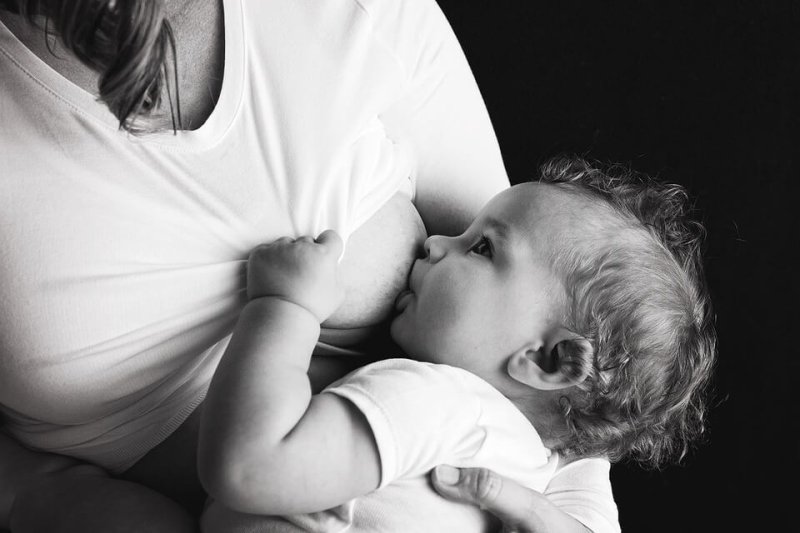
Evolutionary riddle: Why humans have breasts?

breastfeeding motherhood mother
Image credit: Max Pixel

Over the years, researchers have proposed a number of explanations for human breasts. Some claimed evolution favored “pendulous” breasts — as scientists dryly describe them — because they gave babies something to cling to like handle bars. Others suggested permanent breasts evolved as an energy reserve, lumps of fat to be tapped when food is scarce.

Whether or not breasts first served as energy banks or handle bars for mothers and infants, they eventually caught the attention of males. This is why most researchers assume sexual selection has been at work: They argue that over the course of human evolution, permanent breasts helped females attract mates. Like the ostentatious feathers of male peacocks, breasts served as a message to the opposite sex.

And in the case of peacock feathers, and potentially breasts, there’s truth in advertising. The more spectacular the feathers, the healthier the bird, and therefore this trait is what evolutionary biologists call an honest signal: a reliable indicator of an animal’s quality as a mate or parent.

Suffice to say, if there are underlying, biologically evolved preferences for certain breast qualities, cultural and individual factors can override them. More research is certainly needed.

Read full, original post: Scientists Still Stumped By The Evolution of Human Breasts

{{ reviewsTotal }}{{ options.labels.singularReviewCountLabel }}
{{ reviewsTotal }}{{ options.labels.pluralReviewCountLabel }}
{{ options.labels.noReviewsLabel }}
{{ options.labels.newReviewButton }}
{{ userData.canReview.message }}

Related Articles

Infographic: Global regulatory and health research agencies on whether glyphosate causes cancer

Infographic: Global regulatory and health research agencies on whether glyphosate causes cancer

Does glyphosate—the world's most heavily-used herbicide—pose serious harm to humans? Is it carcinogenic? Those issues are of both legal and ...

Most Popular

Screenshot-2026-07-09-at-1.09.25-PM
Anti-vaccine myths rattle health care
ChatGPT-Image-Mar-10-2026-01_39_01-PM
Viewpoint—“Miracle molecule” debunked: Why acemannan supplements don’t work
Screenshot 2026-07-28 at 3.22
Hidden hunger: Climate change is speeding up the decline of important nutrients in our food
Screenshot 2026-07-22 at 1.38
Viewpoint: Are the U.S. and Europe headed towards a repudiation of agricultural biotechnology red tape?
Screenshot 2026-07-28 at 3.03
What is cyberchondria?
Screenshot 2026-07-28 at 2.04
Viewpoint: How AI supercharges conspiracy theories and oversimplifications to distort online health information
organic scaled
Facts & Fallacies podcast: Organic food cuts pesticide exposure? A response to Dr. Rhonda Patrick
png-terrace-Farm-asia
Europe’s tentative embrace of agricultural gene editing could revolutionize food production and health in Asia
ChatGPT-Image-Jul-9-2026-11_33_49-AM
Viewpoint: High-dose resveratrol supplements to extend health and life? Don’t waste your money.
ChatGPT-Image-May-26-2026-11_51_01-AM
Viewpoint: RFK, Jr.’s depressingly misguided (and litigator-funded) crusade against antidepressants
Screenshot-2026-07-27-at-3.23.14-PM
Prioritizing AI, robotics, and nuclear energy: Trump administration is guiding research funding away from independent universities to private companies
Screenshot 2026-07-28 at 3.43
Fat cat? GLP-1 weight loss drugs for animals are on the horizon
ChatGPT-Image-Jun-25-2026-12_23_17-PM
No, Bill Gates did not secretly engineer ticks to promote veganism
glp menu logo outlined

Get news on human & agricultural genetics and biotechnology delivered to your inbox.