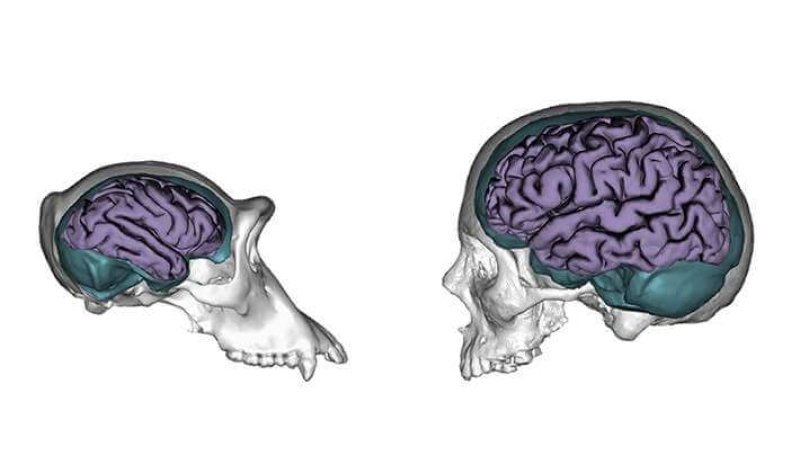
Human brains have more in common with our ‘ape cousins’ than previously thought

chimpanzee human brains

Our brains could have more in common with our ape cousins than previously thought, which might require us to rethink ideas on the evolution of brain specialism in our early human ancestors.

The left and right sides of our brains aren’t symmetrical; some areas on one side are larger or smaller, while other parts protrude more.

The pattern of these anatomical differences, or asymmetries, was thought to be uniquely human, originating when our brain hemispheres became specialized for certain tasks, such as processing language with the left side.

Now, it seems the pattern came first – before humans evolved. Brain pattern comparisons between humans, chimpanzees, gorillas and orangutans reveal that our brains’ left-right differences aren’t unique, but shared with great apes.

“It suggests it is an ancestral pattern that was established far earlier during evolution, before the split of human and great apes lineages,” says Simon Neubauer at the Max Planck Institute for Evolutionary Anthropology in Germany.

What’s more, it is no longer evident that our early human ancestors, whose fossils show the asymmetric pattern, evolved specific functions that rely on the left or right side of the brain.


Read the original post

{{ reviewsTotal }}{{ options.labels.singularReviewCountLabel }}
{{ reviewsTotal }}{{ options.labels.pluralReviewCountLabel }}
{{ options.labels.newReviewButton }}
{{ userData.canReview.message }}

Related Articles

Infographic: Global regulatory and health research agencies on whether glyphosate causes cancer

Infographic: Global regulatory and health research agencies on whether glyphosate causes cancer

Does glyphosate—the world's most heavily-used herbicide—pose serious harm to humans? Is it carcinogenic? Those issues are of both legal and ...

Most Popular

ChatGPT-Image-Jun-15-2026-11_00_13-AM-2
Glucosamine alert: Alzheimer’s progresses faster among those taking the popular supplement
Screen Shot at AM
Facts & Fallacies Podcast: Right-wing politics bad for your health? Separating speculation from science
ChatGPT-Image-Jun-9-2026-01_11_37-PM
Turmeric supplements: More risks than benefits
ChatGPT-Image-Jun-15-2026-12_13_41-PM
Viewpoint: Behind the effort to re-purpose the tobacco attack strategy to fight ultra-processed foods
ChatGPT-Image-Jun-3-2026-04_29_13-PM
Viewpoint: While unvaccinated children are dying overseas, Congress challenges Trump and Kennedy’s block on aid
Screenshot-2026-06-12-at-2.10.55-PM
Physician warns online statin myths delay care and raise heart risk
ChatGPT-Image-Mar-10-2026-01_39_01-PM
Viewpoint—“Miracle molecule” debunked: Why acemannan supplements don’t work
Screenshot-2026-06-14-at-9.14.26-AM
‘Humanitarian catastrophe’: Trump’s USAID shutdown could help drive nearly 23 million deaths — including 5.4 million children — by 2030, Lancet study warns
ChatGPT-Image-Jun-15-2026-10_42_06-AM
Viewpoint: ‘Steroid Olympics’ marketing stunt: ‘It seemed less like a sporting event and more like a loss leader to peddle testosterone injections, GLP-1s, and peptides’
ChatGPT-Image-Jun-14-2026-09_41_44-AM-2
Viewpoint—‘The gleeful efficiency of an arsonist’: Administration’s health and science research cuts are ‘sabotaging’ America’s future
Screenshot-2026-06-05-at-2.12.30-PM
Some plants can poison you. So how did humans figure out what is safe to eat?
ChatGPT-Image-Jun-11-2026-01_15_03-PM
Selective Pressure, Selective Silence
glp menu logo outlined

Get news on human & agricultural genetics and biotechnology delivered to your inbox.